Gold Mining Expands into Protected Areas in Suriname, New Study Finds
February 3, 2026
Drawing on 24 years of satellite data, the analysis maps gold-mining deforestation across the country and shows recent incursions into protected areas.
A new analysis by Amazon Conservation Association’s Monitoring of the Andes Amazon Program (MAAP), combining over two decades’ worth of satellite data with recent AI monitoring results from Amazon Mining Watch, reveals that gold mining has impacted an estimated 92,000 hectares (approximately 227,000 acres) of forest in Suriname over the past 24 years, an area larger than New York City.
Just as similar MAAP analyses have revealed rapid expansions of gold mining across the Amazon in countries such as Peru, Ecuador, and Colombia, the data now show a comparable pattern emerging in Suriname.
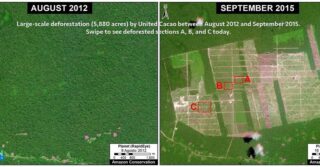
Using high-resolution satellite imagery dating back to 2001, this report provides the first comprehensive, data-driven assessment focused exclusively on deforestation caused by gold mining activities in the Surinamese Amazon. The long-term historical analysis is based on data from the University of Maryland, while evidence of new mining activity is provided by Amazon Mining Watch, a recently launched AI platform developed through a partnership between Amazon Conservation Association, Earth Genome, and the Rainforest Investigations Network of the Pulitzer Center, with support from the Gordon and Betty Moore Foundation. A gold mining path is clearly visible in the satellite images.
Approximately 3,000 hectares (equivalent to 7,400 acres) of new gold mining deforestation have been detected over the past five years, with activity increasingly encroaching on protected areas. In recent years, nearly 10% of Brownsberg Nature Park has been affected by mining-driven deforestation, while Brinckheuvel Nature Reserve is beginning to experience a mining invasion, highlighting growing pressure on conservation areas.
“The intensifying gold mining deforestation in Suriname is particularly concerning,” notes Matt Finer, Senior Research Specialist and Director of Amazon Conservation Association’s MAAP initiative. “It reflects the same expanding pattern that we have heavily documented in other Amazonian countries, including Peru, Ecuador, and Colombia. This deforestation is having a devastating impact on many iconic protected areas such as Brownsberg Nature Park.”
Turning Information into Action
These findings have already contributed to ongoing dialogues with key decision makers in Suriname. A confidential report based on this analysis was shared with the Surinamese government, helping inform discussions on responses to illegal gold mining in the region. According to Finer, “this type of precise monitoring is essential for enabling authorities and partners on the ground to respond more effectively to illegal mining and prevent irreversible environmental damage.” In response to this report and related information, the Suriname government has indicated plans to tighten its approach to illegal gold mining in Brownsberg Nature Park.
This analysis was developed in collaboration with Amazon Conservation Association’s local partner, Amazon Conservation Team, and was generously made possible by the Gordon and Betty Moore Foundation.
Read the full report here: https://www.maapprogram.org/gold-mining-suriname/
About Amazon Conservation Association, MAAP, and Amazon Mining Watch
Amazon Conservation is an international conservation nonprofit that has worked for more than 25 years to build a thriving Amazon. Its holistic approach focuses on partnering with local organizations and allies to protect wild places, empower people, and put science and technology to work for conservation.
As part of Amazon Conservation’s efforts to use the latest in science and technology for conservation, the organization leads initiatives such as the Monitoring of the Andes Amazon Program (MAAP) and Amazon Mining Watch. MAAP provides cutting-edge, real-time technical analysis to report on the most urgent cases of deforestation and fires across the Amazon, using the latest satellite-based technology, and produces pan-Amazonian reports on basin-wide issues – such as unsustainable infrastructure, agricultural expansion, and climate change impacts – to drive conservation and policy action. Amazon Mining Watch, a collaboration between Amazon Conservation Association, Earth Genome, and the Pulitzer Center, complements this work by integrating near-real-time AI-based detection of new gold mining activity with land-designation and policy data, helping assess whether mining is likely unauthorized or illegal, and estimating the socio-environmental costs of mining impacts for a more robust analysis. Together, these tools strengthen transparency, accountability, and decision-making to help protect priority areas in the Amazon before irreversible damage occurs.
For more information, visit amazonconservation.org.
Press Contacts
Priscila Steffen, Communications & Public Relations Manager: info@amazonconservation.org.
 Loading...