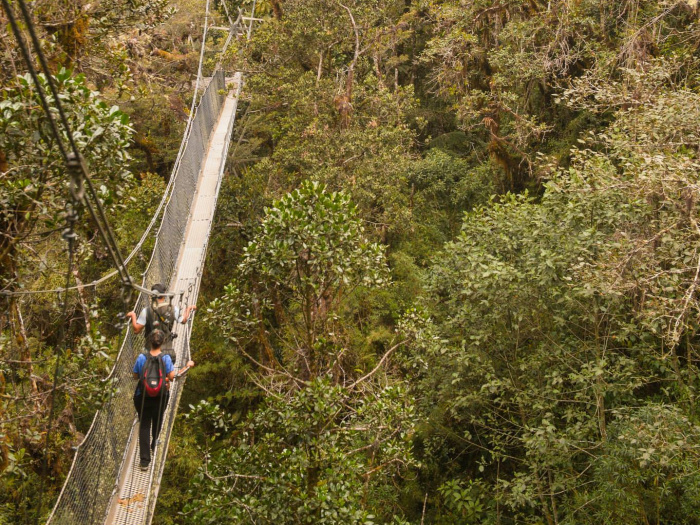
Our three conservation hubs offer a unique opportunity to explore and discover the outstanding biological and cultural diversity of this region. Spanning an altitudinal gradient from 820 to 9,880 feet (270 to 3,100 meters) along the eastern border of Manu National Park in southeastern Peru, our hubs are active centers of learning and discovery, attracting researchers, university courses, volunteers, and visitors from around the world.
Why do we have these hubs? They provide Amazon Conservation an on the ground presence where we conduct our conservation work, and where the work of researchers contributes to the local scientific community, raises awareness about tropical ecology and conservation, and informs our conservation decisions.
Learn more about each of our conservation hubs:
 |
 |
 |
|---|---|---|
Our first conservation hub, Los Amigos, was established in 2000 on the conviction that the greatest forest on earth deserves the best research centers in the world.
Collectively, our three research stations are the single largest facility for field research in the Amazon, enjoying a unique altitudinal gradient that makes them perfect for biological and climate research. Every year, we facilitate science for over 50 researchers from prestigious universities in Peru and around the world, including Wake Forest, Duke, Oxford, British Columbia, and others.
– Dr. Miles Silman, Professor and Director at the Center for Energy, Environment and Sustainability at Wake Forest University
Our trained scientists are there to support you in your project, and promote excellence in research by providing premier facilities and logistical support, and facilitating communication and collaboration among researchers, communities, decision-makers, and other actors.
Research conducted at these centers for research informs conservation work on the ground, which has included species monitoring, conservation corridor design, protected area establishment, community engagement, reforestation, agroforestry, and more.
Our conservation hubs:
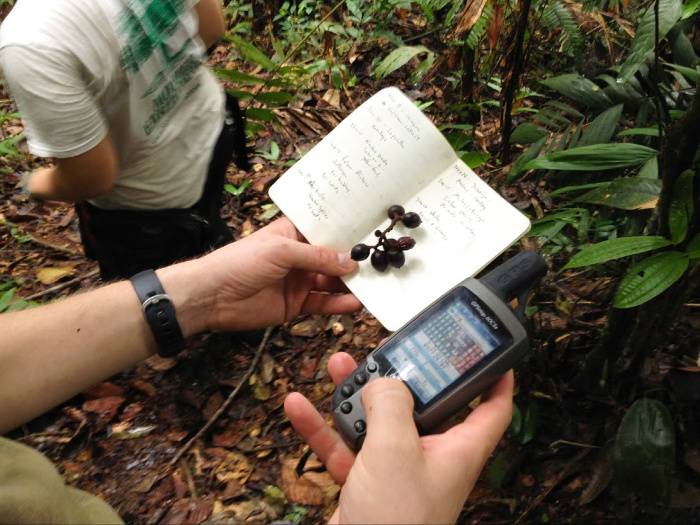
If you are thinking of conducting research at one or multiple of our conservation hubs, begin by reviewing our Researcher Guide, which provides an overview of how to prepare to conduct research at research stations, including information on pre-fieldwork planning and research application procedures, what to expect during your stay, health and safety considerations, as well as post research follow-up information.
The following are additional documents and forms you will need to conduct research at our stations (please submit at least three months in advance of your anticipated arrival):
Our conservation hubs are ideal for conducting research, and include comfortable dorms, restrooms, labs, limited internet, and the option for three hearty meals a day. Visit each station page to find more about what our unique facilities have to offer.
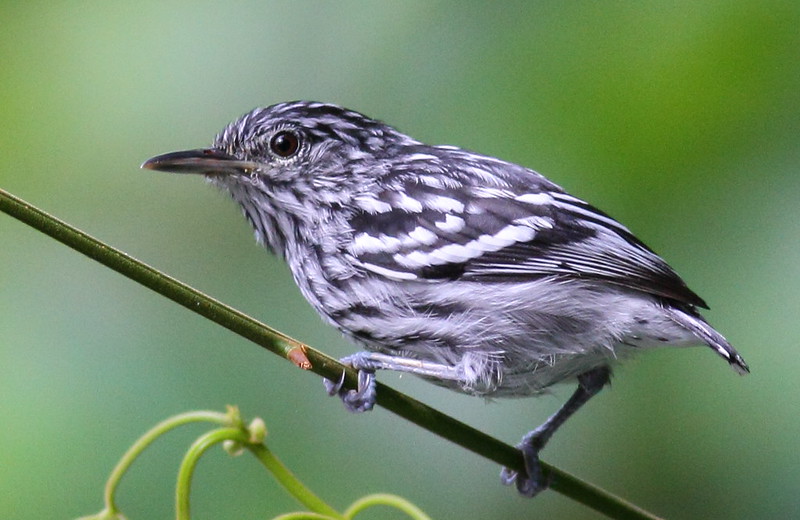
The interpretation of the behavior of flocks as having leader and follower roles has profound consequences for the understanding of the advantages and disadvantages of flock participation. This study hypothesizes that the leader and follower roles of antshrikes and antwrens are context-dependent. Experiments were made by walking transects along trails at Los Amigos Biological Station, detecting flocks by vocalizations and then approaching the flock to determine its species and individual composition by sight and sound. Purported leaders and followers were always attracted to conspecific vocalizations. Purported followers were almost always attracted to purported leader vocalizations and purported leaders were attracted to purported follower vocalizations about half the time. The fact that purported leaders were attracted to purported follower vocalizations was unexpected and contrary to all previous assumptions about the relationship between the so-called “leader” antshrikes and “follower” antwrens. The data suggest that antshrikes follow antwrens and vice versa, suggesting that the relationship between antshrikes and antwrens has mutual benefits.
-PhD project by Sean Williams from Michigan State University, U.S.A.
– Micah Scholer, PhD Candidate, Department of Zoology, University of British Columbia at Vancouver
 Loading...




1025 Connecticut Ave NW · Suite 415 · Washington DC 20036 · USA
202-234-2356 / info@amazonconservation.org