A New Twist On El Niño: The Bigger Impacts Will Come In 2027
August 18, 2026
Leia em Português Leer en Español
New Amazon-wide analysis of eight El Niño events finds that stronger events are followed by greater primary forest fire loss, and that reducing deforestation now could lower the risk of a major fire crisis in 2027.
As forecasts indicate, a very strong El Niño will develop in the last three months of 2026 (from October to December). Headlines around the world have focused on rising ocean temperatures, drought, and extreme weather. But according to a new study from Amazon Conservation’s Monitoring of the Andes Amazon Program (MAAP), a key part of the story unfolds after El Niño peaks.
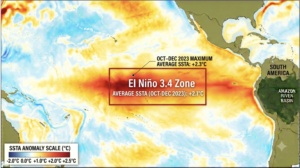 The report finds that the two most severe Amazon fire seasons in recent history, in 2016 and 2024, both occurred immediately after the two strongest El Niño events of the past two decades (2015 and 2023, respectively). Researchers analyzed all eight El Niño events since 2002 and found a consistent pattern: stronger El Niño events were followed by more severe fire seasons in the following year, leading to greater losses of primary forest to wildfires.
The numbers illustrate the pattern clearly. The very strong El Niño of 2015 (a sea surface temperature anomaly of +2.34°C) was followed by 4.35 million acres (1.76 million hectares) of primary forest lost to fire in 2016. The strong El Niño of 2023 (+1.49°C) was followed by 6.89 million acres (2.79 million hectares) lost in 2024, the worst fire season on record. By comparison, weak El Niño years were followed by losses under 395,000 acres (160,000 hectares). Researchers note the relationship approaches the traditional threshold of statistical significance, a meaningful signal given the limited sample of only eight qualifying El Niño events.
This report’s analysis focuses on primary forest loss rather than total burned area, because primary forests are the Amazon’s most intact ecosystems, storing great concentrations of carbon and sheltering high levels of biodiversity across the basin. Unlike secondary growth or agricultural land, primary forest does not regenerate on human timescales once lost. And because these forests do not burn on their own, any fire-driven loss signals that flames have likely escaped from recently cleared land into untouched forest, making primary forest loss a direct measure of the most irreversible damage occurring in the Amazon.
What makes this analysis distinctive is this scope: rather than focusing on individual countries or total burned area, as previous studies, researchers analyzed the Amazon as a single connected biome and measured primary forest loss from fires across the entire region, offering a basin-wide perspective on one of its most urgent conservation challenges.
“Our critical finding is all about a lagging or delayed impact for the Amazon,” said Dr. Matt Finer, Director of MAAP and Senior Research Specialist at Amazon Conservation. He explains that “20 years of data indicate a very strong El Niño in 2026, which means a very likely intense Amazon fire season in 2027, creating a critical window for governments to act now, before the next major fire season.”
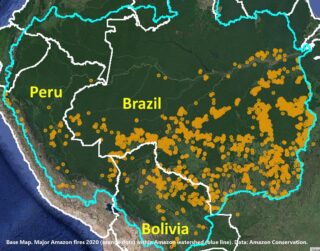
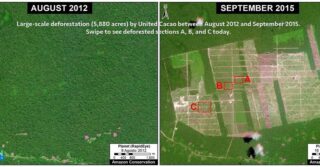
The report emphasizes that El Niño does not directly cause Amazon fires. Unlike many forests around the world, the Amazon Rainforest does not naturally burn because it’s naturally humid. Nearly all fires are caused by human activity. Most begin when recently deforested land is intentionally burned for agricultural expansion, and then escape into surrounding forests under the hotter, drier conditions associated with El Niño. Previous MAAP analyses have shown that more than 70% of major Amazon fires originate in recently cleared areas, making reductions in deforestation a critical tool for preventing wildfires.
The report also reviews how Amazonian countries responded to the record-breaking 2024 fire season. While preparedness has improved in Brazil, Peru, and Bolivia, researchers caution that the lower fire impacts observed in 2025, 3.71 million acres (1.5 million hectares) burned, versus 6.9 million acres (2.8 million hectares) in 2024, were largely aided by the wetter conditions associated with La Niña (the cooler counterpart to El Niño that often brings more rainfall to the Amazon) rather than institutional readiness alone. Bolivia illustrates the risk of uneven progress most clearly: the country’s fines for illegal burning remain roughly 2% of Brazil’s, and a land-reform measure that would have accelerated deforestation in the hardest-hit departments of Santa Cruz and Beni was enacted in early 2026 before being repealed amid public protest. Combined with the country’s deepening economic and political crisis, researchers warn that Bolivia could become the epicenter of the 2027 fire season.
However, the true test of preparedness will come in 2027, when the delayed impacts of El Niño reveal whether the decisions governments make now were enough to reduce fire risks across the Amazon.
Understanding El Niño
El Niño occurs when ocean temperatures rise above normal in an area of the Pacific Ocean that strongly influences weather patterns around the world. Scientists consider an El Niño event to be underway when those temperatures are at least 0.5°C warmer than average. Current forecasts suggest they could rise more than 2°C above average by the end of 2026, which would make this a “Very Strong” El Niño. The last event to reach that level was in 2015, shortly before the devastating 2016 Amazon fire season. Some models suggest temperatures could climb close to 3°C above average, potentially making this one of the strongest El Niño events ever recorded.
“We can’t stop El Niño, but we can act now to minimize its impacts in the Amazon,” said Finer. “Reducing deforestation in 2026 and the fuel load it becomes, is one of the most effective strategies for minimizing fire impact in 2027.”
 Loading...