
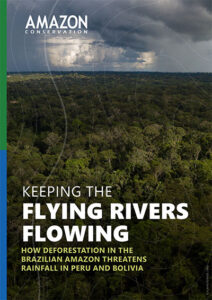
 Understanding the Role of Flying Rivers and their impact in the Amazon
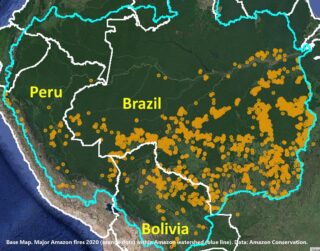
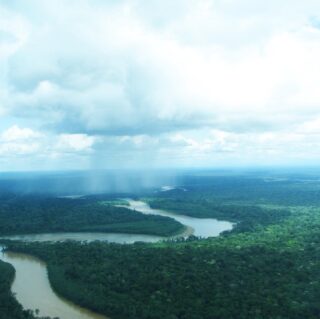
The Amazon’s “flying rivers” are invisible atmospheric currents that carry moisture from the Atlantic across the rainforest and into the Andes. They sustain rainfall, ecosystems, agriculture, and communities across South America. But as deforestation advances across the Brazilian Amazon, this critical hydrological system is increasingly at risk.
In this new white paper, researchers map the seasonal pathways of these moisture flows and identify the forests most essential to maintaining rainfall in Peru and Bolivia. The report highlights how infrastructure expansion, forest loss, and climate change threaten the resilience of the Amazon’s water cycle and outlines key recommendations to protect this interconnected system before critical tipping points are reached.
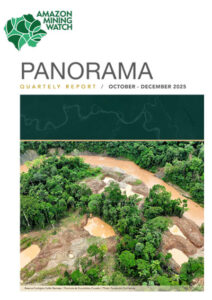 Dispatch of the latest on gold mining impacts across the Amazon
Amazon Mining Watch Panorama provides critical quarterly insights into the escalating threat of illegal gold mining across the Amazon. Based on AI-powered detection of mining scars anywhere in the region from Amazon Mining Watch (AMW), a multiparner initiative led by Amazon Conservation, Earth Genome, and the Pulitzer Center, it offers a data-driven perspective on the environmental challenges facing the world’s largest rainforest.
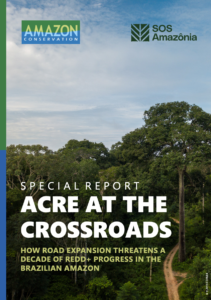
For more than a decade, the Brazilian state of Acre has been a global pioneer in forest protection. Its jurisdictional REDD+ program, the first of its kind in the world, has brought in millions in climate finance, helping drive deforestation down since 2022 and directing most carbon credit revenue to Indigenous and forest communities. But now, new road projects, including a proposed international highway to Pucallpa, Peru, threaten to reverse these hard-won gains.
In this new special report, we model three road expansion scenarios and how they could reshape deforestation in Acre, drawing on what happened after the state’s last international highway opened (BR-317). The report finds that the Pucallpa connection alone could add 133,800 hectares (over 330,000 acres) of deforestation over 20 years, putting at risk up to US$1.83 billion in potential carbon credit revenue, a national park, and territories of Indigenous peoples in voluntary isolation. It also outlines a path forward: well-governed infrastructure planning and a forest-based bioeconomy show that Acre’s forests are worth more standing.
 Loading...









1025 Connecticut Ave NW · Suite 415 · Washington DC 20036 · USA
202-234-2356 / info@amazonconservation.org