After Illegal Mining was Identified in Indigenous Territories, New Report Reveals Activity also in Protected Areas of the Xingu
May 6, 2026
After documenting the ongoing presence of illegal mining on indigenous territories in the Xingu region of the Brazilian Amazon, a new analysis shows that the activity also occurs in protected areas in the region, increasing the pressure on one of the most strategic territories for forest conservation.
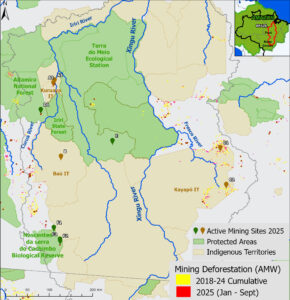 The new report from the MAAP initiative (Monitoring of the Andes Amazon Program), led by Amazon Conservation, was developed in partnership with the Socio-Environmental Institute (ISA), which led the study, is the second part of a series on illegal mining in the Xingu River Basin, located in the eastern portion of the Brazilian Amazon (states of Pará and Mato Grosso). While the previous study (MAAP #239) analyzed indigenous territories, this new part (MAAP #240) details the conservation units affected by the activity.
The center of the analysis, the Xingu Socio-Environmental Diversity Corridor, connects 24 indigenous territories and 9 conservation units, covering more than 26 million hectares—one of the largest contiguous blocks of protected forests on the planet.
Recent cases in conservation areas
In 2025, the Xingu+ Network established a partnership with Amazon Conservation, providing access to high-resolution satellite imagery (from Planet), which made it possible to validate alerts and identify drivers of pressure. This collaboration also incorporates the Amazon Mining Watch (AMW) online platform.
The SiRAD X and AMW monitoring systems have identified consistent patterns of deforestation associated with gold mining in the Xingu Corridor since 2018, including the continuation of illegal activities throughout 2025.
The data indicate recent deforestation due to mining in six conservation units within the corridor, in addition to the indigenous territories reported in Part 1.
In the first phase of the study, three affected indigenous territories were detailed (Kuruaya, Baú, and Kayapó). In this second part, the analysis focuses on three conservation units: the Altamira National Forest, the Terra do Meio Ecological Station, and the Nascentes da Serra do Cachimbo Biological Reserve.
In the Altamira National Forest, illegal mining led to 832 hectares of deforestation between 2016 and September 2025. In the first eight months of 2025 alone, the impacted area already exceeded the total recorded for the entire year of 2024, indicating a recent increase in pressure. A new front in the southeastern sector, which began in 2024, had already reached 36 hectares by October 2025, accounting for 45.7% of the deforestation caused by mining recorded in the area that year.
At the Terra do Meio Ecological Station, a strictly protected area, gold mining was first identified in September 2024 and had reached approximately 30 hectares by the end of 2025, establishing a new front of activity within the unit.
Illegal airstrip identified through monitoring
In the Nascentes da Serra do Cachimbo Biological Reserve, illegal mining advanced throughout 2025, expanding from an initial area of about 2 hectares to at least 26.8 hectares in just a few months, with successive reports of expansion throughout the year. The report also documents the opening of an illegal airstrip in 2025, as well as direct impacts on waterways that supply neighboring indigenous territories.
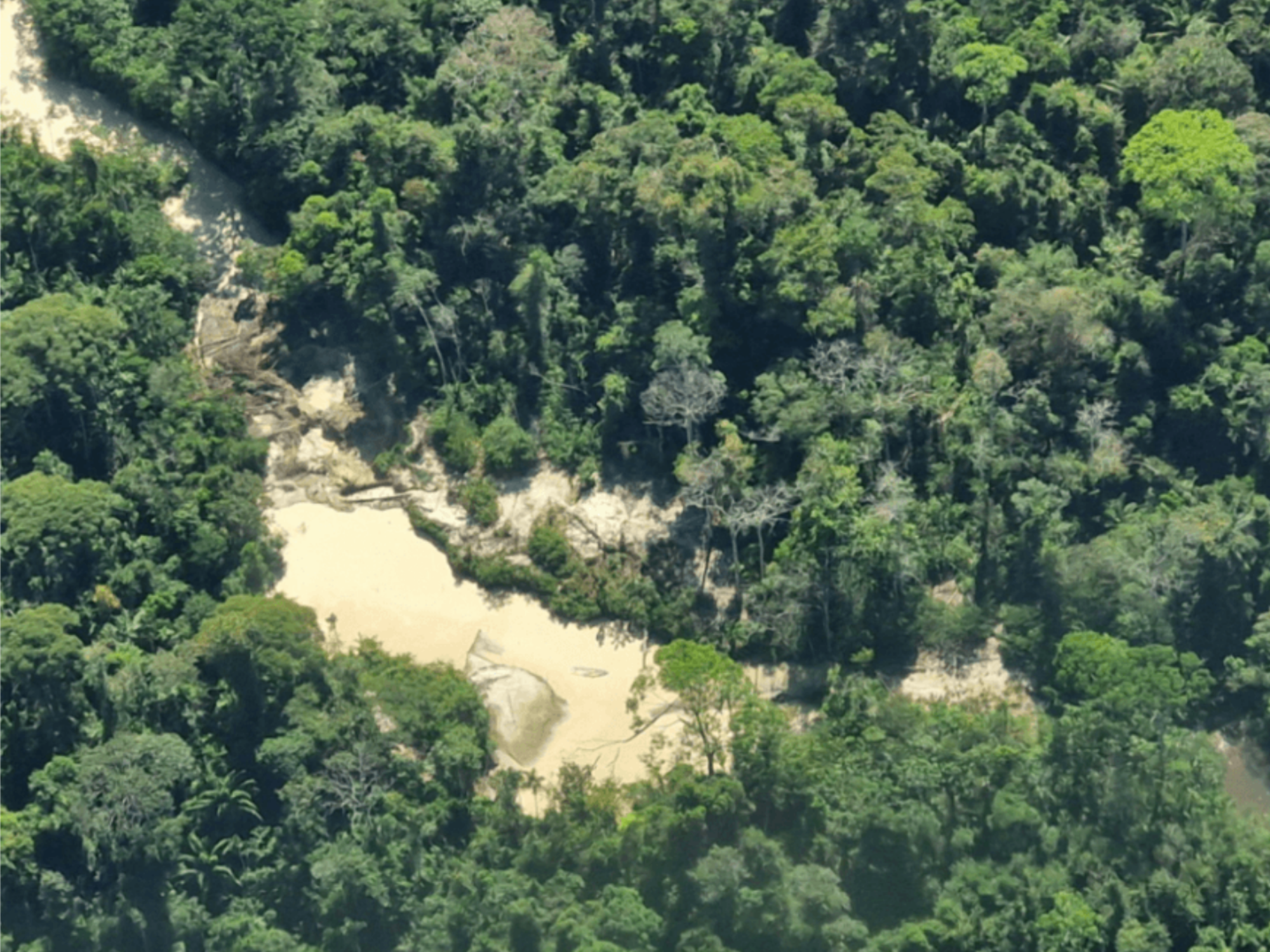
The findings indicate that illegal gold mining occurs both on indigenous lands and within conservation areas, including zones where such activity is prohibited by law.
In addition to deforestation, the use of mercury in gold extraction poses a direct risk of river contamination, affecting ecosystems and communities that depend on these resources.
The fact that these activities continue even after enforcement actions highlights the challenges involved in effectively protecting these areas. Based on the data, the report recommends strengthening coordinated action among enforcement agencies, establishing permanent bases in critical areas, decommissioning clandestine airstrips, and seizing machinery, in addition to expanding monitoring and the restoration of degraded areas, and improving gold traceability mechanisms.
The report is part of a series on gold mining in the Amazon, developed by Amazon Conservation in partnership with regional organizations, with support from the Gordon and Betty Moore Foundation.
 Loading...