Bringing New Voices Together for the Future of the Amazon
November 5, 2026
Protecting the Amazon requires more than better technology, stronger science, or more funding alone. It requires bringing those pieces together and making sure the people developing new tools, funding solutions, shaping policy, and working on the ground are part of the same conversation.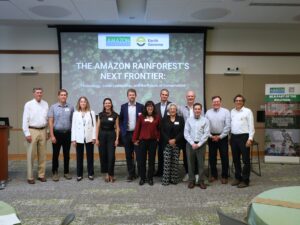
That was the idea behind The Amazon Rainforest’s Next Frontier: Technology, Local Leadership, and the Future of Conservation, an exclusive gathering co-hosted by Amazon Conservation, the Gordon and Betty Moore Foundation, and Earth Genome in Palo Alto, California.
The evening brought together leaders from conservation, technology, philanthropy, media, civil society, and the private and public sectors to explore how AI, satellites, real-time data, and local expertise are changing what is possible for the Amazon. Just as importantly, it created space for people who do not often work side by side to meet, exchange ideas, and identify opportunities for collaboration.
Connecting ideas, technology, and action
Rhett Butler, CEO and Founder of Mongabay, served as master of ceremonies. The evening opened with reflections from Avecita Chicchón, Program Director at the Gordon and Betty Moore Foundation; John Nassikas, Board Member at Amazon Conservation; and Steve McCormick, CEO and Co-Founder of Earth Genome.
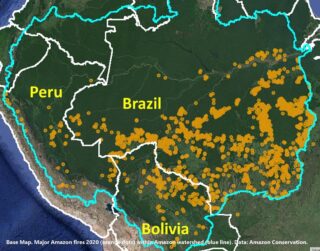
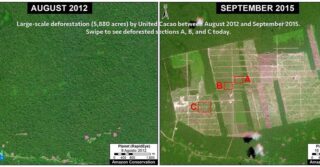
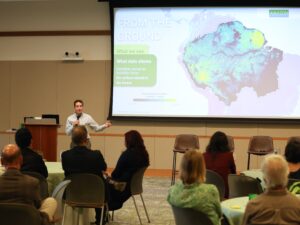 Matt Finer, Director of Science and the MAAP Program at Amazon Conservation, then provided an Amazon-wide view of the rainforest, showing how satellite data and science are helping reveal both the resilience of the ecosystem and the growing threats it faces. His presentation reinforced a central theme of the evening: better information is powerful, but its real value comes when it reaches the people and institutions able to act on it.
The technology portion of the program featured Ben Strong, Science and Machine Learning Lead at Earth Genome; Amy Rosenthal, Senior Global Director for Conservation Initiatives at Planet; and Ted Schmitt, Senior Director of Conservation at the Allen Institute for AI. Together, they highlighted how advances in Earth observation, artificial intelligence, and machine learning are making environmental change easier to detect, understand, and respond to—while emphasizing that technology is most useful when it supports real conservation decisions.
The evening concluded with a panel moderated by Kuek Ser Kuang Keng, Senior Editor for Rainforest Investigations at the Pulitzer Center, featuring John Beavers, President of Amazon Conservation; Carmen Josse, Executive Director of Fundación EcoCiencia; Maria Franco Chuaire, Program Officer with the Andes-Amazon Initiative at the Gordon and Betty Moore Foundation; and Marcos Woortmann, political scientist and policy specialist with Caritas Brazil. Their discussion focused on what must happen next: building local capacity, strengthening institutions, improving policy and enforcement, and ensuring that new technology translates into meaningful conservation outcomes.
Where Collaboration Becomes Conservation
The most important part of the evening was not any single presentation. It was the mix of perspectives in the room.
Technology leaders spoke with conservation practitioners. Funders heard directly from organizations working across the Amazon.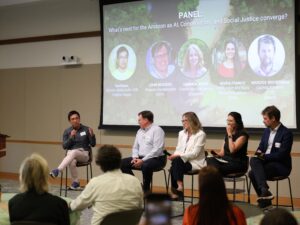 Scientists, journalists, policy experts, and private-sector leaders had the opportunity to connect around shared challenges and emerging solutions.
That kind of exchange is essential. The Amazon is one interconnected system, and protecting it requires an equally connected network of people and institutions. Amazon Conservation is committed not only to advancing science, technology, and on-the-ground action, but also to helping convene the partnerships that can move conservation forward at the scale the rainforest demands.
We are deeply grateful to our co-hosts, the Gordon and Betty Moore Foundation and Earth Genome, for their continued partnership and support, and to every speaker, partner, and guest who helped make the evening a success.
The challenges facing the Amazon may be immense, but so is the collective knowledge, creativity, and dedication available to meet them.
 Loading...