Data reveal the ongoing presence of illegal mining in Indigenous Lands in the Xingu region of the Brazilian Amazon
May 5, 2026
Between January and September 2025, a total of 335 hectares, an area comparable to about 530 soccer fields, were deforested due to illegal mining in Indigenous Territories within the Xingu River Basin, between the states of Mato Grosso and Pará in the Brazilian Amazon. The analysis indicates that isolated enforcement actions have not been sufficient to halt the advance of mining activities, underscoring the need for structural, long-term responses to address the problem.
A new study reveals that illegal gold mining continues to maintain a persistent presence in Indigenous Territories across the Amazon, particularly in the Xingu River Basin, raising concerns about growing risks to forests and local populations.
The analysis, conducted by the Monitoring of the Andean Amazon Project (MAAP) of Amazon Conservation in partnership with the Instituto Socioambiental (ISA), which led the report, combines MAAP data with two monitoring systems: SiRAD X, developed by the Xingu+ Network, and Amazon Mining Watch, created by Amazon Conservation, Earth Genome, and the Pulitzer Center. These systems use satellite imagery, radar, and artificial intelligence to detect mining areas. Their complementary methodologies reveal consistent patterns of expansion over time.
The data show that between January and September 2025, a total of 335 hectares were deforested within Indigenous Territories, underscoring the continued pressure of illegal mining in the region.
According to the report, at least 11,500 hectares of forest were lost between 2018 and 2024 in Indigenous Territories and protected areas within the Xingu River Basin. Deforestation associated with illegal mining continues to occur within protected territories, even following recent enforcement operations.
Territory under pressure
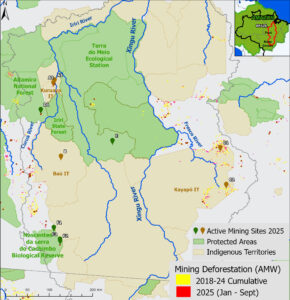
At the heart of this dynamic lies the Xingu Socio‑Environmental Diversity Corridor, one of the largest continuous expanses of officially protected forest on the planet, spanning more than 26 million hectares. The corridor connects 24 Indigenous lands and 9 protected areas, and plays a critical role in safeguarding the Amazon rainforest. However, it remains under intensifying pressure from illegal gold mining, expanding agribusiness, illegal logging, and human‑caused forest fires.
This initial part of the study offers a detailed analysis of three Indigenous lands: Kuruaya, Baú, and Kayapó, revealing how illegal mining has advanced in recent years and the direct impacts it has imposed on these territories and their communities.
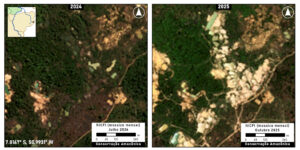
In the Kuruaya Indigenous land, illegal mining has intensified along the Madalena River. Between 2023 and July 2025, the affected area surpassed 34 hectares. In the Baú Indigenous land, the report identifies at least 110 hectares of destroyed forest, along with documented incidents of armed conflict between miners and Indigenous peoples.
The most critical situation is on the Kayapó Indigenous land, which shows the largest area deforested by illegal mining in the Brazilian Amazon. Report data, based on the Amazon Mining Watch platform, indicate a cumulative total of approximately 7,940 hectares impacted, including 140 hectares between January and September 2025. Despite federal government operations in May to remove miners and equipment, at least 2 new hectares of mining activity were detected in June.
“The data from monitoring systems used by both institutions leave no doubt that the Xingu Corridor is facing a scenario of increasing and widespread pressure, with illegal mining pushing into areas that had remained intact until now. Addressing this requires a long‑term, structural response to ensure the integrity of these forests and the peoples who depend on them,” says Thaise Rodrigues, Geoprocessing Analyst at Instituto Socioambiental (ISA).
Technology and Monitoring Reveal Consistent Patterns
In 2025, ISA partnered with Amazon Conservation to expand access to high-resolution satellite imagery provided by Planet through MAAP. This resource improved the validation of alerts and the identification of pressure drivers. The collaboration also integrates the public Amazon Mining Watch dashboard, developed by Amazon Conservation, Earth Genome, and the Pulitzer Center.
The Xingu+ Network conducts monthly monitoring of deforestation and other pressures in the corridor through SiRAD X (Xingu Remote Deforestation Alert System), which uses radar technology. The system is also supported by a network of local partners responsible for on-the-ground territorial monitoring.
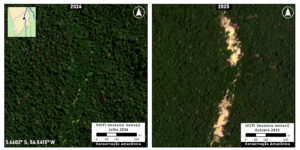
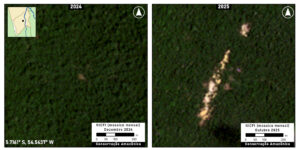
(Mining in Barú Indigenous Territory. Data: Planet/NICFI.)
The Amazon Mining Watch platform uses artificial intelligence and satellite data to detect deforestation caused by illegal mining across all countries in the Amazon Basin.
The impacts of illegal mining go far beyond forest loss. The activity is linked to mercury contamination of rivers, biodiversity loss, and increased socioenvironmental conflicts, putting at risk the safety and livelihoods of Indigenous and riverine communities, as well as urban populations that depend on forest and river resources and ecosystem services such as climate regulation.
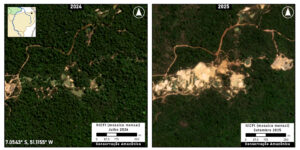
(Mining in Kayapó Indigenous Territory. Data: Planet/NICFI.)
“This is one of the most comprehensive analyses to date on the growing impact of gold mining in Indigenous lands and protected areas within the Xingu Corridor, one of the main hotspots of mining activity in the Brazilian Amazon. By bringing together complementary and previously unavailable datasets, the study enhances our understanding of recent trends and helps guide more effective monitoring, enforcement, and decision‑making.” says Matt Finer, director of the MAAP program at Amazon Conservation.
From response to action
The report underscores that beyond enforcement operations to remove miners, it is necessary to coordinate interinstitutional actions and prioritize the implementation of public policies in territories threatened by illegal mining. Key recommendations include the creation of a permanent interinstitutional task force to dismantle mining logistics networks, strengthening enforcement agencies such as IBAMA, ICMBio, and FUNAI, expanding community-led territorial monitoring, and advancing gold supply chain traceability with greater transparency regarding its origin.
Without a long-term strategy, the study warns of a high risk of recurring invasions following enforcement operations.
This report is part of a two-part series on the advance of illegal mining in the Xingu River Basin. This first edition focuses on Indigenous Territories, while the second will examine mining-related deforestation in protected areas, with analysis centered on three conservation units: Altamira National Forest, Terra do Meio Ecological Station, and Nascentes da Serra do Cachimbo Biological Reserve.
Read the MAAP 239 full report – Part 1 – HERE.
 Loading...