Illegal Gold Mining Clears Nearly 19,500 Acres Along Brazil–Colombia Border
October 29, 2026
New report finds 92% of mining-related deforestation occurred in Brazil, while rapid expansion into Colombia threatens Indigenous peoples living in voluntary isolation, despite repeated government operations.
A new report from Amazon Conservation’s MAAP (Monitoring of the Andes Amazon Program), developed in collaboration with the Field Museum of Natural History, reveals that illegal gold mining has cleared 7,901 hectares (19,518 acres) of Amazon rainforest along the Puré–Puruê River, a remote region spanning the border between Brazil and Colombia. The analysis highlights three key findings:
- Most deforestation is concentrated in Brazil: About 92% of total forest loss occurred along Brazil’s Puruê River, and 88% of all mining-related deforestation in the study area was recorded since 2022.
- Mining is rapidly expanding into Colombia: Although Colombia accounts for only 8% of the total deforestation, illegal mining has expanded into Puré River National Park, threatening the territories and safety of the Yurí and Passé Indigenous peoples, who live in voluntary isolation.
- Government operations have not stopped mining expansion: Despite seven enforcement operations, including three coordinated efforts between Brazil and Colombia, mining activity has repeatedly r
MAAP #251: Transboundary Illegal Gold Mining: Brazil (Puruê River) & Colombia (Puré River) highlights that Mining was first detected along Brazil’s Puruê River in 2001, but deforestation remained relatively limited for two decades, reaching 980 hectares (2,421 acres) by the end of 2021. Since then, the situation has changed dramatically. Since 2022, approximately 88% of all mining-related deforestation in the region has occurred, including 4,130 hectares (10,202 acres) cleared in 2022 and 2023 alone.
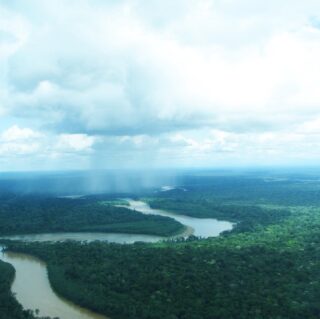
Today, mining operations extend along the Brazilian Puruê River from its confluence with the Japurá River to the Colombian border.
“We have been monitoring illegal gold mining across the entire Amazon, and this area stands out as one of the most emblematic cases of transboundary environmental crime,” said Dr. Matt Finer, lead author of the report, and Senior Reserach Specialist at Amazon Conservation.”Illegal gold miners have been ravaging the Brazil side (Purue River) for years, and now they are expanding deeper into the Colombia side (Pure River). The situation therefore requires a strategic, coordinated, binational response.”
Rapid escalation inside Colombia and a direct threat to Indigenous peoples in voluntary isolation
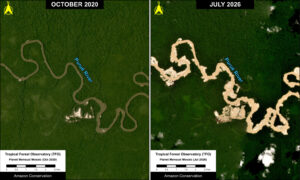 The pace of expansion is particularly concerning. Mining-related deforestation along Colombia’s Puré River was first detected in June 2024, when fewer than 5 hectares (12 acres) had been cleared. By the end of that year, the affected area had reached 38 hectares (94 acres). Deforestation doubled in early 2025 and continued to accelerate in 2026, with another 177 hectares (437 acres) cleared between January and May.
Previous MAAP monitoring also identified more than 50 mining dredges operating along the river inside Puré River National Park during 2024 and 2025.
All mining-related deforestation documented on the Colombian side lies within the national park, where mining is prohibited. The expansion poses serious risks to the Yurí and Passé Indigenous peoples, including potential violent encounters, disease transmission, mercury contamination, and disruption of their territories and traditional ways of life.
These risks extend beyond the Colombian side of the border. Evidence from the wider Puré–Puruê landscape indicates that Indigenous peoples living in voluntary isolation may move through a continuous forest territory spanning Colombia and Brazil, regardless of national boundaries. On the Brazilian side, indications of the presence of Indigenous peoples living in isolation require urgent investigation and precautionary protection by the competent authorities.
Mercury contamination and wider environmental impacts
The consequences of illegal gold mining extend beyond the areas directly cleared for extraction. Mercury used in mining can contaminate rivers and aquatic ecosystems, threatening downstream communities whose food security and livelihoods depend on fish and other aquatic resources.
The Puré–Puruê river corridor connects to the wider Japurá river system, so pollution and environmental damage can affect areas far beyond individual mining sites. Mining activity also creates spillover pressures on neighboring protected areas, including Brazil’s Juami-Japurá Ecological Station, and on Indigenous territories connected to the broader landscape.
Although Colombia has prohibited mercury use through legislation introduced in 2013 and strengthened in 2023, the report notes that mercury continues to be used in illegal gold mining in border areas such as the one examined in this analysis. These broader environmental impacts underscore the need to address illegal mining as an interconnected environmental and territorial security challenge.
Enforcement operations have not stopped mining expansion
The report documents seven government operations against illegal mining in the region: four focused on the Brazilian side, while three involved binational coordination between Colombian and Brazilian authorities in December 2023, May 2025, and November 2025. While these interventions temporarily reduced mining activity, deforestation resumed within months.
Following the May 2025 operation, mining-related deforestation in Colombia declined during June and July before increasing again by November. A similar pattern followed the November 2025 operation, with activity declining temporarily before rising again in March 2026.
The report also highlights the role of organized crime and logistical networks that sustain illegal mining. Brazilian municipalities such as Japurá, Maraã, and Jutaí serve as transportation and supply hubs, connecting mining operations to larger commercial centers, including Manaus.
These river networks facilitate the movement of equipment, fuel, supplies, and illegally extracted gold, making enforcement increasingly complex.
In August 2026, Colombia’s Ministry of the Interior issued an early warning calling for coordinated government action. However, the response has so far been limited to administrative coordination, without new operational deployments.
The findings reinforce the need for a sustained binational strategy that goes beyond isolated enforcement operations. The report recommends stronger territorial protection, coordinated action against criminal and logistical networks, and continued satellite monitoring to detect new mining activity and evaluate enforcement efforts.
The report calls for a long-term strategy that combines territorial protection, stronger governance, sustained binational coordination, and permanent monitoring.
“Protecting the people and the biodiversity of the Amazon requires cooperation across borders. Sustained coordination between Brazil and Colombia can address threats and safeguard the connected forests and rivers Indigenous peoples depend on. For Indigenous peoples in voluntary isolation, protecting their territories and respecting their decision to remain uncontacted are essential to their survival,” according to Jeremy Campbell, Director of the Andes-Amazon Program at the Keller Science Action Center of the Field Museum.
 Loading...