Illegal Gold Mining Is Shifting Not Disappearing Across the Amazon
June 2, 2026
This month, our Monitoring of the Andes Amazon Program (MAAP) released two major reports on illegal gold mining in two of the Amazon’s most critical territories: the Yanomami Indigenous Territory in Brazil and the Tambopata National Reserve in Peru. The findings are both encouraging and deeply alarming.
Brazil: Progress in Yanomami, but miners are adapting
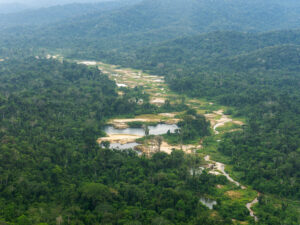 The new report released by Instituto Socioambiental (ISA) in partnership with our MAAP initiative, documents a sharp decline in mining-driven deforestation inside the Yanomami Indigenous Territory following the Brazilian government’s large-scale intervention in 2023. Newly cleared mining areas dropped from roughly 1,800 hectares in 2022 to just 45 hectares in 2025. This means a reduction of over 90%. But the threat has not gone away, it has shifted. Satellite mapping shows that illegal miners have adopted a more decentralized tactic and are moving toward areas closer to the Venezuelan border to evade enforcement. The Yanomami Indigenous Territory Alert System recorded 66 territorial alerts in 2025 alone, the majority involving clandestine aircraft, river incursions, and the movement of supplies into mining zones.
Peru: A dangerous resurgence in Tambopata
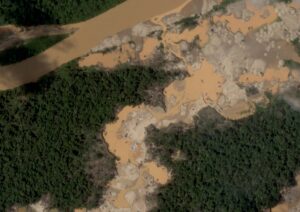 The analysis conducted by Conservación Amazónica–ACCA, in partnership with our MAAP initiative, documented more than 500 hectares of forest lost, and identified 183 active mining structures, 67 illegal camps, and an estimated 1,000 people currently operating within the protected area. What makes this resurgence especially alarming is that mining is now expanding close to government control posts inside the reserve, significantly increasing risks for the park rangers who defend it. In 2025 alone, mining-driven deforestation inside Tambopata exceeded 400 hectares, surpassing even the worst years of incursions recorded between 2016 and 2017. The report points some factors driving this return: record-high international gold prices, weakened environmental regulations, and reduced enforcement capacity, all creating conditions in which criminal networks can reorganize faster than the State can respond.
Together, these two reports show a defining challenge for the Amazon: enforcement works, but it must be sustained in order to protect these territories.
 Loading...