Jefferson: The Man Who Dreamed of Protecting Rivers
July 31, 2026
Written by: Emma Rada – Conservación Amazónica-ACEAA, Bolivia
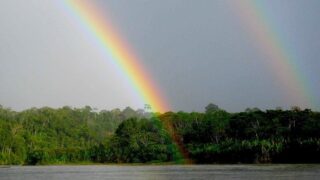
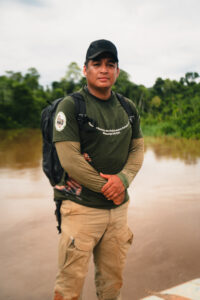 When the boat engine falls silent in the middle of a river that serves as both road and lifeline, nature seems to reclaim the landscape. The water becomes still again, a heron soars across the sky, the wind stirs the crowns of towering trees. And for a fleeting moment, everything seems to breathe without hurry. Jefferson watches. Then smiles.
Long before he ever donned a park ranger’s uniform, Jefferson Gonzales was just a boy who would accompany his father on fishing trips along these rivers. As he watched his father deftly navigate the waterways, he imagined that one day, he would be steering the boat. But he never expected that this childhood daydream would ultimately define his life, leading him to devote his career, his life, to protecting some of Bolivia’s best-preserved natural landscape.
Eleven years ago, Jefferson secured a job as a park ranger for the Manuripi National Wildlife Reserve in Pando, Bolivia. He was only twenty years old, naive, yet perceptive enough to grasp this fundamental truth about himself: he belonged in the forest.
“Being a park ranger isn’t a job,” he says with a knowing smile. “It’s an adventure.”
It only takes a few minutes of conversation to realize he isn’t exaggerating.
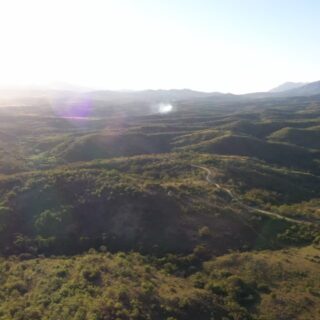
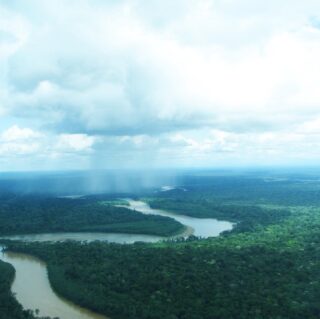
The Reserve protects nearly 747,000 hectares (over 1.8 million acres) of forests, rivers, and wetlands that host an extraordinary diversity of wildlife. Overseeing a territory of this scale means hours spent navigating rivers, hiking long forest trails, guiding and managing visitors, and responding swiftly whenever an activity threatens the forest’s integrity. And it all rests on the shoulders of a small team of rangers, whose daily commitment preserves one of the most valuable landscapes in the Bolivian Amazon.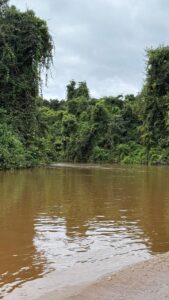
Yet when asked about the hardest part of being a ranger, Jefferson never mentions the rain, the mosquitoes, the snake bites, the strenuous hikes, or the conflicts that arise during the Brazil nut harvest season.
Instead, he talks about his family.
About the birthdays he has missed. About the special occasions that inevitably pass while he remains stationed at a remote outpost, far from home. “That is the hardest part,” he admits, his voice tightening with emotion.
And so he has come to understand that conserving the forest means accepting the quiet sacrifices of his chosen life: giving up the everyday luxuries most people take for granted.
Protecting nature is not only about preventing illegal logging or safeguarding vulnerable species. It is also about choosing to stay, even when that commitment means missing irreplaceable moments with the people you love most.
And yet, somehow, the forest always finds a way to give that time back.
Jefferson remembers every colleague with whom he has shared a patrol. Some have retired; others have followed different paths. Yet every trail, every tree, every river holds a memory of those years spent together. Now it is his turn to carry that legacy forward, helping new rangers understand that love for a protected area does not appear overnight. It grows with every patrol, every sunrise reflected on the river, and every day spent deep in the forest.
Today, the boy who once admired his father’s harmony with nature is in his second year of environmental engineering studies. After more than a decade of learning the forest through experience, he wanted to see it through yet another lens.
His studies have revealed to him a whole new framework for interpreting the forest: that beneath the water lies an invisible world teeming with microorganisms; that plants such as water hyacinth (Pontederia crassipes) naturally help purify freshwater ecosystems; and that every species plays an essential role in maintaining the balance of the Amazon. What he once understood intuitively, he can now explain.
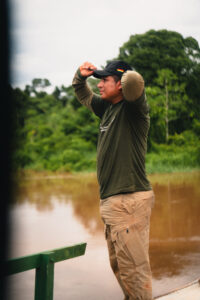 But perhaps the most important lesson a park ranger can learn takes place neither in the forest nor at school. It happens at home.
Jefferson proudly shares that his children already speak regularly about conservation, pick up any litter they spot on the ground, and care for nature as part of their everyday lives. These small acts were born from watching their father leave, time and again, for the forest, unwavering in his conviction that protecting the Amazon is worth every sacrifice.
In his children, Jefferson witnesses a quiet but essential truth. The spirit of conservation can and must be passed down through generations. An intact forest requires so much more than legal protections and park rangers; it depends on the willingness of those who love it deeply to teach and spread that love.
On International Ranger Day, we celebrate these selfless men and women who walk remote trails, patrol rivers, and protect biodiversity. But rarely do we stop to think about everything that lies behind the uniform: childhood dreams realized, families forced to learn to love across distance, tricks of the trade whispered from one colleague to another. And a man who, even after eleven years of difficult work, looks at the river with the same sense of wonder as the child who once dreamt of mastering the art of navigating its flowing waters.
Thank you, Jefferson.
And thank you to every park ranger who teaches us that once you truly learn to love a forest, you can’t help but dedicate your life, in countless ways, to protecting it.
 Loading...