Mining Has Encroached On 111 Hectares Inside Protected Areas In The Southern Ecuadorian Amazon
June 10, 2026
Satellite monitoring and drone analysis reveal the expansion of mining into national parks, biological reserves, and protected forests that are critical for the biodiversity and ecological connectivity of the Ecuadorian Amazon.
The expansion of gold mining in the southern Ecuadorian Amazon continues to push into strategic ecosystems and protected areas of high ecological importance. This is highlighted in the report by Fundación EcoCiencia, “MAAP #243: Mining in the Southern Ecuadorian Amazon – Zamora Chinchipe Province,” which documents the growth of mining activity within and around key conservation zones in Zamora Chinchipe.
Zamora Chinchipe, located at the southern edge of the Ecuadorian Amazon, is one of the country’s most ecologically significant regions due to its position at the transition between the Andes and the Amazon lowlands. This unique geography supports high biological diversity and includes strategic ecosystems such as cloud forests, páramos, and rare formations like the sub-Andean tepuis.
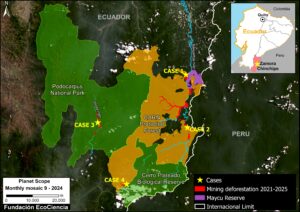 The analysis identifies approximately 111 hectares affected by mining within protected areas and conservation zones across four case studies monitored between 2011 and 2025. The impacted areas include Podocarpus National Park, the Cerro Plateado Biological Reserve, the Maycú Nature Reserve, and the Cuenca Alta del Río Nangaritza Protective Forest, territories that are essential for ecological connectivity and for conserving emblematic species such as the jaguar, tapir, and spectacled bear.
One of the most concerning findings comes from the monitoring conducted in Podocarpus National Park, where 44 hectares affected by mining were identified between August 2023 and December 2025. The study shows that mining activity is taking place inside a protected area where mineral extraction is prohibited by law. In addition to forest loss, satellite monitoring revealed impacts on the Loyola River, part of the park’s hydrological network and a key element for the conservation of cloud forests and Andean páramos.
The report also documents impacts within the Cerro Plateado Biological Reserve, a core zone of high ecological importance in the southern Amazon. Between August 2024 and December 2025, 13 hectares affected by mining were recorded, including areas inside the reserve itself. The analysis further found that 92% of the intervened areas lie outside authorized concessions, indicating possible irregular mining activities in environmentally sensitive territories.
Additional impacts were identified in the Maycú Nature Reserve, where 21.22 hectares were affected by mining, and in the Cuenca Alta del Río Nangaritza Protective Forest, with 44.27 hectares impacted. The study warns that the expansion of mining continues to increase pressure on strategic ecosystems in the Ecuadorian Amazon.
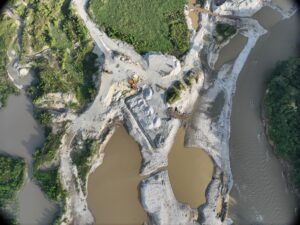
Using high-resolution satellite imagery and drone monitoring, the report identified the clearing of vegetation, soil erosion, sediment pools, and abandoned camps associated with mining activity. These findings reveal an extractive pattern marked by the repeated opening and abandonment of mining fronts, generating cumulative impacts and increasing challenges for environmental oversight.
The report also notes that Zamora Chinchipe has gone from registering around 5 hectares affected by mining in 1995 to more than 6,800 hectares in 2024, solidifying its position as one of the main hotspots of mining expansion in the Ecuadorian Amazon.
In this context, the report recommends strengthening the mandatory use of satellite-monitoring technologies and early-warning systems to detect new mining activities in protected areas and remote zones. It also underscores the need to incorporate technological evidence – such as satellite imagery, drones, and georeferencing systems – into administrative and judicial processes related to environmental crimes and illegal mining.
The study emphasizes that effectively protecting Amazonian protected areas requires reinforcing territorial control, surveillance, and institutional coordination to prevent the expansion of extractive activities in ecosystems that are critical for Ecuador’s biodiversity and ecological connectivity.
The report further warns that the rapid expansion of irregular mining activities in remote and environmentally sensitive areas poses an escalating challenge for territorial governance and the State’s capacity to exercise control. This trend highlights the need to strengthen monitoring systems, early-warning mechanisms, and more robust administrative and judicial processes to address environmental crimes and illegal mining.
Access the full report: https://www.maapprogram.org/ecuador-gold-mining-zamora/
 Loading...