GLAD alerts are a powerful new tool to monitor forest loss in the Peruvian Amazon in near real-time. This early warning system, created by the GLAD (Global Land Analysis and Discovery) laboratory at the University of Maryland and supported by Global Forest Watch, was launched in March 2016 as the first Landsat-based (30-meter resolution) forest loss alert […]
Based on analysis of satellite imagery, we have documented that the deforestation due to illegal gold mining activities within Tambopata National Reserve (Madre de Dios region) now exceeds 350 hectares (872 acres) since the initial invasion in late 2015 (see Image 39a). Although the rate of deforestation has decreased since April, when the Peruvian government installed a permanent control […]
The Peruvian Ministry of Agriculture and Irrigation (MINAGRI) recently issued a resolution approving the Update of the Soil and Optimum Land Use Suitability Studies for Areas in the Loreto Region. It is important to emphasize that “Optimum Land Use” (Capacidad de Uso Mayor in Spanish) is not determined by forest cover, but the quantitative interpretation of the soil, […]
In the previous MAAP #26, we presented a map of Deforestation Hotspots in the Peruvian Amazon during 2015*. This analysis showed that the highest concentration of deforestation is in the central Peruvian Amazon. Here in MAAP #37, we focus on this region, as indicated by Image 37a. Specifically, we analyze the hotspots shown in Insets C […]
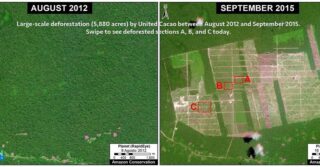
To date, we have published 4 MAAP articles* tracking deforestation by the company United Cacao in the northern Peruvian Amazon (outside the town of Tamshiyacu in the Loreto region). In these articles, based on analysis of satellite imagery, we have documented the deforestation of 2,380 hectares (5,880 acres) related to this project. The company, however, continues to deny […]
In several previous MAAP articles, we have detailed gold mining deforestation in the southern Peruvian Amazon. Here, we provide evidence of the first known case of gold mining deforestation in northern Peru. A recent news article published by the Peruvian organization DAR reported that gold mining activity continues to increase in the Santiago River (see Image 36a), located in the […]
Tarwi may not be a well-known legume in the US, but it is helping farmers in Peru not only sustain themselves financially, but also improve soil quality! Thanks to extremely generous support from the The Body Shop Foundation, ACA has been working with local communities in the Andean highlands to plant and harvest tarwi on their land. […]
In Bolivia, our sister organization ACEAA (Asociación Boliviana para la Investigación y Conservación de Ecosistemas Andino Amazónicos) is partnering with the local government of Pando to provide technical expertise for the preparation of a long-range plan to protect the Amazon and implement conservation projects on the ground. “Working with the Pando government has been very […]
The Norwegian Agency for Development Cooperation (NORAD) has approved a grant of over $2 million dollars to ACA to help monitor and protect the forests in Peru! This exciting project will build capacity for near real-time deforestation monitoring efforts and forestry management in the country, helping us achieve REDD+ goals in the Peruvian Amazon. The goal of the project is […]
May is a big birding month not only in North America, but across the world. ACA took part in some major birding activities throughout the month and we were excited to meet old and new birding friends! The Biggest Week in American Birding took place in early May, to much success. The 10-day annual festival was organized and hosted by Black Swamp […]
 Loading...





1025 Connecticut Ave NW · Suite 415 · Washington DC 20036 · USA
202-234-2356 / info@amazonconservation.org