New Office, Same Mission: Amazon Conservation Is Moving

As we continue to grow and deepen our impact across the Amazon Basin, we’re excited to share that Amazon Conservation Association’s Washington, DC office is moving to a new home.

Starting August 1, 2025, you can find us at:

1025 Connecticut Ave NW.,  Suite 415
Washington, DC 20036

This move marks an important step forward in creating a space that better serves our staff, partners, and the global community of supporters who power our mission to protect the Amazon rainforest.

If you send donations by mail, please update your records to reflect our new address. While mail sent to our previous location will be forwarded for a limited time, using our updated address ensures your support reaches us without delay. All of our other contact information remains the same.

This change comes at a time of renewed energy and commitment. As we celebrate over 25 years of protecting biodiversity, empowering forest communities, and advancing science and policy for conservation, our new office will support us in taking our work to the next level.

Here’s to a new chapter in our shared journey, one that begins in a new space, but with the same unwavering commitment to conservation. Thank you for being part of the Amazon Conservation community.

Make a Will Month: Your Legacy Can Help Keep the Amazon Standing

Our stories don’t end when we do. The decisions we make today can leave an impact that carries forward: protecting the people and places we care about most.

In a time filled with uncertainty, one of the most powerful things we can do is take action to protect what matters most. From standing with Indigenous communities to preserving the region’s unmatched biodiversity, our work is rooted in resilience and partnership.

This August, during National Make-A-Will Month, we invite you to take a moment to reflect on your own legacy. Creating or updating your will ensures that your values and wishes are honored. It can also be a way to expand your impact beyond your lifetime.

To support you in your planning, we’ve partnered with FreeWill, a free and secure tool that guides you through writing your will in about 20 minutes. Through FreeWill, you also have the option to designate Amazon Conservation as a beneficiary of non-probate assets, like a retirement account or life insurance policy.


Click here to create or update your legally‑binding will


The Amazon is home to unmatched biodiversity and plays a critical role in regulating the global climate. But it’s under increasing threat from illegal deforestation, mining, and fire. Your legacy can help us continue providing real-time satellite data, science-based solutions, and on-the-ground support to Indigenous and local communities defending the forest.

Leaving a gift in your will doesn’t require great wealth, just great intention. Whether large or small, your contribution will help ensure the Amazon remains thriving and resilient for future generations.

When you protect your future, you also strengthen the roots of global conservation. Together, we can expand our canopy—sheltering the planet, its people, and future generations. Thank you for considering a gift that keeps the forest alive.

P.S. Have you already included a gift to Amazon Conservation in your estate plans? Please let us know so we can thank you.

Transferring Tech, Empowering Guardians: How Indigenous Communities are Monitoring Their Territories

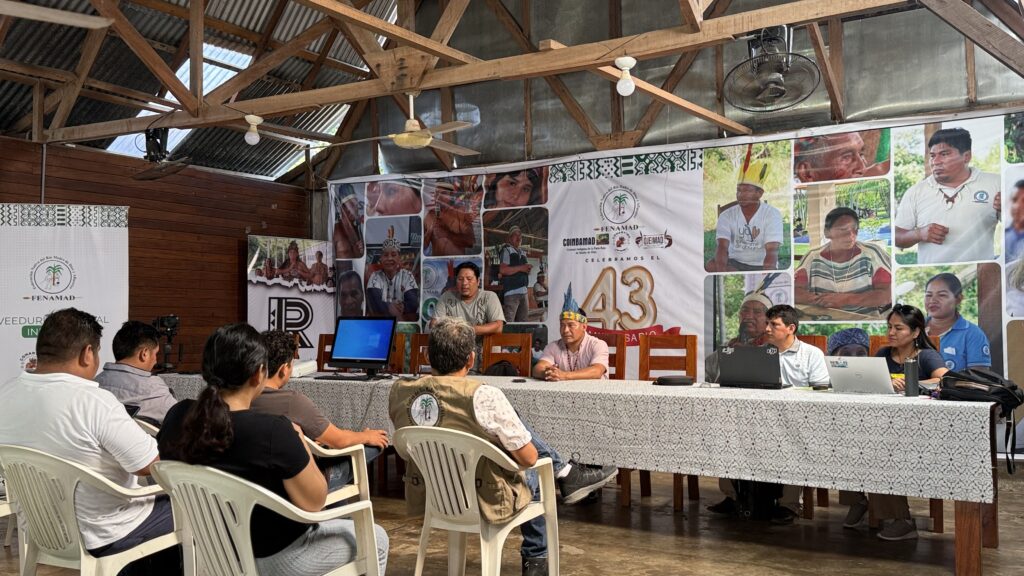
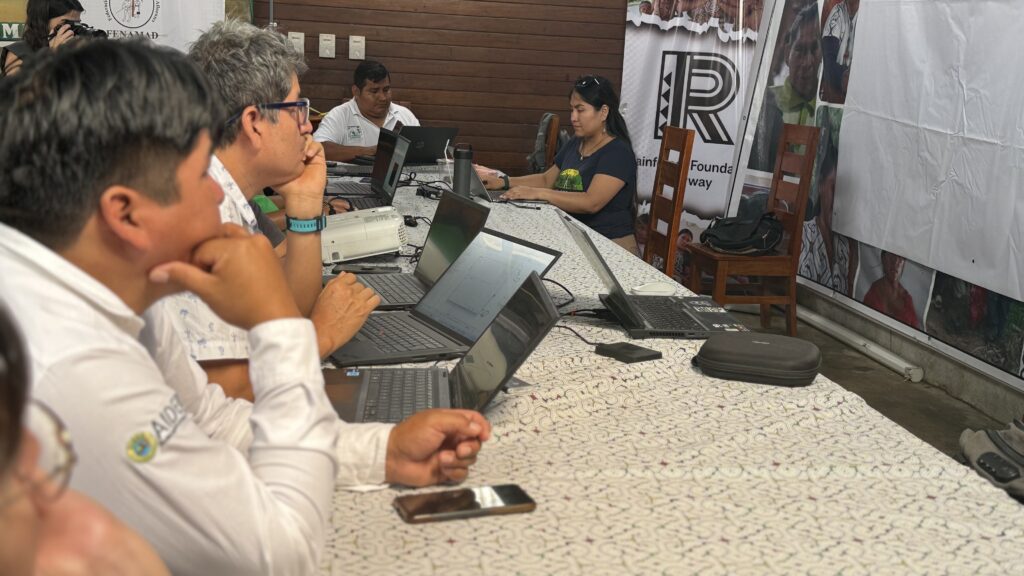
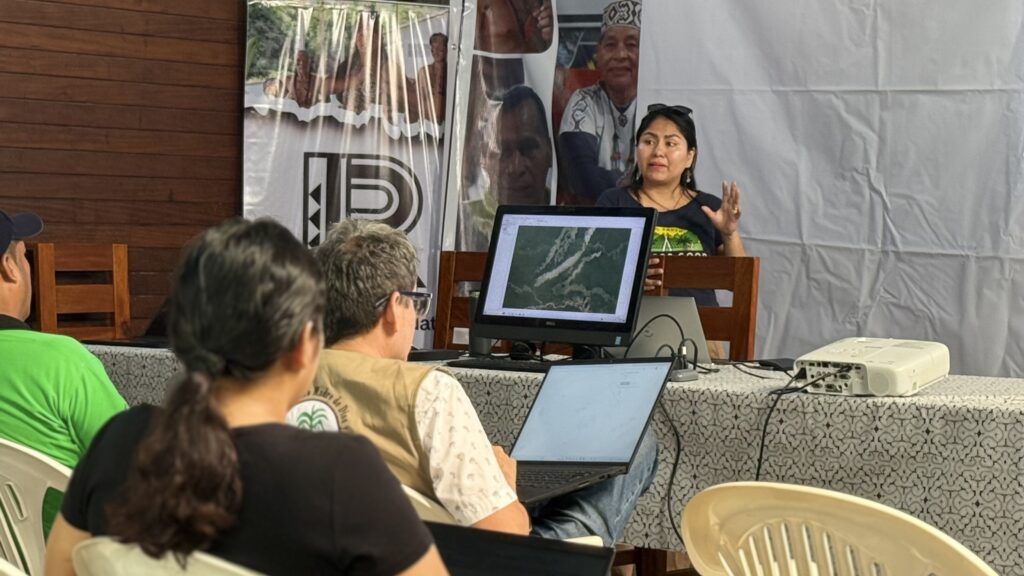
On July 21, Amazon Conservation and our sister organization, Conservación Amazónica-ACCA, partnered with FENAMAD – Native Federation of the Madre de Dios River and Tributaries (Federación Nativa del Río Madre de Dios y Afluentes) to lead the “Training in Technological Tools and Satellite Monitoring in Indigenous Communities” in Puerto Maldonado, Peru, focused on satellite monitoring and geospatial analysis.

The workshop brought together FENAMAD’s technical and legal team, focusing on the staff that goes to visit the communities and work close to the veedores. The objective was to build their capacity to detect and report the analysis to threats, such as illegal mining, logging, and land invasions, using remote sensing tools and legal strategies.

Participants explored key platforms as the analysis using Planet (monthly, daily and Skysat) and Sentinel; and went over other tools like RAMI (from Conservación Amazónica-ACCA), Amazon Mining Watch, and LandTrendr (Amazon Conservation MAAP’s Initiative) that are very useful for the mining detection. The goal is to strengthen Indigenous-led monitoring efforts and ensure community alerts can translate into timely and coordinated responses. 

“The goal is to protect the lives and integrity of Indigenous leaders, because they are the ones most exposed. When a threat is reported, the Federation immediately brings the case to the attention of the public prosecutor’s office”, explains Juan Soto, legal advisor at FENAMAD. The participation of the legal office in the training was key to better understanding how this information is created and receiving their input on what else is needed to work coordinated. “Providing legal security to Indigenous communities has been essential. We’re giving them a real tool to safeguard their rights and physical integrity.”

The work of community monitors, known as veedores comunales, is central to this system. “To protect something, you need to know and build a connection to it. Indigenous forest monitors have a direct relationship with the forest. Their cosmovisión shapes how they see the landscape differently from those of us in the city”, says Piero Rengifo, FENAMAD’s GIS and remote sensing specialist. “But it’s a two-way process; the community’s knowledge is just as vital as the tech. That perspective is key to long-term protection.”
“Monitors alert us to potential threats, and we verify them through the technical team,” adds Joan Aslla, also from FENAMAD’s technical specialists. “This monitoring reduce risks for those on the frontlines and ensures we escalate confirmed cases to the authorities.”

According to Dr. Soto, this coordinated work, powered by community alerts, satellite validation, and legal advocacy, including the Fiscalia’s support, is already impacting on the ground. “Thanks to our collaboration with Amazon Conservation, Conservación Amazónica-ACCA, and support from donors, we’ve successfully stopped illegal activities, obtained prosecutions, and strengthened our relationships with environmental enforcement agencies.”

As part of the training, participants worked on creating standardized templates and protocols that could be shared across FENAMAD’s network of 38 communities. In the future, the project aims to replicate and scale the process, enabling more Indigenous territories to manage and monitoring on satellite data in real-time.

For Nadia Mamani, Senior Geospatial Analyst & Partner Strategy Lead at Amazon Conservation, the initiative’s power lies in its ability to bridge technology, law, and traditional knowledge. “This integration is essential to reversing the spread of illegal activities and supporting Indigenous-led conservation.”

“Technology empowers,” Rengifo adds, “but it’s the deep cultural and ancestral connection that Indigenous people have with the forest that ensures it will be protected for future generations.”

The workshop, made possible through the support of the Gordon and Betty Moore Foundation and Norad, is part of a growing effort to equip Indigenous communities with remote sensing technology and legal pathways to protect the forests they call home.

The Keepers of the Amazon: Honoring Forest Rangers on World Ranger Day

Every day, throughout the Amazon rainforest, forest rangers rise before dawn. They lace up their boots, check their gear, and set out into one of the most biodiverse, as well as threatened, ecosystems on Earth. On World Ranger Day (July 31), we honor their commitment to safeguarding nature, often under difficult and dangerous conditions.

In the Amazon, rangers are much more than protectors of trees. They are guardians of biodiversity, of Indigenous lands, and oftentimes first responders to threats like illegal logging, mining, and fires. Their presence helps ensure that the forest and the people who depend on it, can continue to thrive.


“I love nature, I love the environment, and I love protecting it. I also help guide visitors, reminding them to care for the forest and take their waste with them.”
Yolanda Quispe Higuera, park ranger from Phinaya, Cusco, Peru, that works our sister organization Conservación Amazónica-ACCA

Through our Amazon Conservation Alliance, made up of Amazon Conservation (U.S.), Conservación Amazónica–ACCA (Peru), and Conservación Amazónica–ACEAA (Bolivia), we work with local park and forest rangers across the region, equipping them with the tools, training, and technology they need to succeed. From GPS and drones to satellite data, we provide modern tools that complement their deep knowledge of the land, allowing them to monitor vast forest areas, identify early signs of deforestation, and respond quickly and safely to emergencies.

Yet for many rangers, what motivates them is not the gear – it’s the mission. Rangers across the Amazon face growing risks: extreme weather, limited access to remote areas, and organized environmental crime. But they continue to show up, day after day, because they know what’s at stake.

This World Ranger Day, we invite you to stand with them.

By supporting our work, you’re helping us expand ranger programs, train new people, and ensure that forest guardians have the support they need to keep the Amazon standing, for wildlife, for climate, and all of us.

Photo: Yolanda Quispe Higuera, park ranger from Phinaya, Cusco, Peru | Credits: Fernanda Lacerda

Forest Guardians: Indigenous Women Lead Conservation in Pilón Lajas

©Consejo Regional T’simane Mosetenes Pilon Lajas

The T’simane Mosetene Regional Council continues an ambitious project with the support of Critical Ecosystem Partnership Fund (CEPF) and WCS Bolivia, aiming to reduce threats to biodiversity across 400,000 hectares (988,000 acres) and empower Indigenous women as forest guardians. To achieve this, this initiative seeks to strengthen shared territorial management, empower women and youth, and promote financial sustainability and communication.

In the heart of Bolivia, where the snow-capped Andes Mountains merge with the Amazon, the Indigenous T’simane, Mosetene, and Tacana peoples face a constant struggle to defend their territory: the Pilón Lajas Biosphere Reserve and Native Community Territory.

This territory holds the dual designation of Biosphere Reserve, managed by the National Service of Protected Areas (SERNAP), and Indigenous Territory, managed by the T’simane Mosetene Regional Council (CRTM). It encompasses nearly 400,000 hectares (988,000 acres) of well-preserved forests and is home to unique biodiversity and cultures deeply connected to nature.

However, this natural and cultural wealth is under threat. Illegal mining, forest fires, infrastructure expansion, and unauthorized development endanger not only the ecosystem, but also the livelihoods and identity of its inhabitants.

©Consejo Regional T’simane Mosetenes Pilon Lajas

Faced with these challenges, the T’simane Mosetene Regional Council has taken a leading role in defending its territory through an ambitious project with the support of CEPF and in partnership with WCS Bolivia, aiming to reduce threats to biodiversity and empower Indigenous women, strengthening territorial governance, and promoting sustainable livelihoods.

A Comprehensive Approach to Conservation

The project is structured around three strategic pillars: strengthening shared territorial management; empowering women and youth; and ensuring financial sustainability and communication.

The first pillar involves close coordination between SERNAP and CRTM. Through this pillar, patrols done by a security force composed of park rangers and community representatives, have been intensified. In addition, training workshops are being organized to improve their capacity to respond to forest fires and to monitor and report illegal activities, such as gold mining.

©Consejo Regional T’simane Mosetenes Pilon Lajas

The second focus area prioritizes training in leadership, Indigenous rights, and sustainability. Women from four communities have launched productive enterprises. Some produce essential oils and dehydrated Amazonian fruits, while others provide food services to tourists. This generates income and improves local food security.

The third focus area is identifying and adapting sustainable financing instruments and ensuring the equitable distribution of benefits. Additionally, the CRTM’s communication capacities are being strengthened, integrating a gender perspective into its operations.

Women at the Frontlines of Conservation

One of the project’s most inspiring achievements is the leading role assumed by Indigenous women. The CRTM is currently led by a strong female leader, Magaly Tipuni.

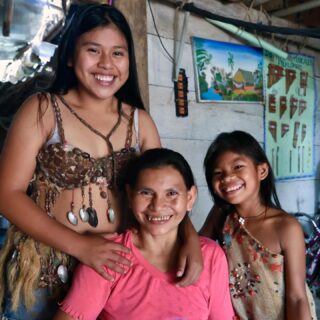
With the support of their communities, the community’s women have built artisanal facilities for extracting essential oils to produce high-quality products that are already being sold. This process improves local family economies and, at the same time, reinforces the role of these women as guardians of the forest and their territory.

These initiatives are aligned with the “Management Plan and Life Plan of the Reserve.” This is a strategic document developed by the CRTM and SERNAP, which guides the sustainable management of the territory and the conservation of its biodiversity.

Regional and Global Impact of a Model for Hope

The project’s focus extends beyond the local level. By conserving the forests of Pilón Lajas, it protects one of the planet’s largest carbon sinks and freshwater sources. Furthermore, it promotes the responsible consumption of Indigenous and sustainable products, raising awareness about the importance of preserving these forests.

This initiative also demonstrates that effective conservation is possible when Indigenous leadership, especially that of women, is recognized and strengthened. When faced with multiple threats, the T’simane, Mosetene, and Tacana peoples are building a development model in harmony with nature, based on ancestral knowledge, community organization, and local innovation.


World Rainforest Day: The Forest that Feeds Us All

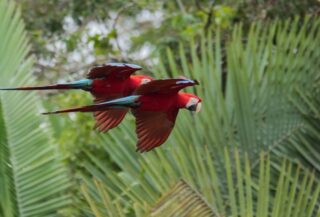
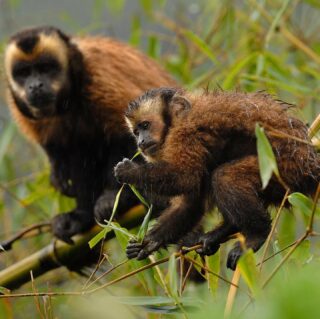
From the roots of an açaí palm to the canopy where monkeys swing and toucans call, the Amazon is alive with food — not just for the animals that call it home, but for people around the world.

On World Rainforest Day (June 22nd), we’re honoring the vital connection between forests and food. In the Amazon, this connection is woven into every tree, animal, and community.

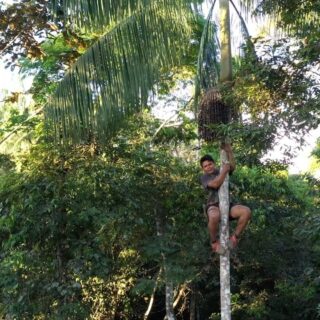
Açaí berries, pollinated by bees and beetles, nourish families and fuel local economies. The towering palma real trees feed tapirs, deer, and rodents, who return the favor by spreading its seeds. Brazil nuts take over a year to ripen and rely on bees and agoutis for their survival in a delicate, ancient partnership. And the cacao and cupuaçu palm trees, cared for by generations of Indigenous and forest communities, offer us cacao and chocolate in flavors as rich as the forest they come from.

These foods are more than just products. They’re part of a living system that supports over 16,000 tree species, 390 million individual trees, and countless lives.

But that system is under threat.

Deforestation and climate change are unraveling the delicate web that makes the Amazon the world’s greatest rainforest and one of its greatest food sources. When we lose the forest, we don’t just lose trees. We lose pollinators. We lose livelihoods. We lose nourishment. We lose balance.

This World Rainforest Day, take action to protect the forest that unites and feeds us.

Your support helps us defend forests from illegal mining, fires, and deforestation while uplifting the communities who care for them. Together, we can ensure that the Amazon continues to thrive, not just for its own sake, but for the future of food, climate, and life itself.

[Donate now] to keep the Amazon thriving and resilient.


Amazon Conservation Earns 2025 Candid Platinum Seal for Nonprofit Transparency

We’re proud to announce that we’ve earned the 2025 Candid Platinum Seal of Transparency, the highest level of recognition for nonprofit accountability and openness!

At Amazon Conservation, we believe that protecting the Amazon rainforest goes hand in hand with building trust. That’s why we make it a priority to share clear, comprehensive information about who we are, how we work, and the impact we’re making across the Amazon basin.

This Platinum Seal from Candid – the leading source of nonprofit data, previously GuideStar – reflects our ongoing commitment to transparency. From our program outcomes and leadership to financial information and strategic goals, our profile gives you an open window into how your donations drive real impact on the ground.

As we face growing environmental challenges and shifts in global weather patterns, we know that transparency, collaboration, and trust are more important than ever. This recognition is a testament to the collective effort of our team, donors, partners, and supporters – and to our dedication to making our mission visible, impactful, and measurable, every step of the way.

Thank you for standing with us in protecting the Amazon.

Learn more: https://app.candid.org/profile/7790364/amazon-conservation-association-52-2211305 

GCF Task Force: Making Conservation Connections for a New Forest Economy in the Amazon

Last week, staff members from our Alliance, comprised of Amazon Conservation, Conservación Amazónica – ACCA, and Conservación Amazónica – ACEAA attended the 15th Annual meeting of the Governors’ Climate & Forests Task Force (GCF Task Force) in Rio Branco, Acre, Brazil. The event this year set up essential  discussions regarding the co-construction of a New Forest Economy that strengthens forest protection, supports land restoration, and fosters sustainable economic growth and job opportunities across the region.

The GCF Task Force was established in 2008 to bring together a coalition of states and provinces across 11 countries to safeguard tropical forests and advance practical approaches to rural development that preserve these forests. Today, it’s the world’s largest platform for this type of subnational collaboration dedicated to tropical forest protection, consolidating a network of entities to support strong environmental governance, green financing, protection of territorial rights, and the well-being of Indigenous Peoples and local communities to strategize effective subnational, national, and international pathways for sustainable economic development that supports livelihoods and reduces deforestation.

Similar to our community-integrated approach to conservation that empowers local people, our Alliance has been working to build a forest-based economy in Peru and Bolivia for the past 10+ years, and is currently working on expanding these efforts into Brazil. We consider this approach to be one of the most effective ways to avoid forest conversion in the long term by providing economic opportunities that rely on standing forests. 

This year’s annual meeting marked an important step forward for Amazon Conservation, as our Alliance hosted a special side event called “People at the Center of Bioeconomic Transitions: Uniting Small Producers, Indigenous Peoples, and Local Communities,” to share progress updates on the development of the bioeconomy and facilitate dialogues between local producers in the Madre de Dios (Peru), Acre (Brazil), and Pando (Bolivia) regions of the Amazon. “My family lives inside the Chico Mendes Reserve here in Acre. Mother Nature feeds us, so we must treat her with care. What we need now are credit lines that actually reach our cooperatives. We discussed that capital is one of the missing pieces for communities like ours”, emphasized Vanusa Ferreira, one of the leaders at Chico Mendes Extractive Reserve

The exchange of experiences among producers of these countries sparked fresh hope and a collaborative spirit grounded in shared missions. As Manoel de Jesus, President of the Chico Mendes Extractive Reserve Association, said, “We’re going home energized. The proposals shaped here, together with partners from Peru, Bolivia, and beyond, show that when we stand united, we have a bright future.” 

Marcos Terán, Executive Director of Conservación Amazónica – ACEAA in Bolivia, added that “bringing producers from Peru and Bolivia to share lessons in Brazil charts a common road toward a forest-based bioeconomy. The southwestern Amazon is not just productive land, it’s a climate engine. Solutions must start with local actors to get them scaled up.”

This session also included engagement from private sector company representatives and investors who have integrated investing in Amazonian organizations and/or communities that harvest forest-based products, connecting small-scale producers and Indigenous communities with potential business partners. As discussions progressed, participants reflected on the challenges of investing in cross-border supply chains and climate adaptation, exploring strategic opportunities for joint impact, and implementing best practices to strengthen sustainable development for the bioeconomy. As we aim to expand these efforts into the productive forests of Brazil, this side event acted as a key space to further boost and support local initiatives that can bolster local producers’ entrance into the global non-timber forest product market. 

“A key insight from these dialogues is that increasing the value of Amazonian forest products, through integrated, internationally recognized supply chains, is vital for long-term forest conservation and for livelihoods that truly value and empower local communities,” concluded Blaise Bodin, Director of Strategy & Policy at Amazon Conservation.

Amazon Conservation Co-Founder Unveils New Edition of His Book “Tropical Nature”

Last week, Amazon Conservation Co-Founder Dr. Adrian Forsyth joined our Peruvian sister organization, Conservación Amazónica-ACCA, for a special event to celebrate the launch of the Spanish edition of his book, Tropical Nature (Naturaleza Tropical), which transforms the ecological complexity of tropical forests into captivating stories about nature that Forsyth witnessed himself during various expeditions throughout the Amazon biome. As a scientist, writer, and conservation leader, Forsyth has inspired generations of conservationists through his vivid vision and unwavering dedication to the Amazon and the Neotropics—regions that are vital to understanding our planet’s ecological health and shaping global conservation strategies. 

Tropical Nature offers a unique perspective on the intricate ecological functions of the Neotropics, meant to inspire generations of biologists and naturalists to learn more about the interconnectedness of plant and animal species with human welfare. Forsyth writes in the book’s introduction, “Our purpose is not merely to set down a compendium of interesting facts about tropical nature, but to provoke curiosity about how such a complex world might function and how it might have evolved.” He later wrote, We felt a need for a book addressing the natural history of tropical rainforests that would be accessible to the legion of naturalists and interested laymen in the temperate zone who might wish to learn something of this remarkable world today.” Now, the Spanish edition of this iconic book can reach a new audience of conservationists located in and around one of the world’s most significant Neotropical regions. 

The event “An Afternoon For Conservation with Adrian Forsyth,” hosted in Lima, Peru, celebrated the official launch of Naturaleza Tropical, and recognized Forsyth’s more than forty years of dedication to exploring and conserving this vital region that inspired this book. The event began with welcoming remarks from María Elena Gutiérrez, Executive Director of Conservación Amazónica-ACCA, who highlighted Forsyth’s profound impact on the protection of tropical forests and the formation of a global community of scientists and conservationists committed to the Amazon. She also extended special thanks to The Gordon and Betty Moore Foundation, whose generous support made it possible to publish this renowned work in Spanish. Key figures of the conservation world, including Amazon Conservation Co-Founder Enrique Ortiz; Avecita Chicchón and Aileen Lee of The Gordon and Betty Moore Foundation; and prominent international scientists such as Miles Silman, Michael Goulding, Russell Mittermeier, and John Terborgh, also shared moving accounts of Forsyth’s prolific accomplishments and his influence on their lives and careers.

Corine Vriesendorp, Conservacion Amazonica-ACCA’s Director of Science, led the presentation of Naturaleza Tropical, followed by a special appearance by photographer and editor Walter Wust, who highlighted how Forsyth invites us, through his written lines, to marvel at the simple things in life and nature. The event also featured a panel with Peruvian university professors who discussed the book’s relevance to the current challenges of climate change and biodiversity loss, as well as its impact on new generations of conservationists. 

“This book is a masterpiece. The way it describes dung beetles is fascinating, and I found the chapter on canyons of light fantastic. The epiphytes, the small details… everything is told with unique sensibility,” remarked Marc Dourojeanni, Professor Emeritus at the Universidad Nacional Agraria La Molina, during the event. “Not much is written at this level in Spanish; this edition will allow many technocrats, students, park rangers, and guides to better understand what they observe. It is the universe of the minuscule, of patient observation. There are many imprecise interpretations out there, and this work helps restore wonder and respect for tropical nature.” 

Forsyth shared how a National Geographic article from the 1960s about the Vilcabamba mountain range in Peru that he read at the age of 13 shaped his desire to pursue a career in conservation. He recalled how that first encounter with the Amazon eventually drew him deep into its heart – trekking in muddy boots, with no map or fixed plan, guided only by a single purpose: to protect it. He spoke of his deep devotion to Peru, describing how a place that once felt like a distant dream became the center of his life thanks to the support of people, such as Peruvian environmentalist Carlos Ponce del Prado, among many others who accompanied him along his journey. Forsyth also highlighted the importance of Peru’s system of natural protected areas, a unique model for conservation that the world should follow. 

Adrian Forsyth receiving a gift in recognition of this prolific career

In his closing remarks at the event, Forsyth issued an important call to action: “In a world where new generations are growing up increasingly disconnected from nature, if this book inspires even one more person to explore the tropics and fight for their protection, then it will have been worthwhile.” In recognition of his legacy, Forsyth received a sculpture of the “Blue Beast of Death,” or dung beetle, one of the species he studied the most throughout his life. As the largest coprophagous beetle in South America, the dung beetle plays a crucial role in recycling nutrients and thus symbolizes the health of forests.

We at Amazon Conservation are extremely proud to celebrate the vision that our Co-Founders, Dr. Adrian Forsyth and Enrique Ortiz, planted more than 25 years ago: to create an organization dedicated to protecting the planet’s most diverse landscapes, training new conservation leaders, and working alongside communities for a sustainable future. Today, we, along with our sister organizations, Conservación Amazonica–ACCA and Conservación Amazonica–ACEAA, continue to work towards making this dream a reality by promoting high-level scientific research and fostering ways of living in harmony with the Amazon ecosystem. Our vision for a prosperous,  resilient, and thriving Amazon remains resolute, and the inspiration of leaders like Dr. Adrian Forsyth paves our path towards effective conservation solutions with hope, commitment, and determination. 

Watch the recording for “An Afternoon for Conservation with Adrian Forsyth.”

MAAP Update: Using AI to Detect Gold Mining Deforestation in the Amazon

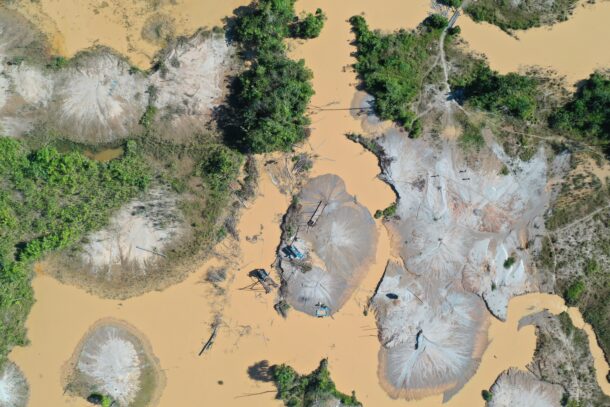
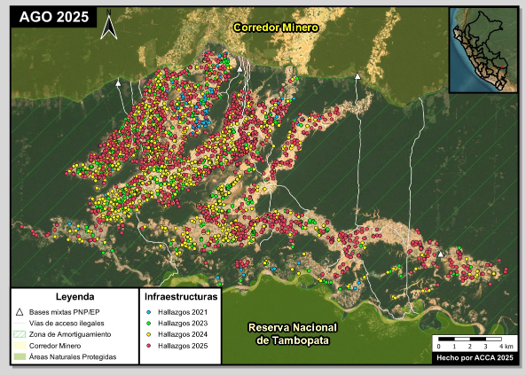
As gold prices continue to increase, small-scale gold mining activity continues to be one of the major deforestation drivers across the Amazon, often targeting remote areas and impacting carbon-rich primary forests. These mining activities are presumed to be illegal based on their location in conservation areas (such as protected areas and Indigenous territories) and outside mining concessions.

Given the Amazon’s vastness, it has been challenging to monitor mining deforestation accurately and regularly across all nine countries to better inform related policies in a timely manner. To address this challenge, Amazon Conservation, in partnership with Earth Genome and the Pulitzer Center’s Rainforest Investigations Network, created Amazon Mining Watch: an AI-powered dashboard to address this challenge. This online tool analyzes satellite imagery to estimate annual and cumulative mining deforestation across the entire Amazon, providing actionable data for management and conservation purposes in near real-time at national and regional levels.

In a previous report on the Amazon Mining Watch dashboard, MAAP #212,  we presented the initial results of mining activities from  2018 to 2024. Our newest report, MAAP #226, presents an update focused on the newly added 2024 data.

This report highlights several major findings:

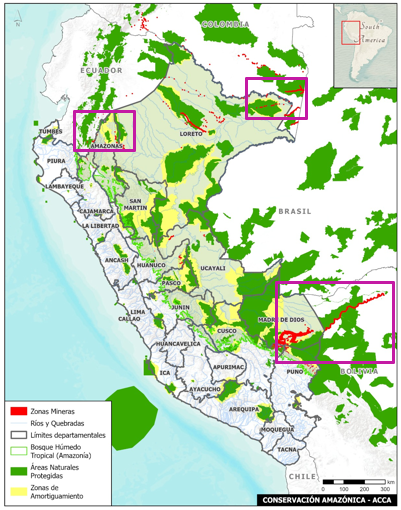
  • Gold mining is actively causing deforestation in all nine countries of the Amazon. This impact is concentrated in three major areas: southeast Brazil, the Guyana Shield, and southern Peru. In addition, mining in Ecuador is escalating.
  • The cumulative mining deforestation footprint in 2024 was over 2 million hectares (nearly 5 million acres) and has increased by over 50% in the past six years.
  • Over half of all Amazon mining deforestation occurred in Brazil, followed by Guyana, Suriname, Venezuela, and Peru.
  • While the cumulative footprint continues to grow, the rate of increase slowed in 2024 after peaking in 2022, likely due to increased enforcement in Brazil. In 2024, we documented the new gold mining deforestation of 111,603 hectares (275,777 acres). This total represents a decrease of 45% relative to the peak year 2022.
  • Over one-third of the mining deforestation has occurred within protected areas and Indigenous territories, where much of it is likely illegal. The top nine most impacted protected areas are all in Brazil, led by the Tapajós Environmental Protection Area. The three most impacted Indigenous territories are also in Brazil (Kayapó, Mundurucu, and Yanomami), followed by territories in Venezuela and southern Peru.
  • These results have important policy implications, and we discuss examples in Brazil, Peru, and Ecuador.

Read the full report.