 Gold mining in the Amazon can devastate riverside forests and human health. Artisanal gold miners, often from poor migrant communities, are lured to Madre de Dios, Peru by the dream of easy riches. The state is the most active alluvial gold mining region in Peru, producing between 50 and 100 tons of gold annually.
Unfortunately, that gold rarely enriches the artisanal gold-mining communities, who are sometimes entrapped by mounting debt for equipment, loans, and concession rentals. Instead, they find themselves locked in an endless cycle of deforestation, mercury poisoning, and poverty.
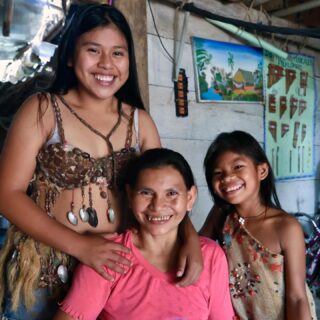
Artisanal miners extract gold from river bottoms and edges using dangerous techniques that expose them to high levels of mercury. Liquid mercury is used to amalgamate the gold, both at the site of extraction and later in shops or in homes where gold is boiled with mercury to form larger nuggets to sell to urban gold traders. Often, the mercury vapors waft out of cooking pots while the whole family looks on. The mercury can poison children and adults alike, causing extreme swelling, hair loss, weakened muscles, kidney dysfunction, insomnia, and memory impairment. In the environment, mercury is likely to reduce reproduction and cause birth defects in wildlife.
 Over the last year, ACA has partnered with the US Environmental Protection Agency (EPA) to produce new scientific data about mining-related mercury emissions in Madre de Dios and their impact on human health. In December 2007, USAID invited ACA to participate in a meeting with the EPA concerning mercury contamination, and a partnership was born. In May, ACA hosted EPA researchers at our project office in Puerto Maldonado, led tours of mining communities and gold shops, and introduced the EPA team to regional government representatives. On field trips, EPA researchers measured mercury levels that far exceeded any they had encountered at their other project sites, in countries as diverse as Brazil and Senegal. In the fall, the EPA team returned at the invitation of Madre de Dios regional government to install a pilot mercury-capture device that reduced mercury emissions from the amalgamation process by 90%.
Recently, these findings have sparked a dynamic conservation initiative, supported by ACA, the EPA, Argonne National Laboratory, Stanford University, and the Dirección Regional de Energia y Minas – Madre de Dios, to:
- Discover how much mercury is building up in the environment around gold mining communities by testing samples from plants, fish, soils, air, and people;
- Provide scientific data about mercury contamination to local decision makers; and
- Develop methods to limit these communities’ exposure to mercury.
One cornerstone of the initiative will be a mercury testing program for aquatic ecosystems. EPA-affiliated researchers plan to test the mercury levels of a variety of common food fish for sale at local markets, transcribing the results into a simple red-yellow-green guide for safe consumption, patterned on the Monterey Bay Aquarium’s popular Seafood Watch guide. As ACA seed-grant recipient Luis Fernandez noted, “Fish consumption is the most important pathway for human methylmercury contamination.”
Over the next year, look to ACA’s website to track progress on this exciting initiative and learn more about how we’re making conservation an attainable goal for local communities.
Figure from: “Mercury in the Environment” USGS Fact Sheet 146-00 (October 2000).
 Cesar Moran-Cahusac began as ACA’s Executive Director in August 2007. Born in Lima, Peru, Cesar has worked on a wide spectrum of conservation projects.
 Converting muddy-boots field work to high-quality research takes years of hard work, but it’s beginning to pay off for our young research program in the Amazon. In the first six months of 2008 alone, work done at the Los Amigos Biologi
 cal Station (CICRA, its Spanish acronym) generated 11 peer-reviewed articles, two Ph.D. dissertations, and half a dozen theses by Peruvian undergraduates.
 As the Interoceanic Highway is paved across highly biodiverse southeastern Peru, it is expected that forest loss will increase dramatically. Road improvement in the Amazon is typically associated with increased rates of deforestation, colonization, illegal logging, and land clearing for farming, artisanal gold mining, and cattle ranching. These practices spread through the construction of illegal secondary roads and increased in-migration. By some estimates, the paving could result in a 60 mile-wide swath of deforestation between Manu National Park and Tambopata National Reserve.
 ACA is partnering with schools to develop environmental awareness both nationally and internationally. With ACA’s support, students at these schools have learned about biodiversity conservation and have sponsored fundraising events to help support ACA’s work.
 On June 5, 2008, ACA’s Peruvian sister organization, ACCA, was awarded the Public Recognition for Environmental Stewardship by the Regional Government of Cusco. This prize is awarded annually in celebration of World Environment Day through Cusco’s Agency of Natural Resources and Environmental Management. ACCA won for its work creating the first conservation concession for an indigenous Peruvian community, the Huachipaire Haramba Queros.
 Since early 2007, ACA has partnered with the
  July 2, 2008 marked the establishment of the world’s first conservation concession managed by an indigenous group. The Haramba Queros Wachiperi Ecological Reserve protects 6,976 hectares (17,238 acres) of highly biodiverse forest located in the Amazon rainforest of southeastern Peru.
 The signing ceremony took place in Lima with Haramba Queros leaders, representatives of Peru’s Natural Resource Agency (INRENA), and members of ACA and ACCA that brokered the agreement.
 These kids are separated by 6,097 km, but
  they’re pulling together. This spring in Longmeadow, Massachusetts, at Lubavitcher Yeshiva Academy’s annual education fair, three 6th grade students raised money for ACA with a display on Amazon conservation. At the same time, schoolchildren from the small town of Boca Amigos were visiting ACA’s field station in Amazonian Peru, doing field work side by side with resident researchers.
 On 15 April 2007 the University of California, Davis Chapter of the Society for Conservation Biology and the UC-Davis Graduate School hosted a blues concert to benefit ACA. All proceeds will go to our Pampas del Heath Project, which aims to conserve Bolivia’s Amazonian savanna ecosystem in partnership with Tacana indigenous communities.
 Loading...