REDD—Reducing Emissions from Deforestation & Forest Degradation—is a powerful new mechanism for mitigating climate change by compensating tropical countries for their reductions of greenhouse gas emissions from deforestation. ACA has designed a REDD project that will alleviate poverty through the creation of training and employment opportunities for local and indigenous communities in Cusco’s highlands and cloud forest zones. In June 2009, ACA received a nearly $500,000 grant from Norway’s international development agency (Norad) to fund the first year of the project.
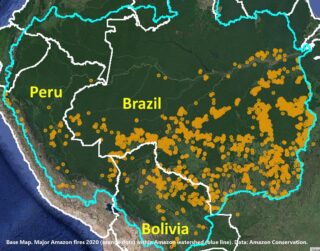
Deforestation and forest fires are a major concern for the department of Cusco, where world-renowned Manu National Park has already lost over 44,000 acres to fires caused by humans. This enormous loss is in part due to about 4,000 head of cattle in the highland areas of the park, where cattle owners burn grasslands to provide young grasses for the cattle. Additionally, in the buffer zone around the park, many communities lack access to cooking fuel and electricity, and instead cut down their forests for firewood.
The heart of the project lies in helping these buffer communities to minimize the use of fire to clear pasture for their cattle and firewood and to create financial and market incentives for them to conserve native forests. A central initiative is to reforest  degraded lands with green firebreaks that are enriched with profitable Andean plant species. Already, ACA has developed fire prevention workshops in partnership with Manu National Park and begun hosting them in local communities.
As part of this grant project, ACA will hold a REDD conference in Cusco on December 3 and 4, 2009. The conference will introduce the concept of REDD to regional government officials, indigenous representatives from the Queros Wachiperi community, and district leaders from the buffer zone of Manu National Park.
Other project activities include firefighting training with Manu National Park guards, construction of plant nurseries, design of pilot REDD projects with communities, and technical support for designing REDD policies in Peru. ACA is also conducting outreach in the United States to policymakers and development funders about the REDD approach in high-forest, low-deforestation countries, such as Peru and Bolivia.
Over the course of the next five years, ACA intends to demonstrate that helping communities build a portfolio of conservation-based industries and connecting them with international and local markets will reduce deforestation pressure on the Andean cloud forest. The project also includes a strong scientific component, extending research already underway on fire frequency,  forest degradation, and greenhouse gas emissions in the Andes. These studies will provide communities with information they need to make good decisions about resource management.
The project is designed as a scalable REDD mechanism that is replicable in other tropical mountain regions and that incorporates strategies to strengthen REDD programs worldwide. Human-caused fire in the tropical Andes is emitting large amounts of CO2, degrading ecosystems, destroying biodiversity, and threatening human livelihoods. Our project can reduce the frequency of fires at the same time it alleviates poverty and conserves healthy watersheds. If you’re interested in learning more, please see our fact sheet (PDF). ACA is currently seeking interested partners and donors for this project. (Photos above by Megan MacDowell and Carmen Giusti.)

 ACA’s Peruvian sister organization, the Asociación para la Conservación de la Cuenca Amazónica (ACCA), recently purchased 7,576 acres of land in southern Peru, thanks to funding from ACA, the American Bird Conservancy, the World Land Trust, and private donors. Located between the Piñi Piñi and Tono Rivers in the Manu Biosphere Reserve, the property is renowned for its incredibly diverse bird population. This acquisition and the creation of a private conservation area by ACCA will help to ensure the long-term protection of the region’s incredible diversity of wildlife. (Photo by Megan MacDowell)
 Bats are among the least understood and most loathed mammals on the planet. Myth and legend paint them as cruel vampires that would not hesitate to drink all the blood from their innocent victims. While it is true that three blood-sucking species exist in the world, they are not as cruel as myths make them seem, and there are many other species that have important roles in their ecosystems. In rainforests in particular, bats control insect populations, serve as pollinators and seed dispersers for numerous plant species, and in some cases regulate populations of small vertebrates, providing balance to the intricate web of life in the forest.
 ACA’s research station functioned as a world-class photo studio for Graham D. Anderson, a leading wildlife photographer, who served as
  “My experience at Los Amigos was fabulous. I am looking forward to my travels to
  The Peruvian Minister of Environment, Dr. Antonio Brack Egg, attended the 8th annual
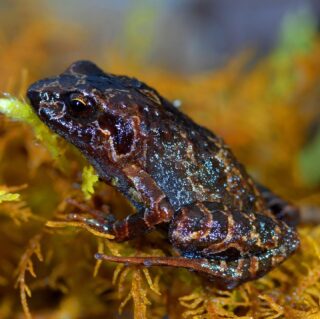
  Scientists have described a new species of frog from ACA’s
  Edgar Lehr from the Senckenberg Natural History Collection in Dresden, Germany and ACA scholarship recipient Rudolf von May from Florida International University’s Department of Biological Sciences describe this new species in the latest issue of the
  On September 7, 2009, ACA/ACCA’s
  Washington-based Amazon Conservation Association will be featured in the
  iology majors at the Universidad Mayor de San Andrés in La Paz, Bolivia have input productivity and physical data into ACA’s Brazil nut tree database for thousands of Brazil nut trees located in northern Bolivia, near Madidi National Park.
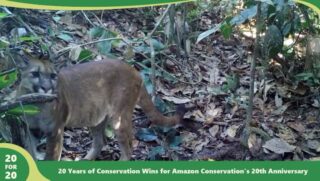
 Photos of animals like the ones here were recorded by three camera traps, each just 250 meters from the CICRA biological station in the Los Amigos Conservation Concession in Madre de Dios, Peru.
 terrestrial mammal.
 Loading...