With the recent transition of executive directors, this is a good opportunity to restate our mission and the strategies we employ to achieve our objectives. Our mission is to conserve the biodiversity of the Amazon. The Amazon covers an enormous area encompassing diverse habitats. This is a bold mission for a small organization like ours. How can we actually achieve conservation success?
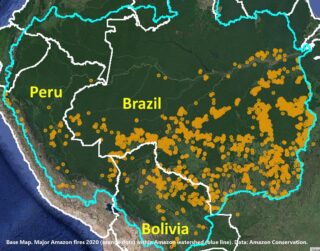
First, let’s set the context. We work in southeastern Peru and northwestern Bolivia on the eastern slope of the Andes, arguably the most biologically diverse region on the planet. Our neighbors include indigenous communities in voluntary isolation, Bolivia’s majestic Madidi National Park, and Manu National Park – the crown jewel of Peru’s national park system. While this region contains a staggering array of biological diversity, it also faces extreme threats. The rapid increase in illegal gold mining combined with the completion of the Interoceanic Highway has wrought enormous change in a remarkably short time frame. These developments have brought a measure of economic improvement to the region, but they have also triggered environmental destruction on a breathtaking scale. Pristine forest has been turned to wasteland and mercury is being dumped into rivers in ever-increasing quantities. At the same time, Bolivia’s highlands face growing development pressures and risks from climate change.
Conserving biodiversity in the face of these threats requires a multi-pronged set of strategies. First, we work diligently to establish protected areas. In the past two years, we have finalized the establishment of conservation concessions covering 47,000 acres, and have another 340,000 acres nearing completion. We’re currently developing an ambitious plan to protect nearly 2,000,000 acres over the next few years. Once established, these areas still have to be managed and monitored, but their susceptibility to threats is reduced substantially.
Second, we work closely with communities throughout the region developing alternative methods for earning a living without using destructive practices. In the lowlands, we’re promoting sustainable Brazil nut harvesting, planting fruit trees and cacao, developing small-scale fish ponds, and fostering ecotourism. In the highlands we’re reforesting degraded lands with sustainable wood that local communities can use for building and heating their homes, and working to develop protein-rich products like tarwi (a native high-protein seed) as a sustainable food source.
 Third, we use scientific analysis to underpin our strategies and solutions. We’ve measured the mercury content in numerous fish species to educate the public on health hazards. We’ve studied the impact of unmanaged livestock on cloud forest regeneration. We’ve meticulously mapped out hundreds of Brazil nut trees and other keystone species to create management plans to protect these resources and the surrounding forests. We’re testing biochar (charcoal made from fast-growing bamboo) as a natural alternative to fertilizers to improve soil fertility and thereby increase productivity for local farmers.
Our three biological stations in Peru, strategically located in the cloud forest, mid-elevation, and the Amazonian lowlands, are a key platform for achieving conservation. These stations enable us to engage local communities over a sustained timeframe and to concentrate scientific research on issues ranging from describing new species to developing a replicable biodiversity monitoring program to analyzing the effects of climate change. They also are centers where researchers, local and international students, tourists, and members of the community can collaborate and exchange ideas.
Finally, we address the threats themselves. We’re advocating for offshore-inland pipeline construction, a roadless construction technique to reduce deforestation. We’re fighting illegal logging and mining through improved governance by providing decision-makers with better information and participating in regional-level planning. We’re increasing local capacity for land management, supporting local and regional government institutions, and providing leadership to regional efforts to respond to forest fires and create conservation finance mechanisms.
All of our efforts are designed to be scaled up, so even though we’re working in a specific geography in Peru and Bolivia, our vision is to create models that can be replicated throughout the Amazon basin. This work is complex and difficult but deeply rewarding. We could not achieve our successes without your support. Thank you all for your interest and your generosity in enabling us to conserve the Amazon.
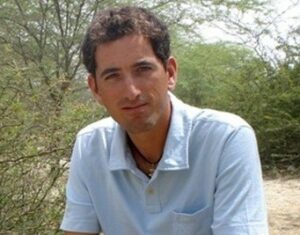
(Text by Jeff Woodman; photo of Jeff by Ronald Catpo; waterfall photo by Gabby Salazar)

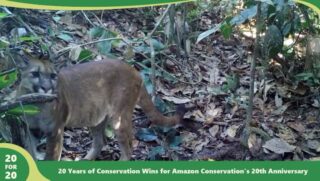
 On a Sunday morning hike this February, ACA Science Director Dr. Adrian Tejedor and others had the privilege of an exciting wildlife encounter at ACA’s Villa Carmen Biological Station. Located in the Manu Biosphere Reserve, the station hosts a wide variety of habitats and is esteemed for its diverse flora and fauna – including big cats!
  From August 19 to 29, the Amazon Conservation Association (ACA) hosted its second annual
  On June 4, 2012, Peru’s first trust fund for a conservation concession was officially created to protect and conserve the
  general director of forestry and wildlife at Peru’s Ministry of Agriculture, spoke in appreciation of the fund, stating that “this is a great accomplishment for the Ministry of Agriculture to have a concession – in this case, Los Amigos – obtain a trust fund that provides a long-term horizon for the development of activities. This experience is a first for conservation concessions, and I believe it is a symbol of good things to come in the future.”
 Anne Lambert, managing director of the ICFC, spoke of the important role the LACC plays in the research and conservation of the region, and about how institutional strengthening of conservation organizations is crucial for ensuring sustained environmental protection. The trust fund will provide the financial resources needed by ACA and ACCA to vigilantly and efficiently protect the LACC from illegal logging, mining, and other threats.
 The
The 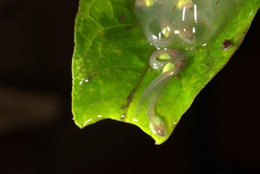
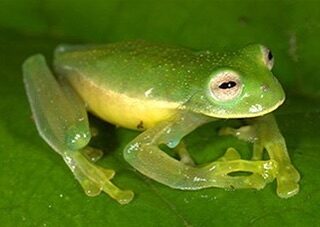
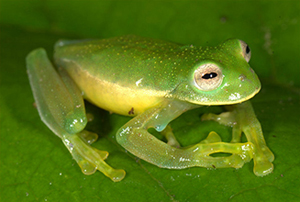
 The team was led by Wayqecha’s research coordinator Alessandro Catenazzi (pictured here) of San Francisco State University. Catenazzi has studied frog populations in and around the Wayqecha Biological Station for over a decade, documenting the decline in frog diversity and populations. A 40 percent loss of frog diversity over the last decade has been documented in the cloud forests around Wayqecha, with aquatic-breeding frogs experiencing the greatest decline. While following patterns of biodiversity loss worldwide, in this instance the decline of glass frogs is likely caused by the recent expansion of the chytrid fungus into the area.
 The highland community of Japu created this 46,196-acre reserve in Peru’s Cusco department; this indigenous community is part of the Q’eros Nation, whose residents are said to be the closest living descendants of the Incas. The rich montane forests of the Ukumari Llaqta PCA are home to an extraordinary number of species, many threatened by habitat loss, including the spectacled bear, Andean fox, and white-tailed deer. The area ranges from Andean highlands to Amazonian foothills, and ensures a refuge for those species expected to be forced to migrate upslope to escape the impacts of climate change.
 The 406-acre Pumataki PCA is located within the territory of the Pillco Grande community in the department of Cusco and shares its eastern border with the southern tip of world-famous Manu National Park. These grassland and cloud forest ecosystems are home to hundreds of species—many of them endangered, such as the spectacled bear and the puma—and also contain the headwaters of the Pilcomayo River. The Pillco Grande community, which began efforts to develop the PCA in 2009, is interested in carrying out environmentally-friendly ecotourism and research activities. Located within an area of rapid deforestation and land-use change, the community has a strong commitment to reducing threats to the area from forest fires, logging, and agricultural expansion so that future generations can receive benefits from these communal forest resources.
 The 57-acre San Juan Bautista PCA, located in the buffer zone of the Tambopata National Reserve in the department of Madre de Dios, was added to Peru’s National System of Protected Areas by a local family. They wish to preserve forests on their land for their grandchildren and carry out ecotourism and provide research and education opportunities within their PCA. This very recent addition to the National System of Protected Areas will help to guarantee conservation efforts in this brilliantly diverse region that is part of the
  Conservation Association’s conservation programs are complemented by the work of ethnomusicologist
 Over the next two years, Dr. Wissler will work to create an archive of Wachiperi songs and text. Much of the present archive is in existence thanks to the hard work of anthropologist Dr. Patricia Lyon, who recorded the songs of the Wachiperi community in 1964 and 1965. In addition to the archive, a website will be created and a two-disc CD set will be produced, making certain future generations will be able to hear their ancestors’ voices and learn the songs themselves. Watch a video about her project
 support to 70 small landowners who are threatened by illegal gold mining and logging.
 In one of the most diverse regions on the planet, Amazon Conservation Association (ACA) has partnered with the Institute for Peruvian Amazon Studies (IIAP, in Spanish) to support local aquaculture and agroforestry ventures. As part of this project, we are working with several communities along the
  source of employment for local fishing communities. The region’s abundant water supply, fish biodiversity, and appropriate climate make the Amazonian lowlands well-suited to aquaculture development, allowing small family farms to produce a highly marketable source of protein and improve their own food security. Not only does farming of native river species reduce pressure on wild fish populations, but it provides small farmers with a sustainable, profitable alternative to slash-and-burn farming or gold mining.
  In addition to the pressures of overexploitation of native fish species, the recent rise in illegal gold mining in Madre de Dios has caused an increase in the contamination of river fish by mercury, a potent neurotoxin used to extract gold.
  From August 11th to the 22nd of 2011, the Amazon Conservation Association (ACA) hosted its first-ever
 Loading...