Earth Month 2026: Celebrating the Power of Collective Action this Earth Day

Happy Earth Day!

Today is a reminder that protecting our planet is both a shared responsibility and a powerful opportunity to make a difference together.

This Earth Month, we have been sharing stories that show what the Power of Collective Action looks like in practice. From technology to policy, from data to community action, these efforts demonstrate how your support helps mobilize conservation impact at scale across the Amazon.

The Impact of Collective Action

What does the impact of the Power of Collective Action look like?

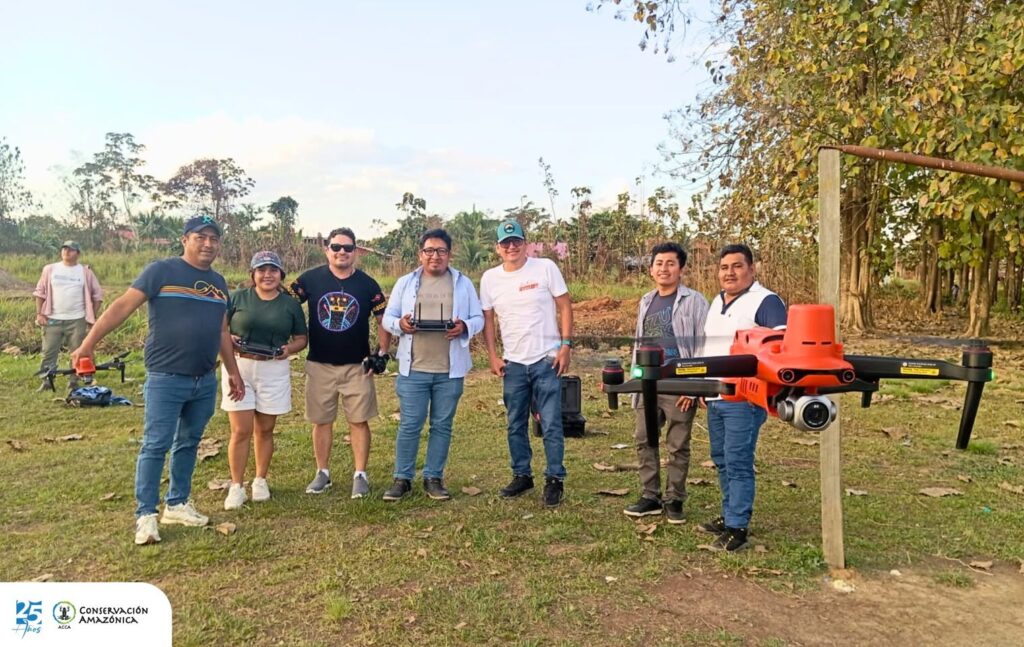
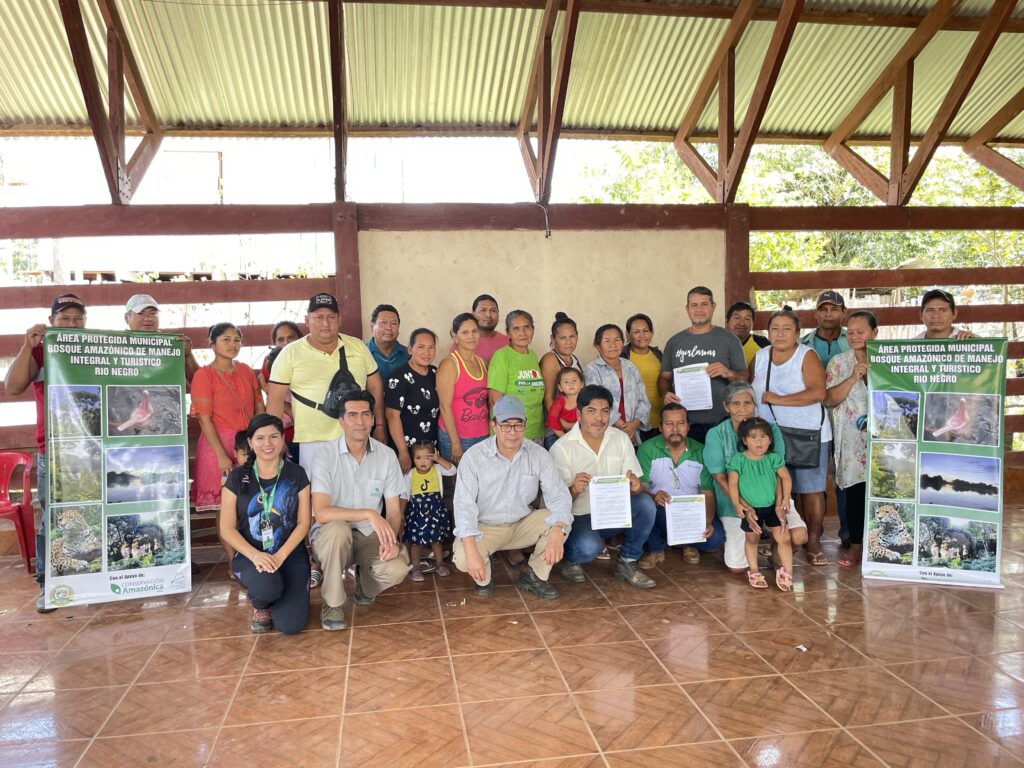
It looks like sustained partnerships on the ground, including our 25‑year alliance with Conservación Amazónica‑ACCA in Peru and our 15‑year alliance with Conservación Amazónica‑ACEAA in Bolivia. This long‑standing Alliance has built the foundation for monitoring, protecting, and restoring critical rainforest landscapes with a committed network of partners across the region. 

It also looks like our 6-year partnership with Fundación EcoCiencia in Ecuador, where we are working together to tackle one of the Amazon’s most complex challenges: illegal gold mining. Illegal gold mining is not a problem unique to Ecuador, nor is it one that will be effectively resolved with solely local action.

In words from Carmen Josse, Executive Director of Fundación EcoCiencia, we are detecting illegal mining and working toward policy solutions that confront the problem at its root.


This is the power of mobilizing conservation at scale: organizations, communities, and experts coming together to protect the Amazon, at the scale it demands.

Ways You Can Take Action

One of the most impactful ways to show your commitment to Mother Earth, or Pachamama, is to support the work happening on the ground. 

Your gift today can:

  • drive down illegal deforestation by supporting the use of real-time satellite monitoring, ensuring forests are protected before damage becomes irreversible.
  • turn data into impact by deepening analysis and amplifying research so that local stories reach headlines, influence policy, and inspire global action.
  • strengthen community leadership by empowering Indigenous and local partners to safeguard critical forests and lead conservation efforts across the Amazon.

Stories of Impact to Celebrate Earth Day

Your support fuels the work we’ve been highlighting throughout Earth Month:

  • From Data to Headlines: Your support ensures that critical information about deforestation reaches the public and decision‑makers. By transforming data into stories that capture global attention, we can influence policy and inspire action at the scale the Amazon requires. 
  • When Technology Meets Action: Your gift helps drive down illegal deforestation by supporting the use of satellite technology and on‑the‑ground monitoring. These tools allow us to detect threats quickly and respond effectively, protecting rainforest ecosystems before damage becomes irreversible.

These are the kinds of tangible outcomes made possible when donors like you invest in conservation.


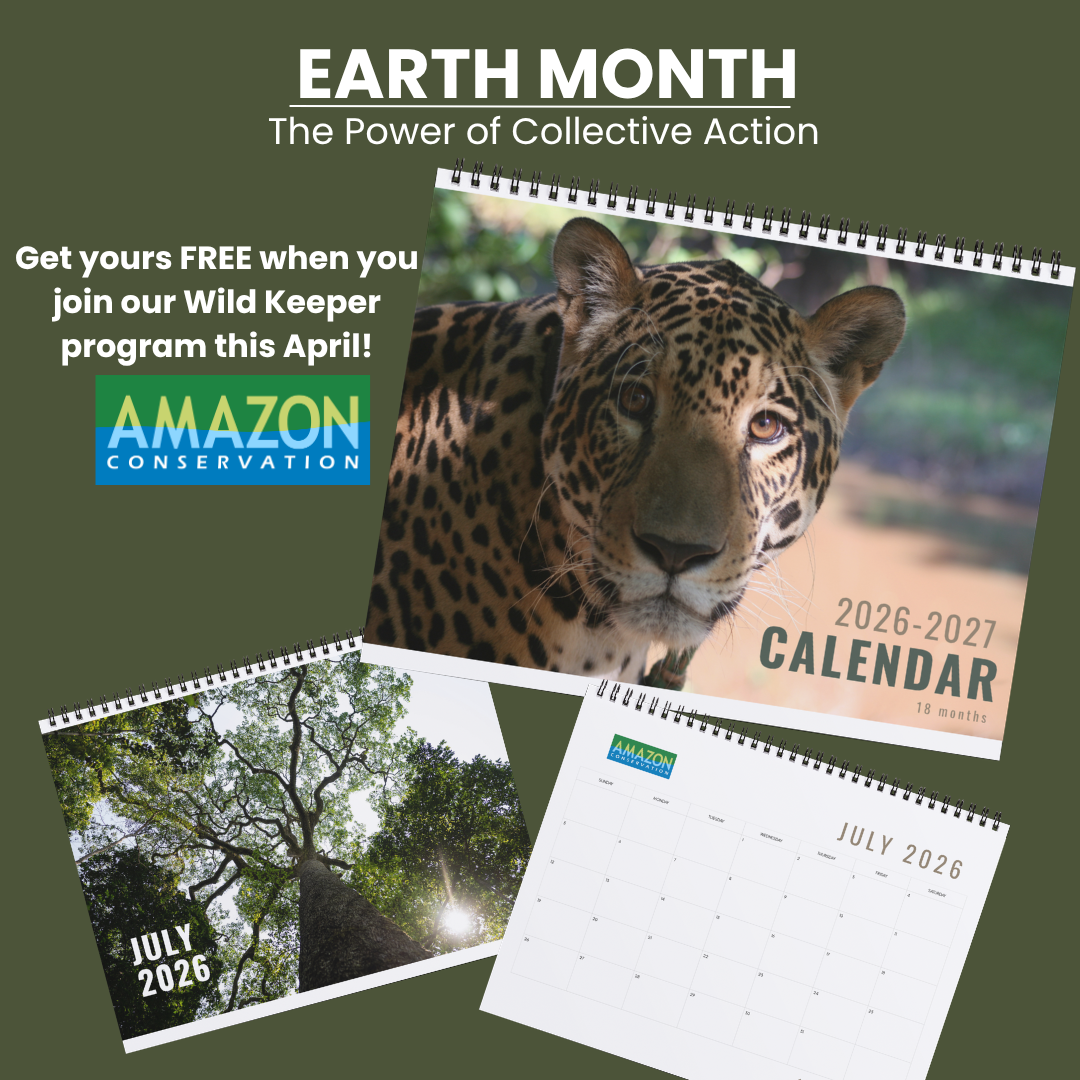
Sign up for a monthly gift of $10 or more this April* for a special bonus gift: an 18‑month wall calendar with breathtaking photos of the incredible landscape where we work! (Note: signing up in April serves as a pre‑order; calendars will be mailed out in June. This offer is for new and existing monthly donors whose gifts are active at time of shipping. Design pictured is for promotional purposes; final calendar may vary. Shipping is limited to the United States and Canada.)


A Special Earth Month Offer:

New monthly donors* receive a special gift as a thank-you for joining our collective effort!
Click to learn more.

*Please note: You must provide a mailing address when you sign up to take advantage of this limited-time offer. Signing up in April serves as a pre-order; calendars will be mailed out in June. This offer is for new and existing monthly donors whose gifts are active at time of shipping. Shipping is limited to the United States and Canada.

Here are 6 ways you can show your support for Earth Day:

  1. Make a Gift: The quickest, easiest, and perhaps most impactful way to show your support this Earth Month is to make a gift to Amazon Conservation. Click here to make a gift through our secure online platform or check out our Ways to Give.
  2. Become a Wild Keeper and Get a Free Gift: Join our global community of sustaining donors who commit to the Amazon with impact that is consistent, easy, and manageable through automated month gifts. Sign up for a monthly gift of $10 or more this April* for a special bonus gift: an 18-month wall calendar with breathtaking photos of the incredible landscape where we work!
    *Please note: You must provide a mailing address when you sign up to take advantage of this limited-time offer. Signing up in April serves as a pre-order; calendars will be mailed out in June. This offer is for new and existing monthly donors whose gifts are active at time of shipping. Shipping is limited to the United States and Canada.
  3. Start Your Own Earth Month Fundraiser: Harness the power of your community by getting your family and friends to join together for this cause. We can do more together than we can alone. Create your personalized, shareable online fundraiser here!
  4. Explore a Business Partnership: Connect your employees and align your company with impactful conservation by supporting our work through in-kind or financial support, event sponsorship, and more. We would love to chat with you and tailor a custom sponsorship package that match your business’s specific goals.
  5. Follow Along on Social Media (Instagram | Facebook | LinkedIn): Connect with us to stay up to date on our work and on the situation on the ground in the Amazon. Interact with and reshare our content to help spread our message!
  6. Make Amazon Conservation a Part of Your Legacy: Legacy gifts ensure that your commitment to conservation continues far into the future, safeguarding forests, wildlife, and communities. Through our partnership with FreeWill, you can create a will for free in just 20 minutes and easily designate a gift to Amazon Conservation as part of the process. Learn more and start your free will today to make a lasting impact.


This Earth Month, we invite you to be part of something bigger. 

Together, we have the power to protect the Amazon, and our planet.


Amazon Mining Policy Scoreboard: the latest findings

Learn more about the latest findings for Perú on the Amazon Mining Policy Scoreboard


Executive Summary

Peru ranks second among five Amazonian countries in the
Amazon Mining Policy Scoreboard, scoring 11.7 out of 15, and achieves the highest regional score in investigation and law enforcement. The country has built a solid legal and institutional architecture: clear definitions distinguishing lawful from illegal mining, prohibitions on dredges and mercury in waterways, due-diligence obligations for gold buyers, a publicly accessible mining cadaster, and specialized prosecutorial units dedicated to environmental crimes. These foundations reflect a genuine and comparatively advanced policy commitment to regulating artisanal and small-scale gold mining (ASM).

This strong performance on paper stands in contrast with conditions on the ground. Illegal mining has continued to expand dramatically, with affected areas growing by 66.9% between 2023 and 2025, deforestation surpassing 139,000 hectares by mid-2025 and new mining frontiers emerging across multiple Amazonian regions. The main driver of this paradox is the relentless rise in international gold prices, which has heightened the economic incentives for illegal extraction, far beyond the deterrent effect of existing regulations and enforcement actions.

However, the gap between regulatory intent and practical impact is also structural: the formalization registry (REINFO) has operated more as a mechanism for tolerating informality than as a genuine pathway to legality, traceability across the gold supply chain remains deeply fragmented, and mining interests have become entangled with subnational governance in ways that undermine enforcement.

To close this implementation gap, the report calls on the Peruvian government to pursue a set of priority reforms, including establishing a national registry of heavy machinery with mandatory GPS tracking; introducing fixed validity periods for ASGM concessions subject to periodic environmental review; auditing and redesigning the REINFO; and developing fiscal incentives and accessible credit to promote mercury-free technologies.

Peru’s criteria-based scores reflect a country that has designed much of the right framework — but where implementation deficit, structural traceability gaps, and the relentless pull of high gold prices continue to fuel one of the most severe illegal mining crises in the Amazon.


Resumen Ejecutivo

Perú ocupa el segundo lugar entre cinco países amazónicos en el Tablero de puntuación de las Políticas Mineras en la Amazonía, con una puntuación de 11,7 sobre 15, y obtiene la puntuación regional más alta en investigación y aplicación de la ley. El país ha construido una sólida arquitectura legal e institucional: definiciones claras que distinguen la minería lícita de la ilegal, prohibiciones sobre dragas y mercurio en cursos de agua, obligaciones de debida diligencia para los compradores de oro, un catastro minero de acceso público y unidades fiscales especializadas dedicadas a los delitos ambientales. Estos fundamentos reflejan un compromiso político genuino y comparativamente avanzado en la regulación de la minería artesanal y en pequeña escala (MAPE).

Este sólido desempeño sobre el papel contrasta con las condiciones sobre el terreno. La minería ilegal ha seguido expandiéndose de manera dramática: las áreas afectadas crecieron un 66,9% entre 2023 y 2025, la deforestación superó las 139.000 hectáreas a mediados de 2025 y surgieron nuevas fronteras mineras en múltiples regiones amazónicas. El principal motor de esta paradoja es el aumento implacable de los precios internacionales del oro, que ha intensificado los incentivos económicos para la extracción ilegal, muy por encima del efecto disuasorio de las regulaciones y acciones de fiscalización existentes.

Sin embargo, la brecha entre la intención regulatoria y el impacto práctico también es de carácter estructural: el registro de formalización (REINFO) ha operado más como un mecanismo de tolerancia a la informalidad que como una vía genuina hacia la legalidad, la trazabilidad a lo largo de la cadena de suministro del oro sigue siendo profundamente fragmentada, y los intereses mineros se han entrelazado con la gobernanza subnacional de formas que socavan la fiscalización.

Para cerrar esta brecha de implementación, el informe insta al gobierno peruano a impulsar un conjunto de reformas prioritarias, entre ellas: establecer un registro nacional de maquinaria pesada con seguimiento GPS obligatorio; introducir plazos de vigencia fijos para las concesiones de MAPE sujetos a revisión ambiental periódica; auditar y rediseñar el REINFO; y desarrollar incentivos fiscales y crédito accesible para promover tecnologías libres de mercurio.

Las puntuación por criterios de Perú refleja un país que ha diseñado gran parte del marco normativo adecuado, pero donde el déficit de implementación, las brechas estructurales de trazabilidad y el atractivo implacable de los altos precios del oro continúan alimentando una de las crisis de minería ilegal más graves de la Amazonía.


Earth Month 2026: When Technology Meets Action

Driving Down Illegal Deforestation in the Amazon

Illegal deforestation in the Amazon often moves faster than governments can respond, especially in remote Indigenous territories affected by illegal gold mining. Over the past five years, Amazon Conservation’s Technology Meets Policy initiative worked to close that gap by linking real-time monitoring with coordinated enforcement and stronger governance. Indigenous leadership and strengthening of local partners through technology transfer were central to this effort, because ancestral and territorial knowledge is often what transforms data into real protection on the ground.

As we continue sharing stories throughout Earth Month, we highlight these partnerships. When cutting-edge tools meet strong collaboration, data becomes more than information, it becomes a driver of real change. This is where the power of collective action comes to life, connecting science, partners, and communities to protect the Amazon at scale.

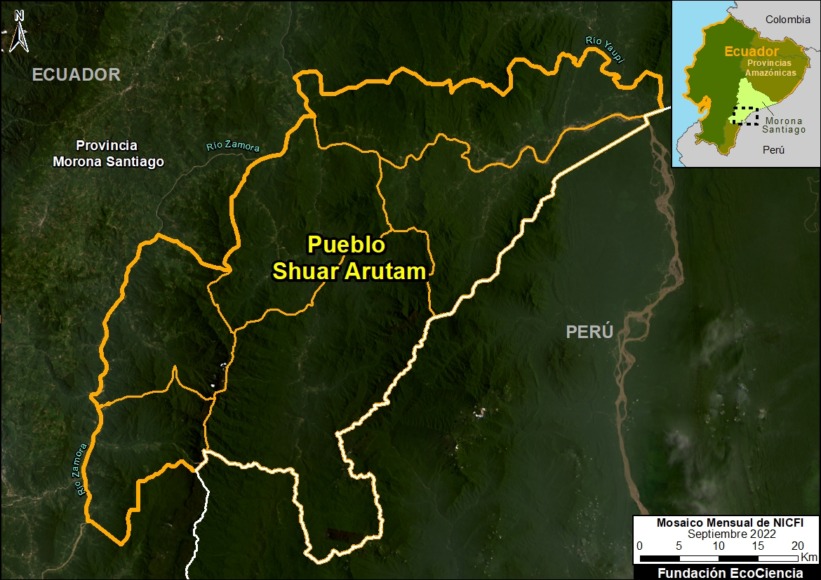
The results are measurable and reflected in concrete enforcement actions. Illegal deforestation dropped significantly across Indigenous territories supported by the project. In Peru, deforestation fell 43% across FENAMAD beneficiary communities compared to 2020 levels. In Ecuador, deforestation also declined in Waorani and Shuar Arutam territories over the same period. These gains reflect improved detection and stronger coordination among Indigenous leaders, civil society organizations, and government authorities responding to illegal mining and other drivers of forest loss.

Closing the gap between detection and enforcement

Illegal mining and forest clearing can expand quickly, while investigations, coordination, and legal processes often lag behind. This project addressed these challenges by connecting Amazon Conservation’s MAAP (Monitoring of the Andes Amazon Program), which delivers high-resolution, timely satellite analysis, with strengthened Indigenous territorial monitoring, legal collaboration, and improved government coordination.

Satellite alerts did not remain data points. Community monitors translated them into documented evidence, supported through legal channels, and shared through confidential intelligence reports with environmental agencies, prosecutors, and police. In Peru, the project strengthened and helped decentralize the National System of Monitoring and Control, an inter-institutional mechanism that supports faster coordination among environmental, prosecutorial, police, and other authorities to respond to forest crime. In Ecuador, Fundación EcoCiencia now leads 100% of MAAP’s real-time monitoring nationally, reinforcing independent civil society leadership and sustained collaboration with public institutions.

Through sustained collaboration, technical exchange, and joint analysis, local partners deepened their ability to interpret satellite data, document cases, navigate legal pathways, and engage directly with public authorities. In Peru, this included close coordination with FENAMAD to reinforce Indigenous leadership in territorial defense. In Ecuador, collaboration with Fundación EcoCiencia helped institutionalize an independent national monitoring capacity. Together, these efforts strengthened governance systems that can respond to forest crime over time.

From satellite image to government response

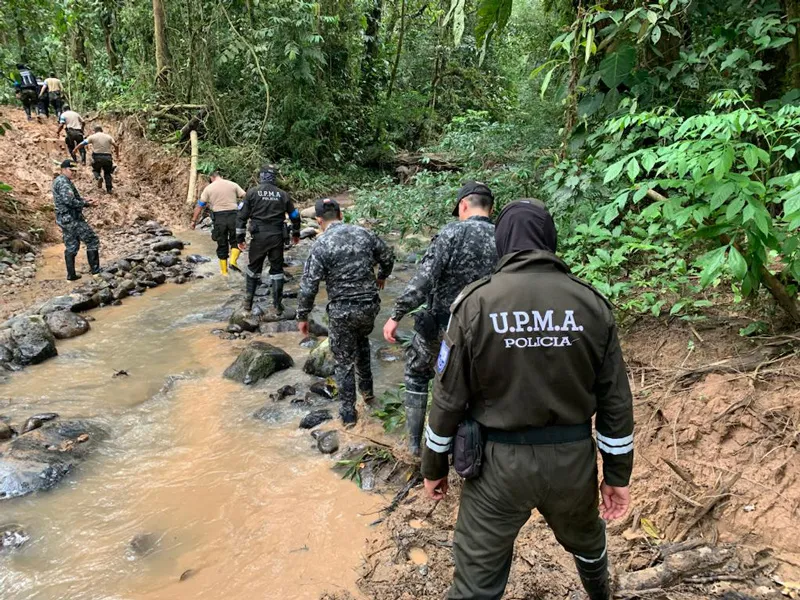
By linking monitoring to action, MAAP analysis supported concrete enforcement efforts, including, for example, Ecuador’s Operation Manatí III in 2023, which covered 8,500 acres (about 3,500 hectares) and resulted in the seizure of excavators and mining equipment. In Peru, timely confidential reports and Indigenous-led monitoring supported investigations and government operations in high-risk areas affected by illegal gold mining.

For communities facing invasions into their territories, satellite imagery, photos, and field documentation strengthen legal pathways and reinforce safeguards for environmental defenders operating under increasing pressure. As Julio Cusurichi Palacios, Indigenous leader from the Peruvian Amazon and former president of FENAMAD, explains, “The information is very important because in one way or another it supports what one can make known. If there is an invasion in a community’s territory, it can be relayed by phone, but it is much better when there is photographic or video evidence.”

The project also contributed to policy progress. In 2025, Ecuador advanced its Organic Law to Strengthen Protected Areas, reinforcing the legal framework governing protected areas. Across both countries, Indigenous organizations, civil society partners, and public authorities worked to ensure that monitoring insights could move through institutional channels and prompt timely responses.

What comes next

The results show that technology alone does not reduce illegal deforestation. Impact comes when timely data is paired with Indigenous leadership, coordinated civil society engagement, and institutions prepared to respond.

Building on this five-year foundation, supported by the Norwegian government through Norad and its International Climate and Forest Initiative (NICFI), and as MAAP marks its 10th anniversary, Amazon Conservation is now scaling this approach, with our Norwegian partners continuing to support the next phase of this work.

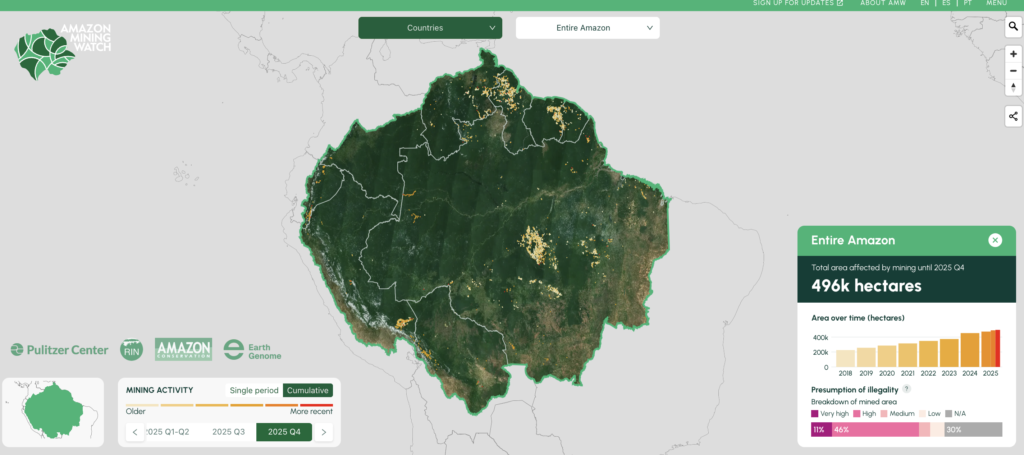
In addition to continuing efforts in Peru and Ecuador, the expansion now includes Bolivia, strengthening Indigenous and civil society leadership while broadening coordinated monitoring and enforcement across priority regions of the Amazon. Timely detection of mining-driven deforestation, together with Amazon Mining Watch, a new AI-based monitoring platform that tracks mining-related deforestation across the Amazon, will further reinforce basin-wide efforts to address forest crime.

For Indigenous peoples and local communities, this work is about rights, safety, and the ability to defend territories for future generations. As Marco Martinez, Territorial Executive of the Shuar Arutam Indigenous Community of Ecuador, put it: “The Shuar Arutam will always fight because that is our right. To those who want to silence our voice, behind me stand other generations, our children’s children, and all the Indigenous peoples of the world who will continue fighting against those who threaten our communities.”

Working alongside Conservación Amazónica ACCA in Peru, Fundación EcoCiencia in Ecuador, and the Federación Nativa del Río Madre de Dios y Afluentes FENAMAD, this collaboration strengthened regional coordination to turn monitoring into action. With continued support from the Norwegian government’s International Climate and Forest Initiative NICFI, the initiative is now expanding to Bolivia through Conservación Amazónica ACEAA.


Regional partners:
           

Supported by:


Implemented by:


This Earth Month, we invite you to be part of something bigger. 

Together, we have the power to protect the Amazon, and our planet.
 

Earth Month 2026: From Data to Headlines

How Amazon Conservation and the Pulitzer Center are using Amazon Mining Watch to track illegal gold mining and make data accessible for journalists

Protecting the Amazon Rainforest at scale goes beyond compiling data. It requires collaboration across borders, organizations, policymakers, people, and diverse audiences, especially with those who help bring critical issues into the public eye.

As part of our Earth Month campaign, The Power of Collective Action: Mobilizing Conservation at Scale Across the Amazon, we are highlighting how partnerships help turn knowledge into action. One example is our collaboration with the Pulitzer Center, a U.S.-based news media organization that raises awareness about underreported global issues and sponsors independent reporting. Together, we are working to ensure that timely, high-quality information about illegal gold mining reaches journalists, decision-makers, and the public in order to help drive awareness, accountability, and action across the region.

“Partnerships like this expand our work as a trusted source of scientific data and resources, helping ensure that journalists have access to reliable and timely information to inform their reporting,” said Priscila Steffen, Communications and Public Relations Manager at Amazon Conservation.


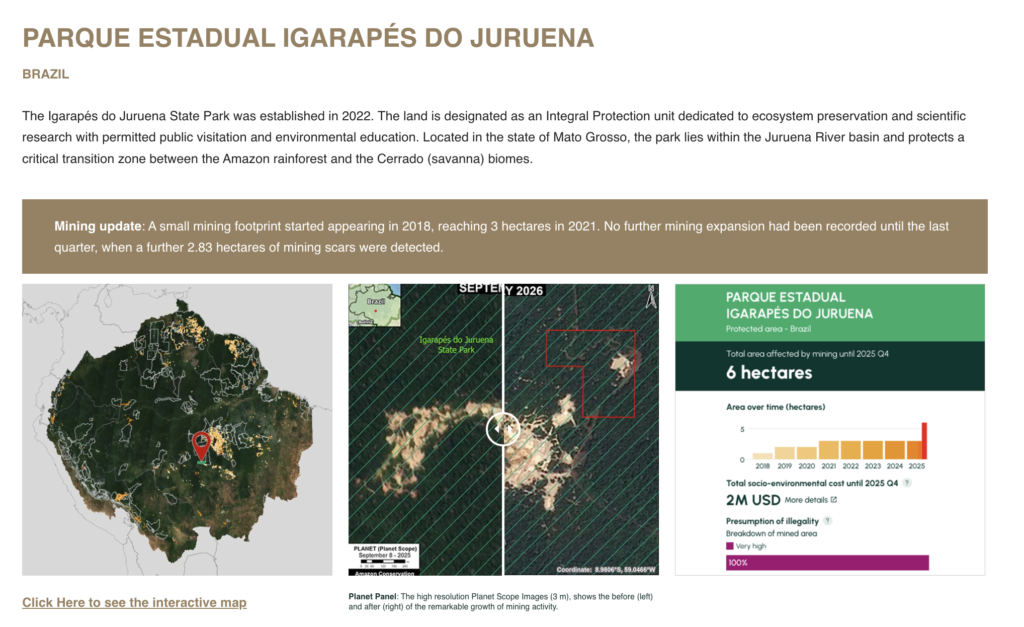
The recent launch of the Amazon Mining Watch’s Panorama reporting series marks a major step forward in making complex data more accessible and actionable. The inaugural report covering October through December 2025 revealed that in just these three months, approximately 6,000 hectares (14,000 acres) of forest were lost to gold mining across the Amazon, a stark reminder of the speed and scale of this growing threat. But data alone does not create change. Through our partnership with the Pulitzer Center, this information is being translated into stories that reach global audiences and bring local realities to international attention. By combining satellite-based monitoring with data-driven and investigative journalism, we are expanding public awareness of illegal mining as a transboundary issue that affects ecosystems, Indigenous territories, and communities across the entire Amazon Basin.

“At the Pulitzer Center, we believe in inspiring action to protect the Amazon Rainforest through collaborative, breakthrough journalism that goes beyond the headlines. We leverage powerful tools, such as Amazon Mining Watch, to transform data into stories that empower communities, promote transparency, and foster stronger governance and collaboration among stakeholders,” shared Jonatan Rodriguez, Program Manager for Latin America at the Pulitzer Center.

A key pillar of this collaboration is equipping journalists with the tools and knowledge needed to investigate and report on illegal mining. The Pulitzer Center is supporting journalists in learning how to use the Amazon Mining Watch platform to identify leads, investigate trends, and uncover stories that might otherwise remain hidden. This approach strengthens not only individual reporting, but also the broader ecosystem of environmental journalism to enable consistent, data-driven coverage of illegal gold mining, one of the Amazon’s most urgent challenges.

This collaboration also extends beyond reporting by individual journalists and media outlets. During a recent regional meeting in Colombia organized by Amazon Conservation and our partners on our Combating Illegal Mining project and thanks to support from the Gordon and Betty Moore Foundation, the Pulitzer Center shared tools for and approaches to collaborative journalism with partners from across the Amazon.

These resources, including a guide on cross-border reporting and “journalistic symbiosis,” are designed to help journalists collaborate more effectively, with civil society sharing data, insights, and narratives that reflect the interconnected nature of the Amazon Rainforest, while also encouraging forward-thinking journalism and projects with extended impact to help protect this vital ecosystem. 

This close partnership is key to amplifying the impact of collective action through Amazon Mining Watch. By bringing together scientists, technical experts, and journalists, we are not only improving how information is generated, but also how it is shared, understood, and used. Protecting the Amazon at scale depends on making the invisible visible and on working together to turn knowledge into action. 

About Amazon Mining Watch
Developed through a partnership between Amazon Conservation, Earth Genome, and the Pulitzer Center, the Amazon Mining Watch platform aims to strengthen transparency and help decision-makers respond more effectively to illegal gold mining, one of the Amazon’s fastest-growing drivers of deforestation, as well as to help international media report on the escalating threats to nature, people, and wildlife.


This Earth Month, we invite you to be part of something bigger. 

Together, we have the power to protect the Amazon, and our planet.