View the PDF here
WASHINGTON, DC (April 17, 2014)—The megadiverse Peruvian Amazon is a globally important arena when it comes to promoting sustainable logging. Despite efforts to achieve sustainability, including a modern Forestry Law and an important Forestry Annex in the US–Peru Trade Promotion Agreement, illegal logging continues to plague the region.
These instruments reformed the legal logging concession system – which allows the Peruvian government to grant long-term contracts for logging rights on specific tracts of public land – and the seemingly comprehensive regulatory framework to manage it. There are currently 609 logging concessions in the Peruvian Amazon.
In a new study published today in the open-access journal Scientific Reports, researchers found that 68% of officially inspected concessions are either cancelled or under investigation for major violations of forestry regulations. Moreover, the nature of the violations indicates that the permits associated with legal concessions are used to harvest and transport trees in unauthorized areas.
“Our new study presents evidence that the legal logging concession system is in reality enabling an illegal logging crisis in the Peruvian Amazon despite important reform efforts,” said Matt Finer of the Amazon Conservation Association. “As a consequence, logging is not contained to concessions, and instead, it threatens all forested lands, including protected areas and indigenous territories.”
The findings derive from analyzing nine years of official information from OSINFOR1 , the supervisory body in Peru that conducts post-logging inspections. In the majority of inspected concessions, OSINFOR documented: timber extraction outside of concession limits, extraction or transport of illegal timber, non-compliance with management plans, and submission of false or incomplete information.
Many of the violations pertain to the illegal extraction of threatened cedar species that are listed under the Convention on International Trade in Endangered Species of Wild Fauna and Flora (CITES), which aims to ensure that international trade in species does not threaten their survival.
“Overall, we found a troubling, yet common, pattern indicating that legal logging permits are often used to facilitate the extraction and transit of timber outside the concession area,” said Melissa Blue Sky of the Center for International Environmental Law.
Through the analysis of reports of inspected concessions, the study found that logging concession owners often indicate the presence of abundant timber, particularly cedar, in their management plan and then claim authorized logging took place. However, when OSINFOR eventually inspects the concession area, they often find that the information in the management plan was false because there are no stumps of the supposedly harvested trees.
“Despite important reforms, much of the timber coming out of the Peruvian Amazon is still likely sourced outside of authorized concession areas,” said Clinton Jenkins of the Instituto de Pesquisas Ecológicas in Brazil. “More reforms and enforcement of regulations are obviously still needed.”
Another key finding of the study is that OSINFOR’s regulatory work is critically important to improving the concession system. “OSINFOR deserves additional support, not less, as the office is increasingly criticized by loggers whose concessions have been canceled,” said Finer.
A new Forestry Law was passed in July 2011, but has not yet gone into effect due to delays in the adoption of the implementing regulation. “Unfortunately, the new 2011 Forestry Law and implementing regulation, which is under development, currently fall short of what is needed to address this problem,” said Blue Sky.
++++++
CONTACT Matt Finer (Amazon Conservation Association) mfiner@amazonconservation.org, Tel: 202-234-2356
Clinton N. Jenkins (Instituto de Pesquisas Ecológicas) clinton.jenkins@gmail.com
Melissa Blue Sky (Center for International Environmental Law) mbluesky@ciel.org
Justin Pine (Northern Arizona University) jrp263@nau.edu
Amazon Conservation Association (ACA) and its sister organization in Peru, Conservación Amazónica-ACCA, have been pioneers in conserving biodiversity in the southwest Amazon since 1999. They seek to preserve the world’s richest forests, train the next generation of Amazonian conservationists, and help people in the Amazon live better lives through sustainable means.
Center for International Environmental Law (CIEL) uses international law and institutions to protect the environment, promote human health, and ensure a just and sustainable society. CIEL is a non‐profit organization dedicated to advocacy in the global public interest, including through legal counsel, policy research, analysis, education, training and capacity building.
The Instituto de Pesquisas Ecológicas (IPÊ) is one of the largest environmental NGOs in Brazil with over ninety professionals working in more than forty projects throughout Brazil. IPÊ undertakes an integrated action model, developed through decades of experience, which combines research, environmental education, habitat restoration, and community involvement with sustainable development, landscape conservation and policy-making.
1 Organismo de Supervisión de los Recursos Forestales y de Fauna Silvestre

 Earlier this year, ACCA (ACA’s Peruvian sister organization) signed a formal cooperative agreement with Cusco’s regional government to support the creation of two new regional protected areas, Urusayhua-Koshireni and Ausangate. As part of this partnership, ACCA will also support the regional government in the management of the Choquequirao Regional Conservation Area, a span of forest which includes ancient Incan ruins just 30 miles from Machu Picchu.
  partnership will offer additional protection for close to 2 million acres of forested and culturally significant land.

 For 11 communities in Challabamba,
 Meet Marisabel Dumas Ramos, the first female leader of the indigenous Matsigenka-Wachiperi community of Santa Rosa de Huacaria in southern Peru.
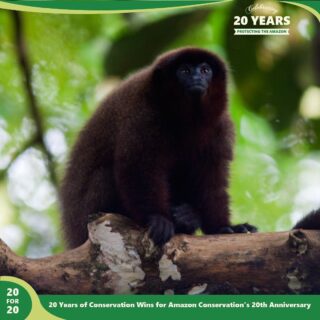
 Sadly, the gray woolly monkey pictured is endangered.
 Pilcomayo—children of loggers who moved near Manu’s Andean slope decades ago—to create a new 12,040-acre conservation concession.
 Today ACA’s
  In just three years, Villa Carmen has established itself as a bustling hub for scientists and conservationists. Over 150 researchers have visited the station from institutions around the world, cataloguing more than 590 species of plants and animals, and leading 38 research projects to date, studying everything from native fish and
  Villa Carmen is also a living laboratory for best practices in sustainable agriculture, and shares lessons learned with residents from surrounding communities. Villa Carmen grows its own local organic crops, while researchers study ways to enhance soil fertility using biochar. Last year, Villa Carmen hosted an international workshop on sustainable agriculture where world experts and local Amazonian farmers shared techniques and experiences.
 Villa Carmen’s
  Innovations in Biochar
 Around ACA’s
 Article contributed by
  Cameras clicked as a sleek and swift Tayra, a South American weasel, stole to the same feeder to grab mouthfuls of a Red-Capped Cardinal’s bananas.
 Thompson’s two trips have this mission: to create flocks of birders devoted to protecting biological hot spots in Peru’s Amazon Basin and in Costa Rica’s pristine Osa Peninsula. Since 1992, Craig has used his vacation time to gather friends of feathers together to personally experience tropical rainforests.
 Taking a trip to the Osa Peninsula or to Peru links Wisconsin and Michigan citizens and our avian denizens to our southern neighbors. Projects supported include monitoring over-wintering survival of Wisconsin birds in tropical forests, purchasing property to enable construction of a field station and ecolodge, and cloud forest and dry forest protection and restoration. Investing in these projects has brought incalculable returns to “our” Midwest birds who migrate to Latin America each winter and return to us to breed in the Midwest each summer.
 This past December, ACA was awarded a grant of nearly $1 million by the
  Loading...