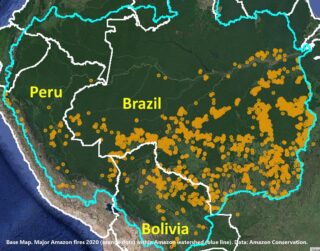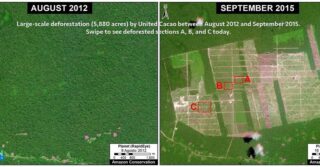
 Gold Mining is one of the major deforestation drivers across the Amazon, often targeting remote areas such as protected areas and indigenous territories. Given the vastness of the Amazon, accurately monitoring mining deforestation in the most real-time, up-to-date format has been a challenge.
To help better analyze deforestation patterns, our latest MAAP report, MAAP #212, gathers results from a new machine learning-based tool known as Amazon Mining Watch, which analyzes satellite imagery archives to detect mining deforestation across the entire Amazon. Machine learning, a subset of artificial intelligence (AI), focuses on the development of algorithms and statistical models that allow computers to learn from and make predictions or decisions based on data. In this case, the use of machine learning in MAAP helps provide a more prompt and accurate analysis of mining deforestation across the entire biome by producing 10-meter resolution mining deforestation alerts based on the European Space Agency’s Sentinel-2 satellite imagery. The alerts currently cover each year annually from 2018 to 2023.
This data collected from Amazon Mining Watch reveals that gold mining is actively causing deforestation in all nine countries of the Amazon Biome.
We estimate that as of 2018, there was a historical mining deforestation footprint of over 963,000 hectares across the Amazon. Between 2019 and 2023, we estimate the mining deforestation footprint grew by over 944,000 hectares (2.3 million acres).
Thus, of the total accumulated mining deforestation footprint of over 1.9 million hectares (4.7 million acres), about half has occurred in just the past five years.
The countries with the most overall mining deforestation are 1) Brazil 55%, 2) Guyana (15%), 3) Suriname (12%), 4) Venezuela (7%), and 5) Peru (7%).
We also present five case studies that highlight the power of the data to see recent trends in mining deforestation.
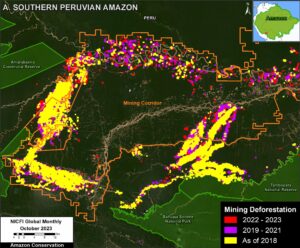
A. Southern Peruvian Amazon. In one of the most emblematic mining sites in the Amazon, we recorded over 135,000 hectares of mining deforestation, of which 38% (51,000 ha) has occurred in just the past five years. We also highlight that 41% (55,000 hectares) is likely illegal.
B. Brazilian Amazon – Yanomami Indigenous Territory. The data shows a major escalation and expansion of gold mining deforestation since 2018, especially along the Uraricoera and Mucajai Rivers. Specifically, we documented the total mining deforestation of over 19,000 hectares, of which the vast majority (93%) has occurred in just the past five years.
C. Brazilian Amazon – Kayapó Indigenous Territory. We documented the mining deforestation of nearly 50,000 hectares, of which 60% (30,000 has) has occurred in just the past five years.
D. Venezuelan Amazon – Yapacana National Park. We documented the mining deforestation of over 6,000 hectares in the southern part of the park, of which just over half (52%) has occurred in just the past five years.
E. Ecuadorian Amazon – Punino zone. We documented the mining deforestation of over 500 hectares in the Punino River area, of which 100% is new (starting in 2023).
Read the full report here.
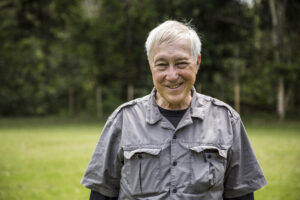 In addition to our incredibly dedicated staff members, our Board of Directors is made up of passionate science, business, and civic leaders who provide their expertise and financial support to help guide our mission in the most strategic direction. With their commitment to protecting the Amazon Rainforest, we can help take action on the ground for both people and wildlife.
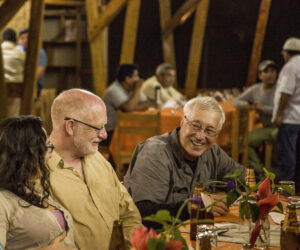 For Board Chair Jim Brumm, who joined Amazon Conservation’s Board of Directors in 2016, the great outdoors has always been a place of solace, especially for bird watching. He has traveled near and far to marvel at the vast array of bird species across the globe and was lucky enough to find the opportunity to become a Board Member through this passion. Jim is also deeply interested in and committed to conservation, Indigenous peoples, and community rights and development, and has served and continues to serve on a number of boards involved in bird conservation, Indigenous peoples’ rights, animal welfare, and conservation science.
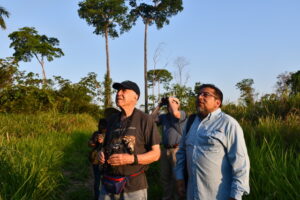 What got you interested in environmental conservation?
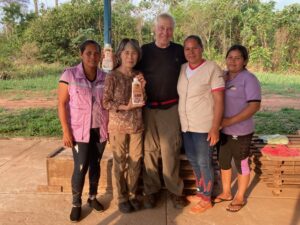 As a Board Member, what are you most impressed/proud of from Amazon Conservation?
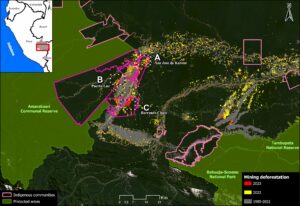 Our newest MAAP report,
 With over 1,400 member organizations and and a network of over 16,000 scientists, the IUCN drives conservation among organizations across multi-national levels to bring the necessary, knowledge, tools, and resources to progress toward safeguarding the natural world. Since its creation in 1948, it has become the world’s most prevalent environmental network and continues to build on human and economic development to address key conservation areas such as species survival, environmental law, protected areas, social and economic policy, ecosystem management, and education and communication. Each organization in the IUCN plays a unique role in a democratic process, where they can contribute to discussions, agendas, and resolutions that develop the foundation for global conservation. This system has helped to establish significant environmental agreements such as the
 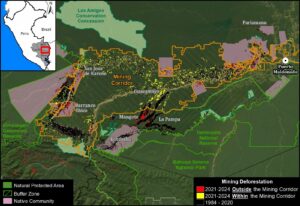 Thanks to support from USAID (United States Agency for International Development) and NORAD (Norwegian Agency for Development Cooperation), we’ve been able to publish a series of reports on the dynamic situation of gold mining in the southern Peruvian Amazon over the past several years.


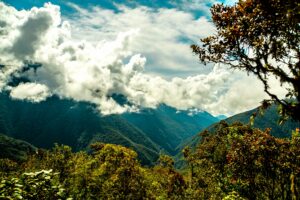 By becoming a champion for nature and biodiversity today, you are joining a movement with long-term global impacts. Here’s what taking action can look like:
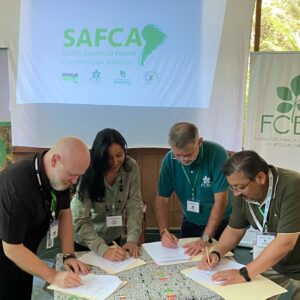 On March 11th, representatives from our sister organizations
 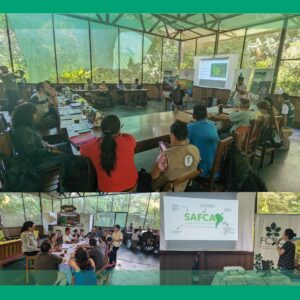 Amazon Conservation and its alliance has had a long history of teaming up with partners across the Amazon to initiate effective conservation efforts to protect biodiversity and local and indigenous people. Overall, understanding key issues in the Amazon opens doors to opportunities for solutions and action-taking when conserving South America’s tropical forests. The formation of SAFCA will help lead to collective efforts in building climate reliance, strengthening livelihoods, and benefiting both the planet and humanity.
 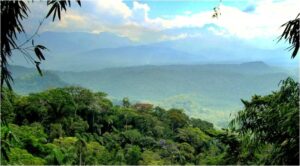 Happy Earth Day from all of us at Amazon Conservation!
  By joining our on-the-ground conservation efforts,
  Loading...