In May 2013, all USAID funding was suspended in Bolivia, which jeopardized ACA’s conservation and sustainable livelihood projects with the Tacana. Thanks to generous donor support, we were able to not only recover needed funds to continue the work planned from the USAID project, but also expand it. This summer, a group of ACA board members and staff from ACA, Conservación Amazónica–ACCA, and ACEAA traveled to the Tacana territory to see those efforts firsthand. Board member Jeff Woodman filed this report:
I had the honor of joining fellow Amazon Conservation colleagues on a trip to visit the Tacana indigenous territory located in northern Bolivia near the border with Peru and Brazil. The Tacana territory covers over 800,000 acres between two premier Bolivian protected areas: Madidi National Park and Manuripi-Heath National Amazon Reserve. Conserving the Amazon requires many strategies…but one critically important aspect of our work is empowering communities who live in the forests. We’ve worked with the Tacana for nearly a decade to support their ability to manage this vast territory for conservation. I couldn’t wait to meet them and see the results of our efforts.
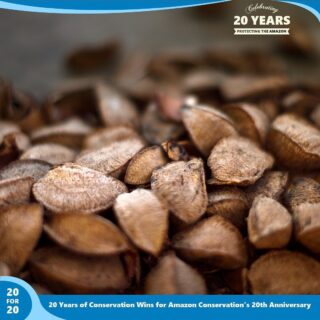
We were also visiting for a more specific reason. In 2013, the Tacana requested our assistance building “payoles,” simple wooden buildings used to store and dry Brazil nuts during the harvest season. With generous contributions from our supporters, Amazon Conservation raised funds for the Tacana to construct payoles. I wanted to hear the full story and learn whether these payoles had benefited the community.
The Tacana territory consists of four small communities: Las Mercedes, Puerto Perez, Toromonas and El Tigre. After flying to Lima, then Puerto Maldonado, then taking a six-‐hour boat ride on what looked like a large motorized canoe, we arrived at Puerto Perez. We were greeted like old friends. It took no time at all to feel a bond form…they were often smiling, joking, or laughing with twinkling eyes. No sooner had we disembarked than we were invited into people’s houses for “un ratito,” a short while, where we were treated to pork with rice, platanos and fish caught from the river. Family members would stand behind us watching every mouthful we ate. After the third “ratito”, my fears of being out of shape seemed unfounded!
Later that evening, the entire community gathered in a large meeting hall. As huge bats circled above us, Edgar Garcia, president of the four Tacana communities, and Hernan Bascopé, president of the Las Mercedes community, welcomed us with a series of speeches. This was followed by discussion between community members and us that lasted well into the evening. It was evident that our work with the Tacana was important and meaningful. After our long day of travel, rather than feeling tired, I felt invigorated.

Tacana members Don Lorenzo (left), Edgar Garcia, President of the Tacana (center), and Hernan Bascopé, President of Las Mercedes (right)
The following day, as we set out on the river, we learned about the Brazil nut harvest and the importance of payoles. The Tacana catch fish, grow fruit trees and practice small-scale farming, but essentially their entire income is dependent upon the harvest and sale of Brazil nuts. Harvesting Brazil nuts is a straightforward process: from January to April, Brazil nuts fall to the ground where they are collected, stored, and then sold. As simple as that sounds, the work is unimaginably difficult. Each harvester packs 60-70 kilos (130-150 pounds) of Brazil nuts into a bag, then carries that bag to a drop-off area near a river. Since the harvest occurs during the rainy season, harvesters work in the rain walking up and down steep muddy trails. Harvesters commonly cover more than ten miles a day, hauling Brazil nuts, day after day. It’s no wonder the Tacana are built like sturdy wrestlers!

Board member Steve Voorhees examining Brazil nuts drying in a new payole
The key to the importance of payoles lies in the fact that it can take weeks for the Tacana to arrange transport for their Brazil nuts to a processing facility. During this time, Brazil nuts are traditionally piled on the ground, making them susceptible to spoilage. In a typical year, 15% of Tacana Brazil nut total production is lost to spoilage. That amounts to about $120,000 of lost income to the Tacana communities each year.
Payoles are simple structures with a wooden floor and a metal roof that maximize drying while minimizing exposure to rain. Though the design is simple, the result is effective—payoles virtually eliminate production lost to spoilage.
On our last day, as we boarded the boat to leave the Tacana community, we reflected on all we’d experienced and learned during our visit. We were awed by their commitment to hard work, impressed by their governance and organizational structure, and charmed by their friendly gracious ways. We learned that by listening and working together we can develop solutions to empower the Tacana to manage their own resources. We left with a deeper understanding of our Amazonian partners and a commitment to continue our shared efforts to conserve the Amazon.

 The landscape shifts dramatically between Wayqecha and Villa Carmen, which means the birds who live in each habitat zone will change, too. Driving between the stations, the elevation drops from 9,875 to 1,700 feet. The birders will pass through puna, cloud/elfin forest, cloud forest, lower montane forest and premontane rainforest in the span of a day.

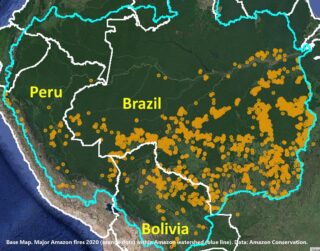
 Our work is focused in the southwestern Amazon, one of the most biodiverse regions on the planet and a global priority for conservation. It is also home to numerous indigenous peoples that depend on forest resources for their livelihoods and cultural identity.
  Next month, a group of Wisconsin birders will trek to Peru to participate in 9 days of bird counts and tallies, all in the name of fun and conservation. And they could use your help!
  As the new Executive Director of the Amazon Conservation Association, I’m thrilled for the chance to work with

 Loading...