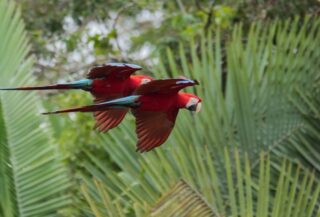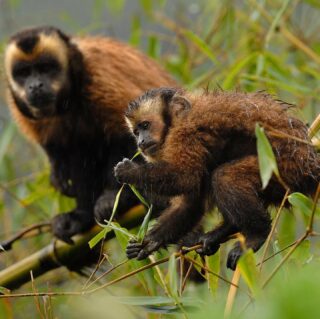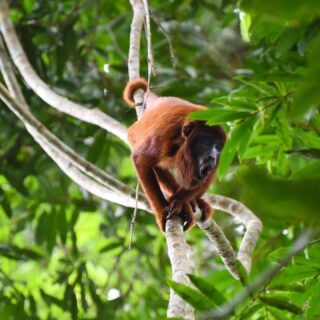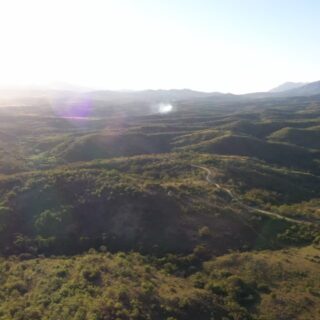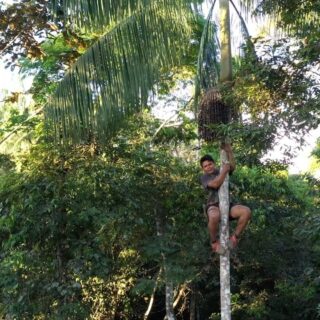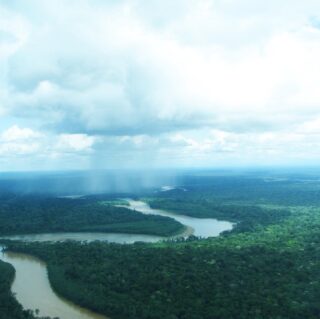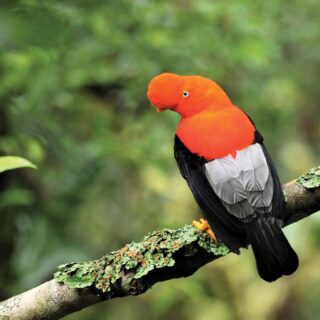
Birds and wildlife, that’s what I was hoping to see on my journey to the tropical rainforest in southeastern Peru with conservationists from Amazon Conservation. Our destination was Amazon Conservation’s Los Amigos lodge and research station, part of a pristine 350,000 acre conservation concession area bordering the iconic Manu National Park. Traveling to the lodge on a lovely four hour boat ride up the Madre de Dios river set the tone for our adventure. We scanned the river banks and were rewarded with jabirus, horned screamers, wood storks and black hawk-eagles in flight, pied lapwings and large-billed terns on sandbanks, a collared peccary swimming across the river and a large capybara by the shoreline. Mining activity was also present along the river, a stark reminder of the importance of protecting habitat.
Author: Ana Folhadella
Get to know our bird guide extraordinaire: Q&A with Percy Avendaño
When you’re in the middle of the Amazon rainforest it’s essential to count on a trusted guide to help you see all the hidden treasures that you might be missing. Meet Percy Avendaño, our staff naturalist and birding guide. He has experience guiding expert-level birders and casual naturalists alike, and our visitors rave about his knowledge of birds and nature, his friendliness and resourcefulness.Percy is also a Top eBirder, ranking second in the world for 2016’s Global Big Day, with 257 species spotted at our Villa Carmen lodge. Learn about how he came to work with Amazon Conservation, what the birding industry is like in Peru and what a birding adventure might look like with Percy as your guide!
MAAP #50: Gold Mining Deforests 31,000 Acres in Southern Peruvian Amazon During Last 4 Years
We analyzed hundreds of high-resolution satellite images to calculate the amount of recent (October 2012 – October 2016) gold mining deforestation in the southern Peruvian Amazon: 30,895 acres. Combining this finding with previous studies, we estimate the total gold mining deforestation of around 154,440 acres in the region. Image 50a shows the recent gold mining deforestation in red, and all previous gold mining deforestation in yellow.
Key findings include:
- The vast majority of the deforestation has occurred in the Madre de Dios region, but also has extended to the adjacent regions of Cusco and Puno.
- The rate of recent gold mining deforestation was much lower (42%) than during its peak, which occurred between 2010 and 2012 (6,640 vs. 15,650 acres/year).
- However, half of the recent gold mining deforestation (15,830 acres) occurred within the buffer zones of three protected areas (Tambopata National Reserve, Bahuaja Sonene National Park, and Amarakeari Communal Reserve).
- Moreover, recent gold mining deforestation invaded two protected areas (Tambopata and Amarakaeri).

Image 50a. Data: MAAP, Asner et al (2013) PNAS, SERNANP. Click to enlarge.
Previously, Dr. Greg Asner and colleagues documented the deforestation of approximately 123,200 acres (50,000 hectares) by gold mining activities in the southern Peruvian Amazon through September 2012 (Asner et al 2013). We have updated this information by analyzing hundreds of recent (2016) high-resolution satellite images (see Methodology section below). We documented an additional 30,895 acres (12,503 hectares) of gold mining deforestation between October 2012 and October 2016. Thus, combining both studies, we estimate the total gold mining deforestation of around 154,440 acres (62,500 hectares).
Inaugural Amazon Birder’s Bulletin
The Amazon Birder’s Bulletin is a bi-monthly newsletter about nature and birding at Amazon Conservation’s three birding lodges in Peru. Each of our birding lodges are open to the public, and they host thousands of birders, researchers, and students alike every year. Staying in our lodges is an opportunity to spot hundreds of species of amazing birds, and to get up close and personal with the crucial work we do to protect the world’s most diverse landscapes, train the next generation of Amazonian conservationists, and partner with communities to support livelihoods that sustain biodiversity.
MAAP #49: New Frontiers of Gold Mining in The Peruvian Amazon
In a series of articles, we have previously detailed the progress of gold mining deforestation in the southern Peruvian Amazon (mainly in the Madre de Dios region).
In the current report, we show the new gold mining frontiers in northern and central Peru (Image 49a): two cases in the region of Amazonas and a case in the buffer zone of El Sira Communal Reserve, in the Huanuco region.
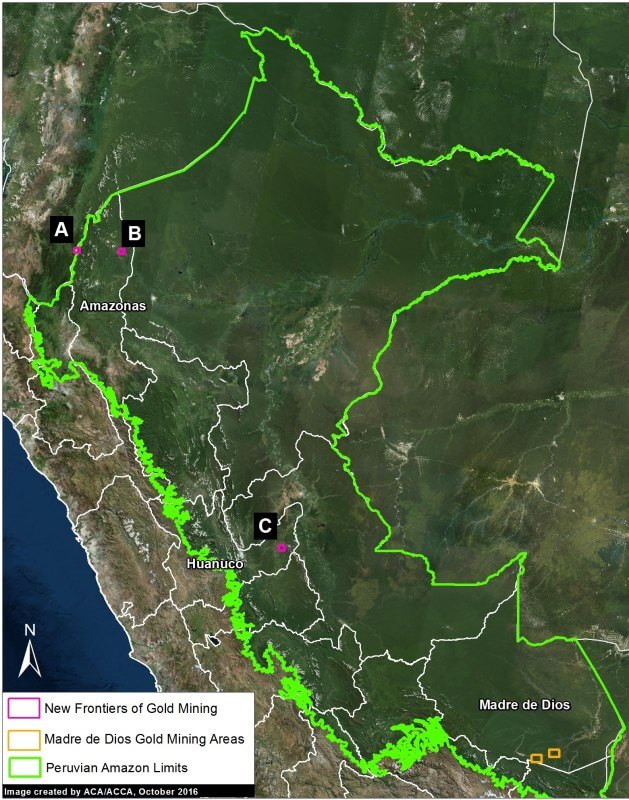
Imagen 49a. Peru’s gold mining frontiers.
Deforestation in these cases is still in its early stages, so there is still time to avoid larger-scale damage, as in the case of Madre de Dios.
Bolivia: Large-Scale Sugarcane Deforestation
New sugarcane plantations have caused the deforestation of more than 6,175 acres (2,500 hectares) in the department of La Paz.
https://news.mongabay.com/2016/10/exclusive-rainforest-rapidly-cleared-for-sugarcane-in-bolivia/
MAAP #48: Oil Palm Deforestation in The Central Peruvian Amazon
In MAAP #26, we presented a 2015 Deforestation Hotspots map for the Peruvian Amazon, which showed that the highest concentration of deforestation is located in the central Amazon region.
Here, we zoom in on one of these hotspots, located in the northern Huanuco region along its border with San Martin (see Inset E of Image 48a).*
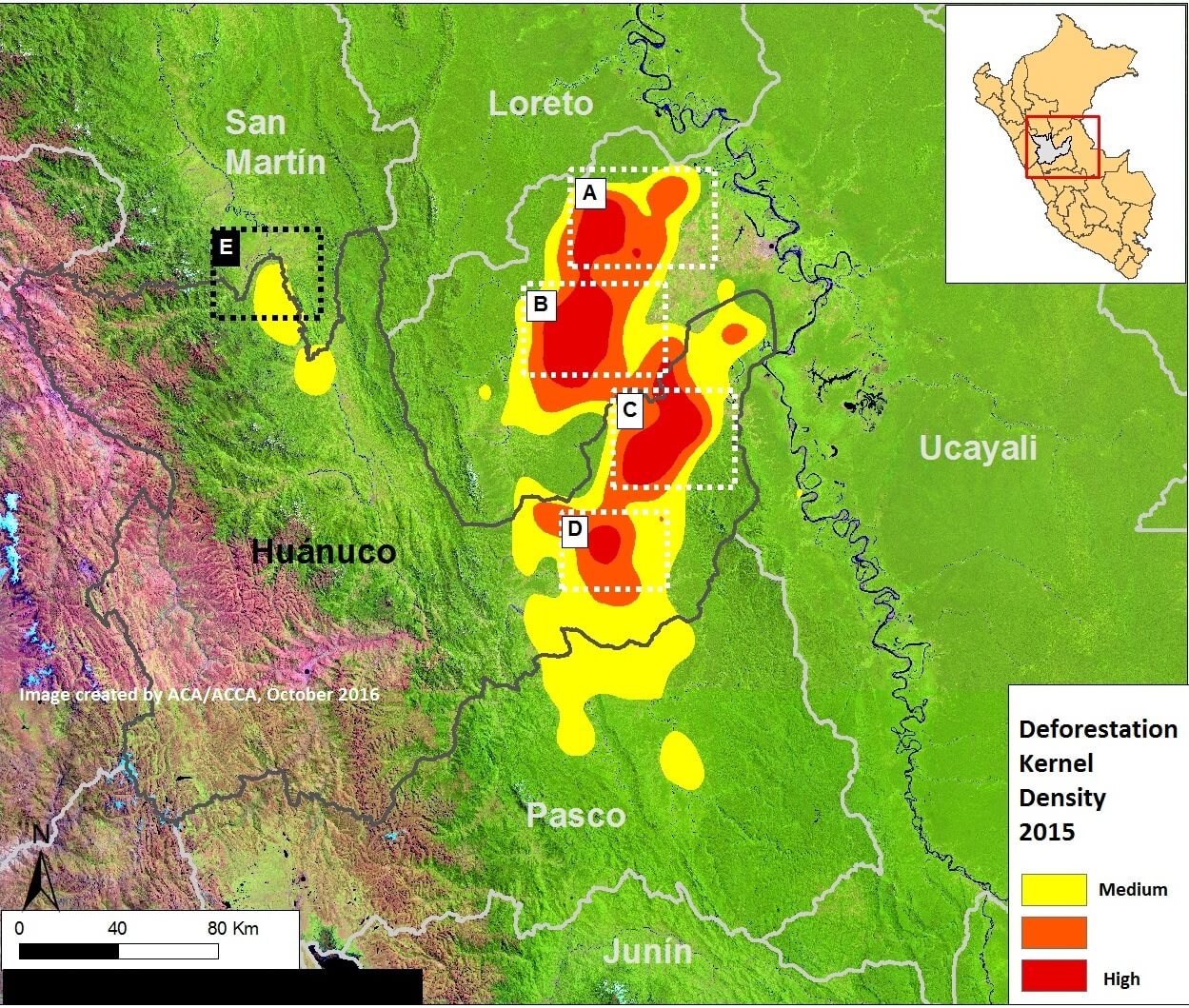
Image 48a. Data: UMD/GLAD
We found that the main deforestation driver in this hotspot was the establishment of small- and medium-scale oil palm plantations.**
*Note that we analyzed the hotspots in Insets A-D in MAAP #26 and MAAP #37.
** We defined small-scale as less than 5 hectares, medium-scale as 5-50 hectares, and large-scale as greater than 50 hectares
MAAP #47: Fires Degrade Southern Peruvian Amazon (Madre De Dios)
The Peruvian Amazon is experiencing an intense 2016 fire season due to one of its driest periods in decades. In recent weeks, we have presented a series of articles showing the power of the new GLAD alerts in detecting deforestation in near real time. Here, we go a step further and also evaluate alerts to detect fires in near real time. These fire alerts are based on the moderate resolution (375 meters) VIIRS sensor that detects heat sources and highlights areas where the temperature is significantly above normal.
We compared, for the first time, these two types of alerts and found a correlation between fires and forest loss along a stretch of the Interoceanic Highway in the southern Peruvian Amazon (Madre de Dios region).
Image 47a shows the occurrence of fire alerts (left panel) in relation to deforestation alerts (right panel) during 2016 along the highway between the towns of Iberia and Iñapari. Insets A-E indicate the areas highlighted in the high-resolution zooms below, where approximately 600 hectares were affected by fires in 2016..
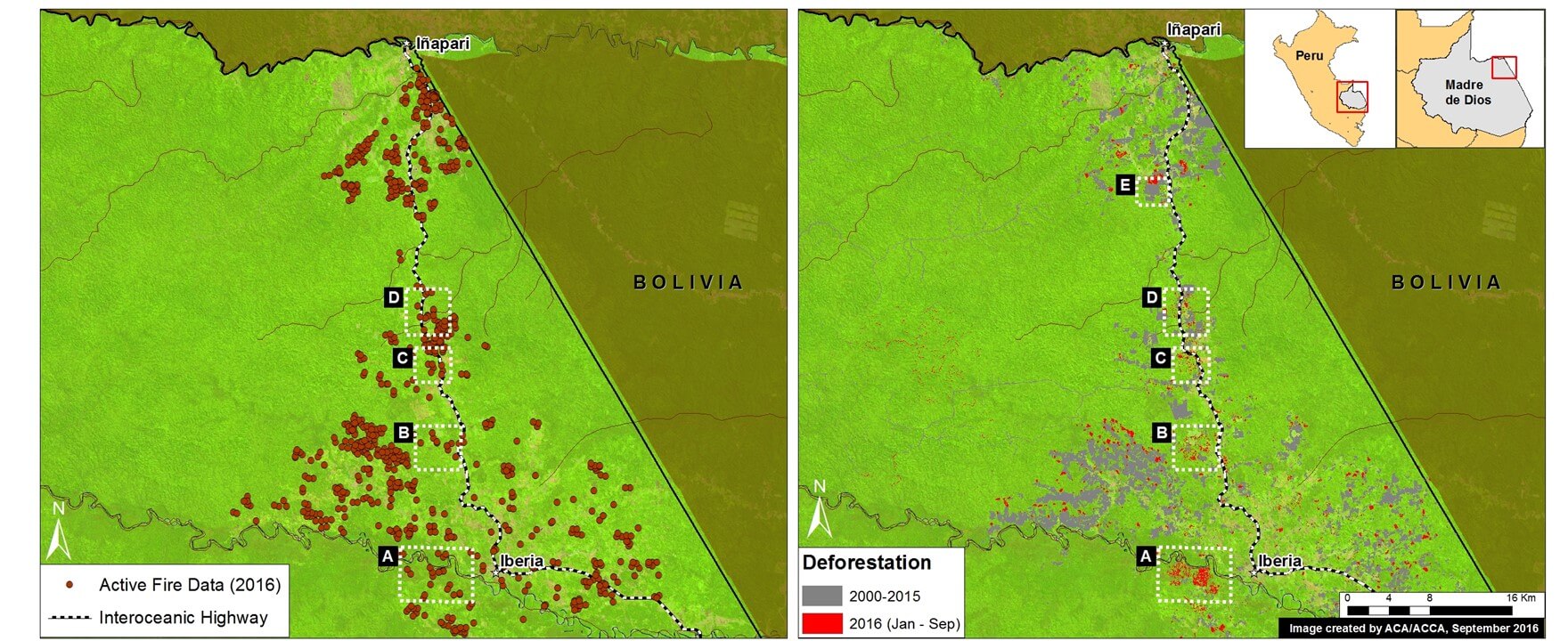
Image 47a. Data: UMD/GLAD, Hansen/UMD/Google/USGS/NASA, USGS/NASA, NASA/INPE
MAAP #46: Gold Mining Deforestation Within Tambopata National Reserve Exceeds 1100 Acres
In previous articles, we documented the illegal gold mining invasion of Tambopata National Reserve (Madre de Dios region in the southern Peruvian Amazon) in November 2015 and the subsequent deforestation of 350 hectares as of July 2016. Here, we report that the mining deforestation in the Reserve now exceeds 450 hectares (1,110 acres) as of September 2016. Image 46a illustrates the extent of the invasion, with red indicating the most recent deforestation fronts. Insets A-D indicate the location of the high-resolution zooms below.
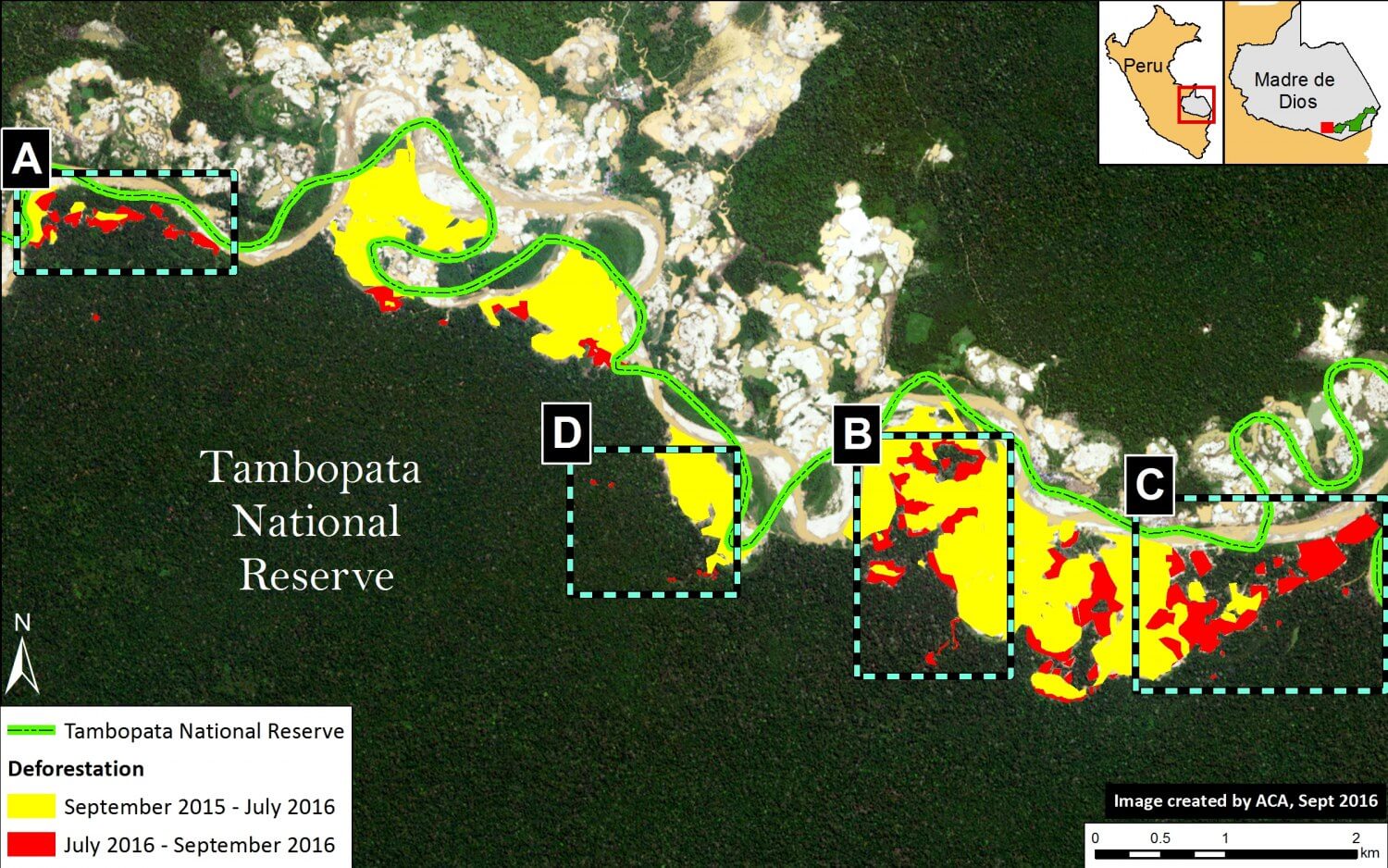
Image 46a. Data: Planet, SERNANP, MAAP
MAAP #45: Threats To El Sira Communal Reserve in Central Peruvian Amazon
El Sira Communal Reserve, located in the central Peruvian Amazon (regions of Pasco, Huánuco and Ucayali), aims to protect the biological diversity of the El Sira Mountain Range in benefit of the native communities of the area (Ashaninka, Yanesha, and Shipibo-Conibo indigenous groups).
This report presents an initial threat assessment for this large national protected area, which covers more than 615,000 hectares (1.5 million acres).
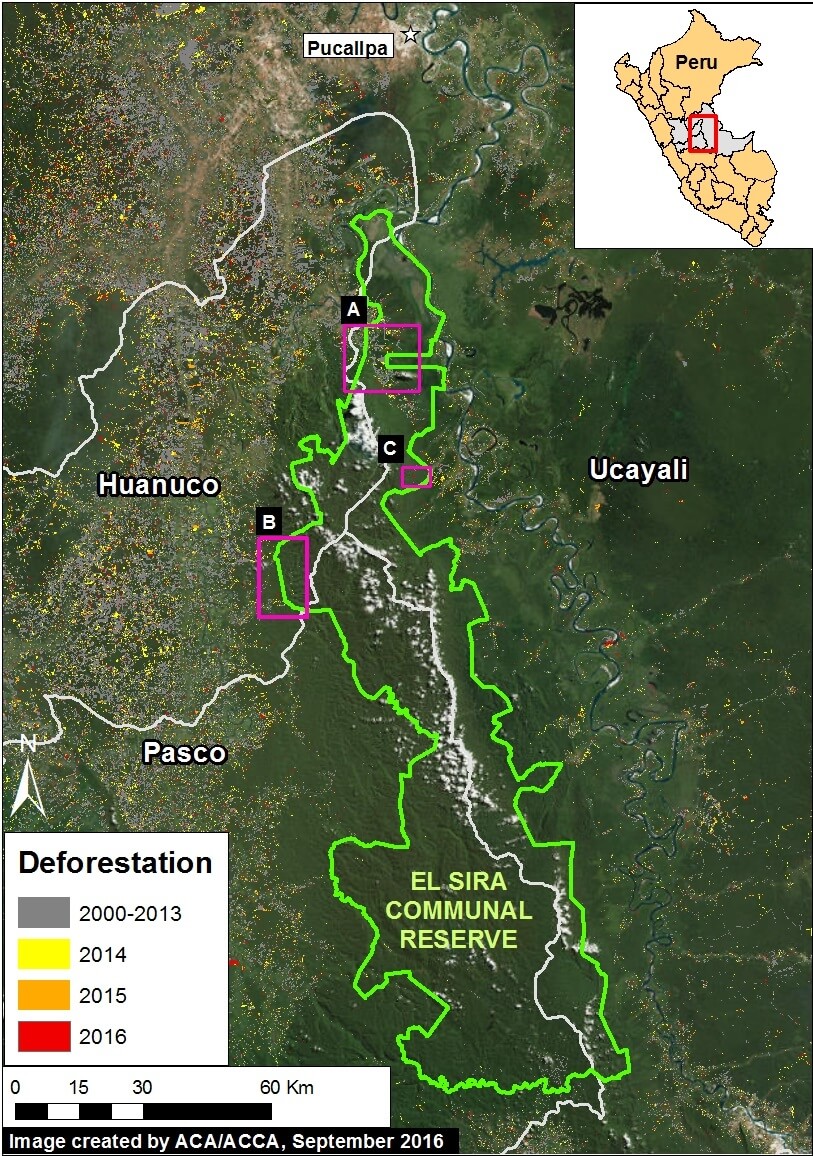
Image 45a. Data: ESRI, SERNANP
We identified 3 threatened sectors of the Reserve, as indicated in Image 45a (see Insets A-C).
We found that the principal drivers of deforestation in these three sectors are agriculture & cattle pasture (Insets A and C) and illegal gold mining (Inset B).
It is important to note that the deforestation for agriculture & cattle pasture continues to rapidly increase – 1,600 hectares (3,950 acres) since 2013 – while the deforestation for gold mining has been limited due to regular interventions by the Peruvian government.
Below, we show high-resolution satellite images of the recent deforestation in all three threatened sectors. Click each image to enlarge.
 Loading...