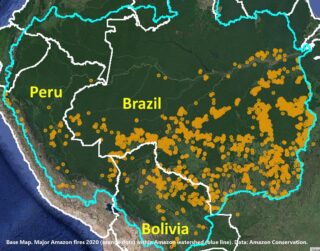
Amazon Conservation’s latest analysis finds that 97 million hectares (240 million acres) of primary forest have been lost – an area the size of Texas and California combined – and that the moisture pathways that forests depend on during the dry and transition seasons are the most disrupted.
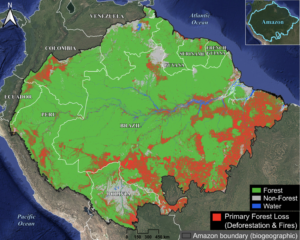
A new report from Amazon Conservation’s Monitoring of the Andes Amazon Program (MAAP) finds that 15% of the Amazon basin’s original primary forest is already gone, and that the losses are concentrated along the moisture routes some regions depend on most.
The report, MAAP #250: Amazon Tipping Point – Where Are We? (2026 Update), estimates that 97.06 million hectares (240 million acres) of primary forest have been lost across the Amazon biome’s nine countries through the end of 2025, mainly due to human-caused deforestation and fires. Total forest loss rose from 13.2% in 2021, as estimated in Amazon Conservation’s first assessment (MAAP #164), to 15% through 2025. Between 2022 and 2025 alone, an additional 13.04 million hectares (32.2 million acres) of primary forest were lost, an area nearly 15 times the size of Yellowstone National Park. This includes record-breaking losses due to fire in 2024, following the 2023’s strong El Niño season (MAAP #229). This additional loss of primary forest brings the Amazon closer to its tipping point, which scientific literature suggests could be triggered at around 25% forest loss, in combination with climate change impacts.
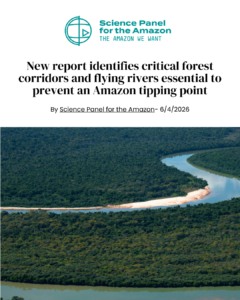
The analysis also breaks down forest loss along the Amazon’s seasonal flying rivers. It finds that the pathways carrying moisture during the dry and transition seasons have lost nearly three times more forest than the wet-season pathway. These pathways sustain forests in the southwestern Amazon, in Peru and Bolivia, where more than 70% of rainfall depends on moisture recycled by forests across the Basin.
These findings take on added urgency ahead of the very strong El Niño forecast expected to intensify for late 2026. MAAP #248 suggests that El Niño may disrupt the Amazon’s wet-season moisture flow, extending the dry and transition seasons and increasing the risk of forest fires. These are the same regions whose moisture pathways MAAP #250 finds are already the most deforested.
Matt Finer, Director of MAAP & Senior Research Specialist at Amazon Conservation, highlights that “media reports often indicate in general terms that the Amazon is approaching a tipping point, but this is the actual data indicating the magnitude of the problem. With 15% of the original Amazon lost to deforestation and fires, we are approaching the point at which the hydrological cycle that sustains rainforests may be permanently disrupted.”
Why monitoring the Amazon’s tipping point matters
The Amazon’s tipping point hypothesis suggests that parts of the rainforest could shift toward drier savanna ecosystems as deforestation reaches 25% and climate change disrupts rainfall patterns and intensifies dry seasons. However, this threshold is not definitive; the changes may be gradual and piecemeal, and the risk may vary considerably across the Amazon.
Amazon Conservation’s 2022 deforestation analysis illustrated this geographic variation. While an estimated 13.2% of the original Amazon biome forest had been lost at the time, loss in the eastern third of the biome (mainly in the Brazilian Amazon) was already approximately 30.8%, exceeding the hypothesized 25% threshold. In comparison, the central third had lost 10.8% and the western third 6.3%. This finding highlighted the importance of monitoring not only total forest loss, but also where it occurs in relation to the Amazon’s interconnected hydrological system. Because the rainforest generates around half of its own rainfall and recycles moisture up to six times through atmospheric flows known as flying rivers, disruptions to this fragile system in one area of the basin can have a domino effect elsewhere.
Flying Rivers Connect Forest Loss in the East to Rainfall in the West
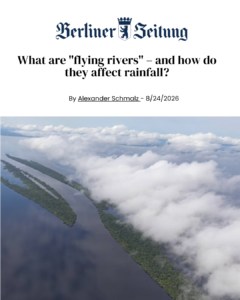
Flying rivers carry moisture from the Atlantic Ocean westward across the Amazon. Trees are a crucial part of this cycle: they draw water from the soil and release it back into the atmosphere as water vapor, helping sustain rainfall all the way to the Andes.
This connection means that deforestation in one region can have consequences beyond its immediate area. When the forests that help sustain these moisture flows are cleared, the amount of moisture reaching downwind regions may be reduced, potentially threatening ecosystems that depend on recycled rainfall. For this reason, the Amazon’s tipping point is unlikely to be a single, uniform event. Instead, it may unfold gradually, over decades rather than abruptly, and differently across regions, with some areas affected sooner and more severely than others.
In MAAP #232 (2025) and the subsequent white paper, Keeping the flying river flowing: How deforestation in the Brazilian Amazon threatens rainfall in Peru and Bolivia (2026), researchers examined these connections in greater detail. They identified the southwestern Amazon (primarily in Peru and Bolivia) as particularly vulnerable and found that these connections are exacerbated by changing seasons. During the dry and transition seasons, moisture reaching this region crosses the eastern and central Brazilian Amazon, including heavily deforested areas of Brazil’s southern Pará region.
Seasonal Trends Remain in 2026 Update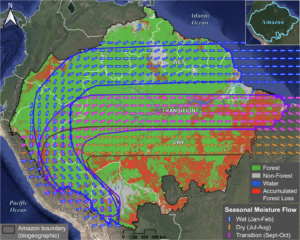
Amazon Conservation’s MAAP #250 brings these two lines of research together, updating forest-loss estimates through 2025 and applying the analysis to the three seasonal pathways identified in MAAP #232. The results show a clear contrast between seasons: The wet season pathway, which crosses relatively continuous and well-protected forests in the northern Amazon, remains comparatively intact, with just 3.2% forest loss. In contrast, pathways active during the transition and dry seasons have lost nearly three times as much connectivity, losing 9.1% and 8.6%, respectively. These findings are particularly relevant for the southwestern Amazon, where forest-driven moisture recycling plays an important role in sustaining rainforest ecosystems during the dry and transition seasons.
The update uses the same baseline developed for MAAP #164: a reconstruction of the Amazon’s original forest before European colonization, estimated at 647.6 million hectares (1.6 billion acres). Of the 97.06 million hectares lost, 84.28 million were due to deforestation and other non-fire causes, including natural events such as landslides and windstorms, and 12.78 million to fire. Brazil accounts for the largest share of total loss (79.4%), followed by Bolivia (6.2%), Peru (5.8%), and Colombia (4.5%). Bolivia now ranks second, up from fourth in the 2022 assessment.
Together, Amazon Conservation’s reports show that understanding the Amazon’s tipping point requires more than a single estimate of how much forest has been lost to date. Monitoring and understanding where deforestation occurs, how it intersects with seasonal moisture pathways, and which regions rely most on recycled rainfall can help identify areas of heightened vulnerability and inform conservation priorities. As pressures from deforestation, fires, and climate change continue, it is essential to start looking at the Amazon as an interconnected system rather than as isolated forests separated by country boundaries. A connected forest calls for connected science and conservation.
Read the full report: MAAP #250: Amazon Tipping Point – Where Are We? (2026 Update)
Additional resources:
MAAP #164: Amazon Tipping Point – Where Are We?
MAAP #229: Amazon Deforestation & Fire Hotspots 2024
MAAP #248: Implications of upcoming major El Niño event on Amazon fires
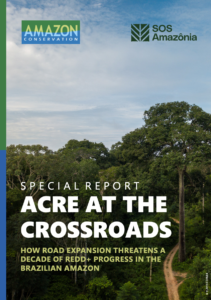 A new analysis of planned road infrastructure expansion in Acre estimates that a paved international road between the Brazilian state and Pucallpa, Peru, could cause approximately 74,700 hectares of additional deforestation over ten years and 133,800 hectares over twenty years, beyond the losses projected from paving BR-364.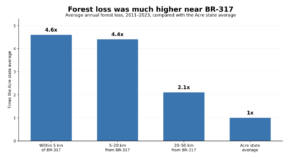
 In the case of the proposed connection to Pucallpa, economic evidence included in the report also raises questions about the project’s viability. A 2022 assessment published by Conservation Strategy Fund calculated a negative net present value for both the Peruvian and Brazilian sections of the connection, with an internal rate of return below zero in both cases.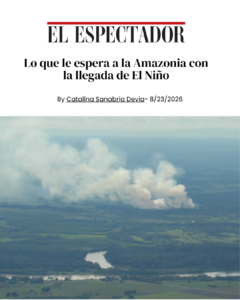
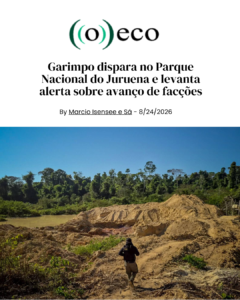
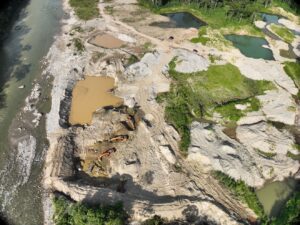 Within the framework of the Monitoring of the Andes Amazon Program (MAAP), Fundación EcoCiencia and Amazon Conservation have documented the continued growth of mining operations in the southern part of Napo province. Satellite data reveal 2,321 hectares affected by mining between January 2017 and March 2026 in five zones within the cantons of Tena and Carlos Arosemena Tola. Of that total, 580 hectares correspond to new mining activity detected during 2025 and the first quarter of 2026.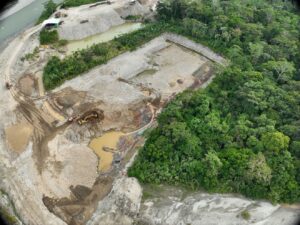
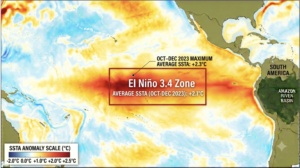 The report finds that the two most severe Amazon fire seasons in recent history, in 2016 and 2024, both occurred immediately after the two strongest El Niño events of the past two decades (2015 and 2023, respectively).
 When the boat engine falls silent in the middle of a river that serves as both road and lifeline, nature seems to reclaim the landscape. The water becomes still again, a heron soars across the sky, the wind stirs the crowns of towering trees. And for a fleeting moment, everything seems to breathe without hurry. Jefferson watches. Then smil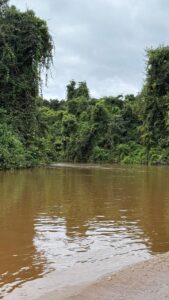
 But perhaps the most important lesson a park ranger can learn takes place neither in the forest nor at school. It happens at home.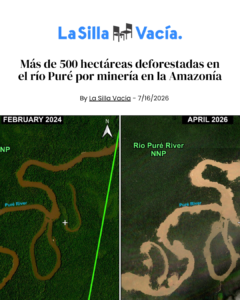

 Behind every success at Amazon Conservation is an array of individuals with a shared passion for the Amazon: our generous donors and funders, dedicated staff
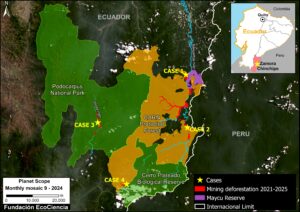 The analysis identifies approximately 111 hectares affected by mining within protected areas and conservation zones across four case studies monitored between 2011 and 2025. The impacted areas include Podocarpus National Park, the Cerro Plateado Biological Reserve, the Maycú Nature Reserve, and the Cuenca Alta del Río Nangaritza Protective Forest, territories that are essential for ecological connectivity and for conserving emblematic species such as the jaguar, tapir, and spectacled bear.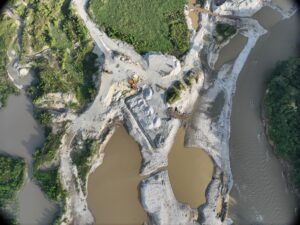
 Loading...