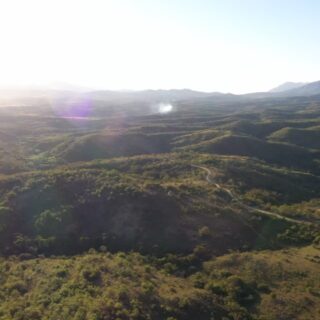
 The “rainbow mountains” of Ausangate have become a popular tourist destination for their unique colorful appearance. The Andean mountain range is striped with colors ranging from turquoise and lavender to maroon and gold due to millions of years of weathering of its unique mineral composition.
In addition to being a geological marvel, the Ausangate mountains are also an important cultural element for local Peruvians, as the mountain range is believed to be the deity of Cusco and considered to be holy. In the month of April, one week before Corpus Christi, the festival of Quyllur Rit’i (which translates in the native Quechua language to “star snow”) brings together the local indigenous people of the Andes as a celebration of the stars. The mountains are inhabited by llama and alpaca herding communities, and constitute one of the few remaining pastoralist societies in the world.
However, this magical place and its inhabitants are currently not an area that is officially protected by the government and this unique ecosystem in the Andes-Amazon is threatened by human destruction. To safeguard Ausangate, we partnered with the local government to create a conservation area of 311,456 acres that will protect this national patrimony. The process is expected to be finalized in late 2017 and we have been able to promote this region through a variety of social media efforts, photography galleries, and more. To see more of this beautiful region, follow our Facebook page.
 U.S., protection of the planet’s richest forest is more critical than ever, especially as we seek to halt global climate change.


 For me, research and science are means of innovation, creativity, and communication; they are tools to help us discover the unknown with the hope for a better future. As a woman scientist, I would like to see more of us working and leading projects towards a more equitable, just and sustainable world, breaking down all gender-based stereotypes. I truly believe that we have the capability, strength and power to enrich and deepen the knowledge of nature, opening new opportunities for innovation and original solutions to the most difficult challenges on Earth.
 Since I was a kid, I had the opportunity to live and be in touch with natural environments, which make my empathy and interest for animals and plants grow. I think I was lucky to receive a good education and motivation at home as well as at school, because I never thought I couldn’t be a scientist. Though it is not an easy path, especially in a developing country, I believe that here where we need science the most. Many times girls don’t even think about becoming scientists, but it is a worthy path that is needed so much right now to protect the only planet we have.
 I have had the privilege of contributing to the creation and management of natural reserves, wildlife rescue operations, environmental education programs, and research on forest and wildlife ecology in the Tropics. Science allows me to fulfill my personal desire to contribute to nature conservation for the enjoyment of future generations. Now one of my main goals is to inspire young scientists and provide them with opportunities to follow their passion, to experience science first hand, and to fall in love with this profession, like I did.
 Loading...