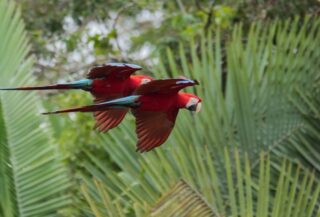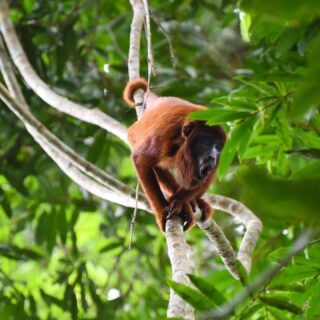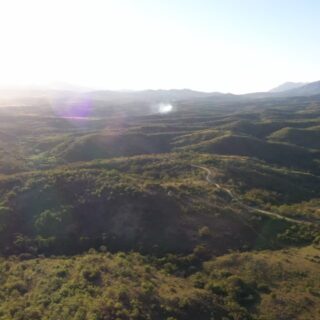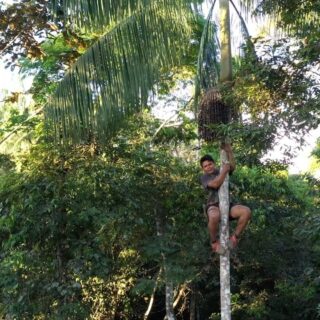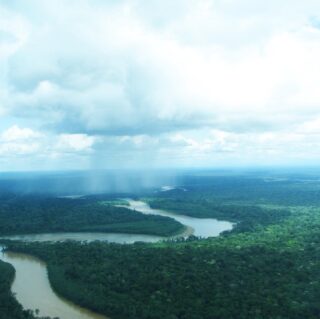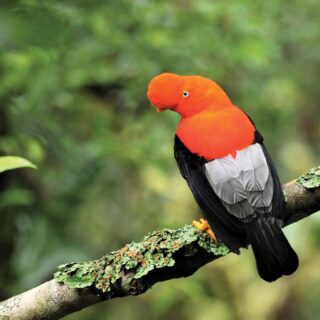
There are many incredible birding festivals taking place in the US every year, and we love meeting new faces every time we attend one! This year, in addition to the Space Coast Birding Festival that we attended in early January, we’ll be sharing the experience of birding with us in the Peruvian Amazon at two upcoming events. If you’ll be in town, make sure to attend and say hello!
Uncategorized
A sneak peek at our Los Amigos Birding Lodge
In the 2015 Global Big Day, Los Amigos Birding Lodge registered the fifth highest number of bird species in the world (308) – and with good reason. Not only do we have sharp-eyed bird guides stationed there, but Los Amigos is adjacent to the Los Amigos Conservation Concession and just east of world-famous Manu National Park, which means it is surrounded by millions of acres of protected wilderness.
MAAP #65: Deforestation Hotspots Of 2017 in The Peruvian Amazon
In an earlier report, MAAP #40, we highlighted the power of combining early warning GLAD* alerts with analysis of high-resolution satellite images (for example, from the company Planet), as part of a comprehensive near real-time deforestation monitoring system.
In the current report, we analyze the GLAD alerts for the first half of 2017 (through July 17) to identify current deforestation hotspots in the Peruvian Amazon.** These alerts indicate an estimated total forest loss of 37,000 acres (15,000 hectares) thus far during the year.
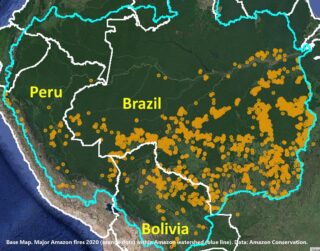
Image 65 (see right) highlights the 2017 deforestation hotspots, defined here as areas with medium to high density of forest loss.
Below, we describe and show images of the most intense hotspots, indicated in red and orange.
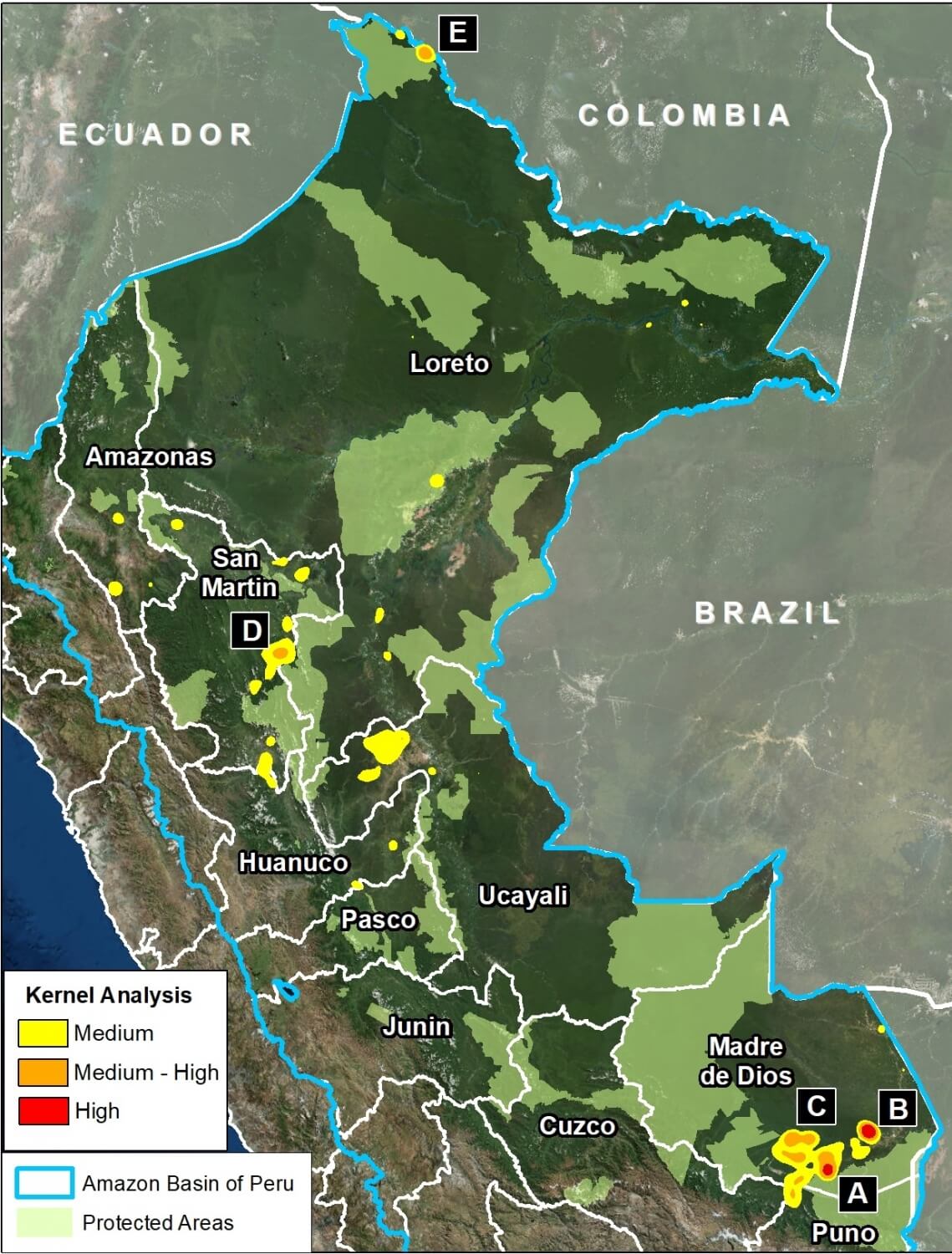
Image 65. Data: MINAM/PNCB, UMD/GLAD, SERNANP, MAAP
These areas include:
- Buffer zones of Tambopata National Reserve and Cordillera Azul National Park
- Natural loss due to blowdowns from “hurricane winds,” in the Madre de Dios region
- Northwest border with Colombia
MAAP #64: Good News Deforestation Stories (Peruvian Amazon)
We admit that most MAAP stories are about the bad news of Amazon deforestation. But fortunately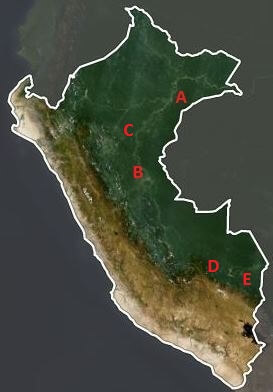
there is good news as well.
Here we highlight 5 good news stories from the Peruvian Amazon that show how near real-time monitoring may lead to halting deforestation from emerging threats, such as gold mining and large-scale agriculture (oil palm and cacao plantations).
The detailed cases are:
A) United Cacao (cacao),
B) Plantations of Pucallpa (oil palm),
C) Grupo Romero (oil palm),
D) Amarakaeri Comunal Reserve (gold mining), and
E) Tambopata National Reserve (gold mining).
United Cacao

Image 64a. Data: NASA/USGS
The rapid deforestation of primary forest for a large-scale cacao plantation in the northern Peruvian Amazon took everyone by surprise in 2013. Civil society led the way in exposing and tracking the deforestation with satellite imagery and the government eventually confirmed the forest loss data. For its part, MAAP published 6 articles (for example MAAP #35 and MAAP #2).
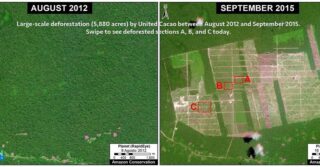
Although total deforestation eventually reached 5,880 acres (2,380 hectares), the company, due to a complicated combination of factors, was suspended from the London Stock Exchange and no new deforestation has been detected in over a year.
Image 64a shows that the cacao project area was covered by intact forest in late 2012, followed by large-scale deforestation of primary forest in 2013. The deforestation slowed, and then stopped, between 2014 and 2017. The yellow circle indicates the cacao plantation area over time.
Plantations of Pucallpa (oil palm)
In a remarkable case, satellite imagery was used to demonstrate that an oil palm company (Plantations of Pucallpa) had breached the Code and Conduct of the RSPO (Roundtable on Sustainable Palm Oil), a non-profit entity founded to develop and implement global standards for sustainable palm oil.
In 2015, the Native Community of Santa Clara de Uchunya (with the support of the NGO Forest Peoples Programme) presented an official complaint to the RSPO against Plantations of Pucallpa, a member of the roundtable. An important component of the complaint alleged massive deforestation, but the company adamantly denied it. MAAP articles showing the deforestation of 15,970 acres (6,460 hectares) were used as evidence (MAAP #4, MAAP #41), as was independent government analysis.
In April 2017, the RSPO concluded that Plantations of Pucallpa cleared 14,145 acres (5,725 hectares) despite declaring no land-clearing, thus breaching the Code and Conduct. Several months prior this decision, the company divested its oil palm estates and withdrew from the RSPO. We have not detected any new deforestation in the project area in over a year.
Image 64b shows the massive deforestation for two large-scale oil palm plantations in the central Peruvian Amazon (Plantations of Pucallpa is the plantation to the north). The yellow circles indicate the oil palm plantation project areas over time. Note that the project area was a mix of primary and secondary forest in 2011, immediately prior to the deforestation, which began in 2012. The deforestation intensified in 2013 before nearly reaching its maximum extent in 2015. We have not detected any new deforestation since 2016.
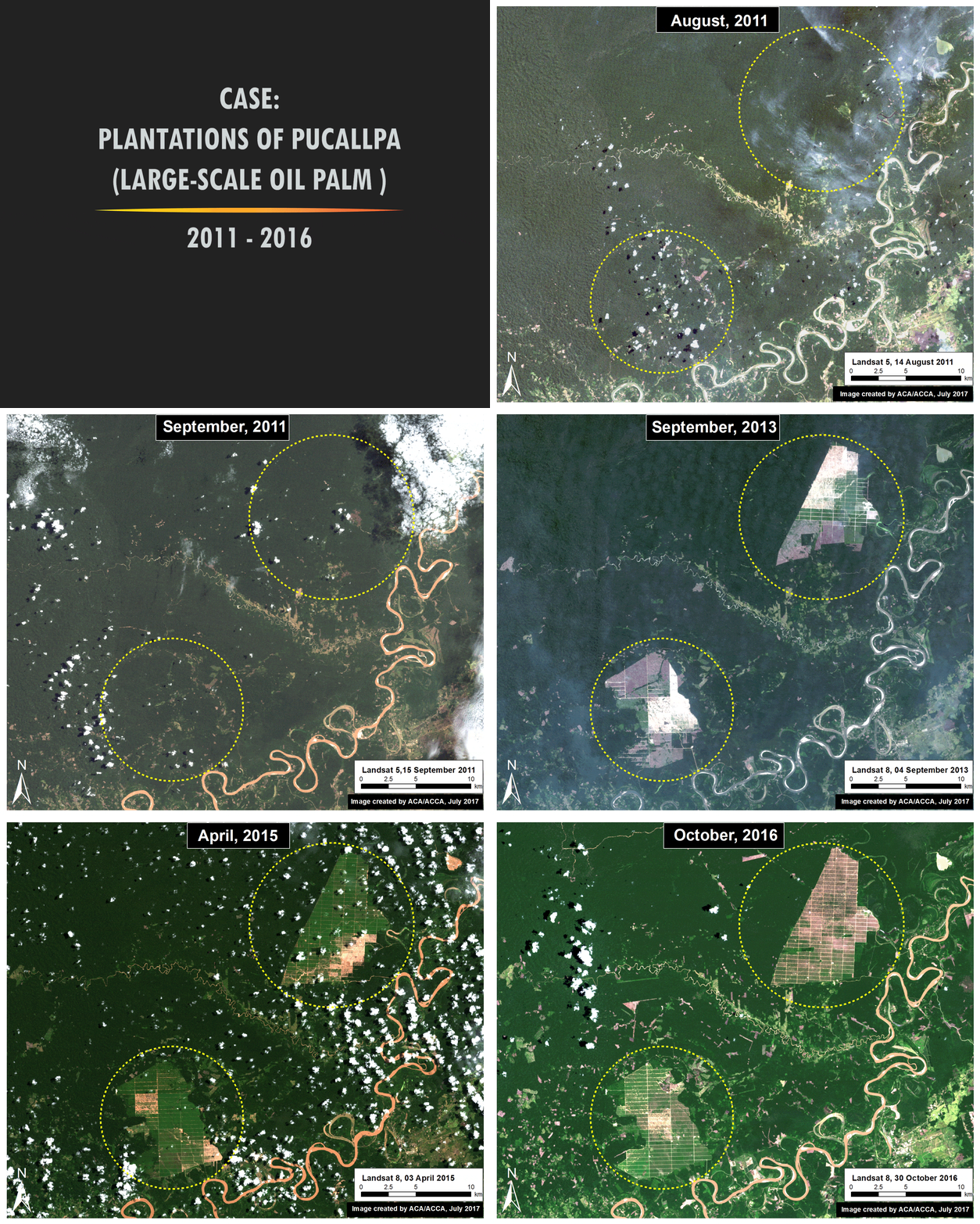
Image 64b. Data: NASA/USGS, MAAP
Grupo Romero (oil palm)
Perhaps the best news of the bunch is about four large-scale oil palm plantations that were stopped before any deforestation occurred. As detailed in a recent report by Environmental Investigation Agency, the Peruvian business conglomerate Grupo Romero conducted environmental impact studies for four new oil palm plantations in the northern Peruvian Amazon. Analysis of these studies revealed that these plantations would cause the massive deforestation of 56,830 acres (23,000 hectares) of primary forest. After strong pushback from civil society, including legal action, a recent report from Chain Reaction Research revealed that Grupo Romero is now working towards a zero-deforestation supply chain and thus found that the four planned plantations are no longer feasible and abandoned the projects.
Image 64c shows how the project area for two of the proposed oil palm plantations (in yellow), Santa Catalina and Tierra Blanca, is largely covered by intact, primary forest.
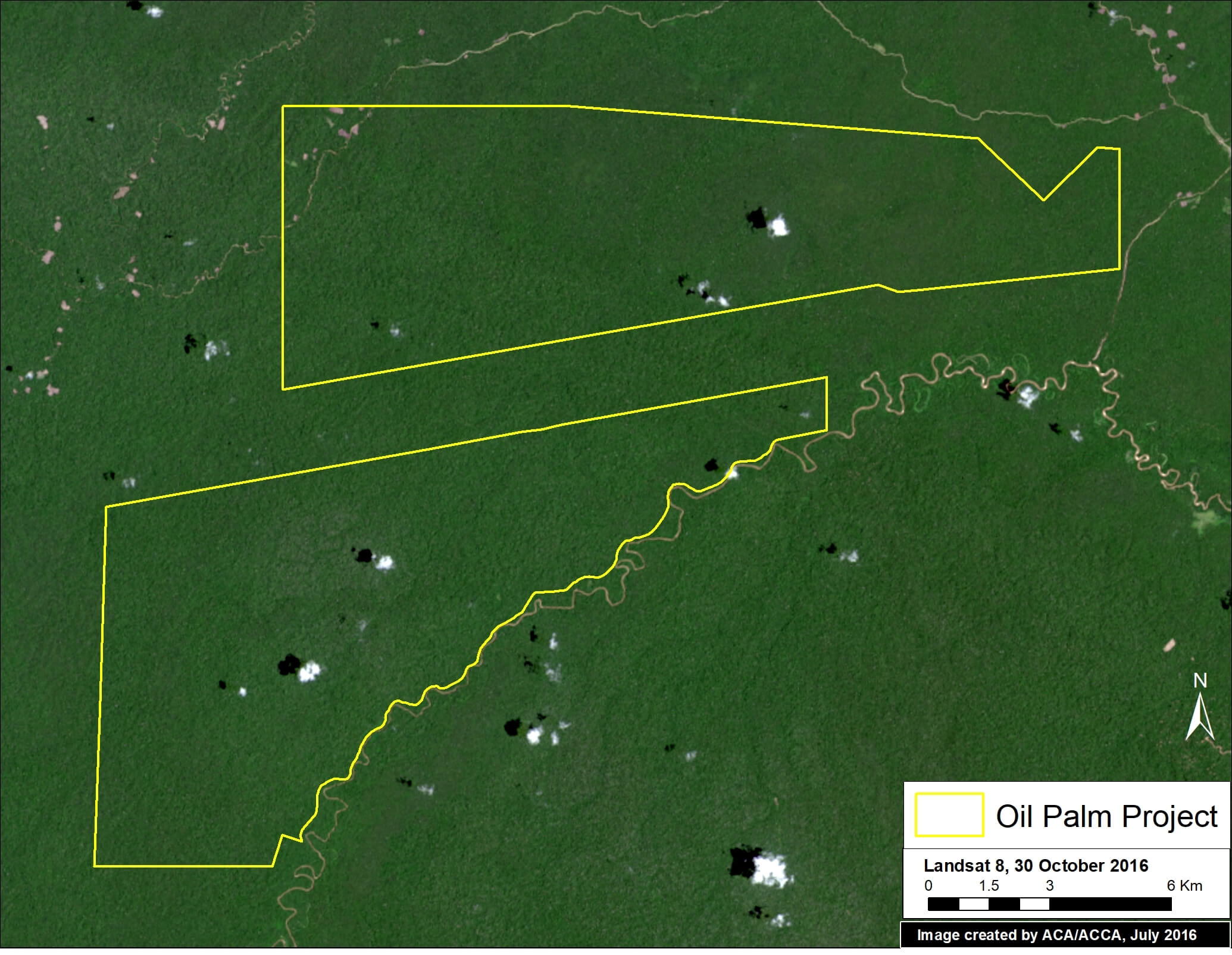
Image 64c. Data: NASA/USGS, Grupo Palmas (Grupo Romero)
Amarakaeri Communal Reserve (gold mining)
In June 2015, we revealed the deforestation of 11 hectares in Amarakaeri Communal Reserve due to an illegal gold mining invasion. The Reserve, located in the southern Peruvian Amazon, is an important protected area that is co-managed by indigenous communities (ECA Amarakaeri) and SERNANP, Peru’s protected areas agency (see MAAP #6). In the following weeks, the Peruvian government, led by SERNANP, cracked down on the illegal mining activities. A year later, we showed that the deforestation had been stopped, with no further expansion into the Reserve (MAAP #44). In fact, we showed that there were signs of recovering vegetation on the recently mined areas.
Image 64d shows the gold mining deforestation approaching (2011-12) and entering (2013-15) Amarakaeri Communal Reserve (yellow circles indicate areas of invasion). However, it also shows how, following action by the government and ECA Amarakaeri, the deforestation was halted and did not expand in 2016-17.
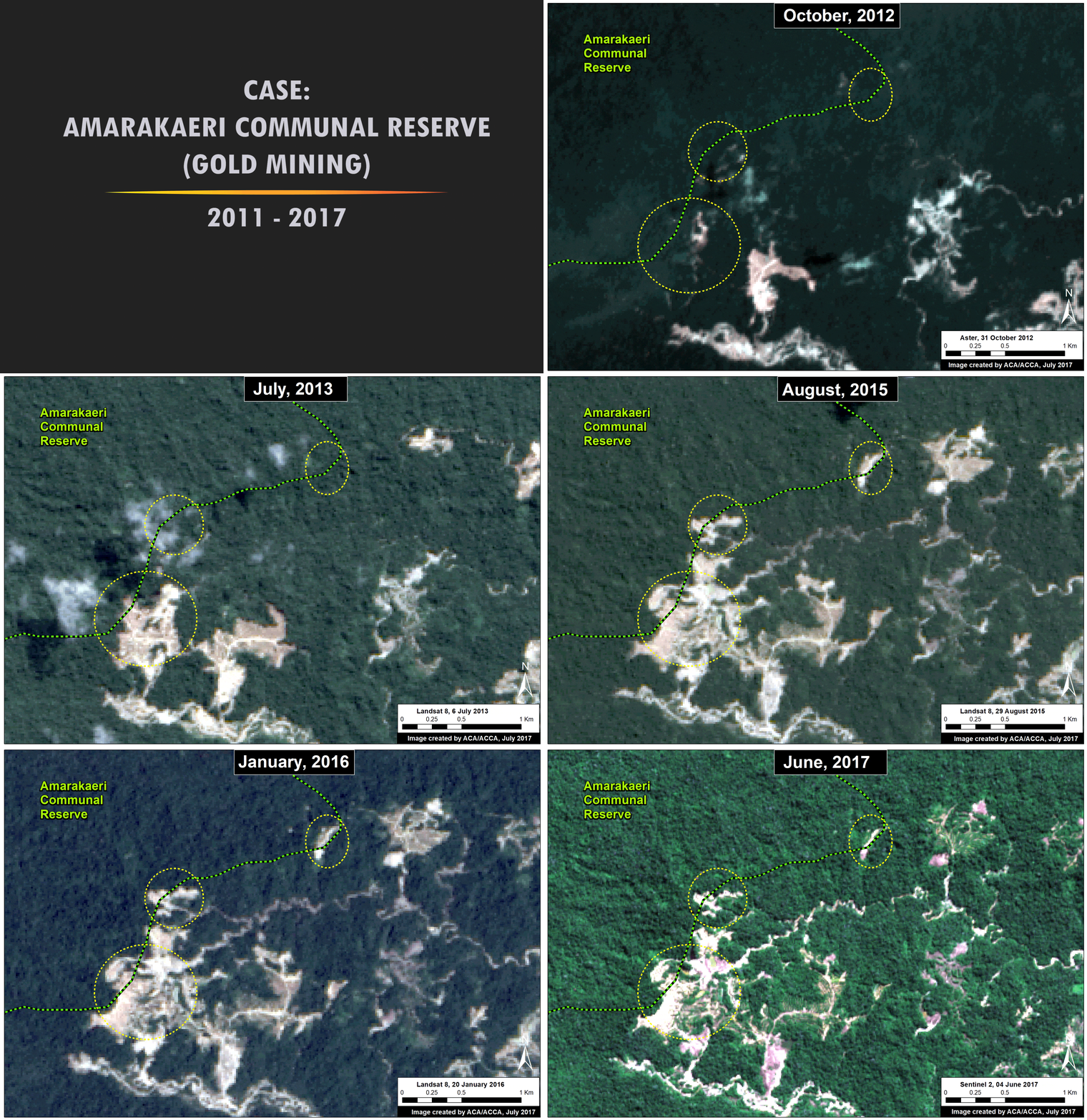
Image 64d. Data: NASA/USGS, Sentinel/ESA, RapidEye/Planet
Tambopata National Reserve (gold mining)
In September 2015, illegal gold miners started to invade Tambopata National Reserve, an important protected area in the southern Peruvian Amazon with world renowned biodiversity. In a series of MAAP articles, we tracked the invasion as it intensified in 2016, and eventually reached 1,360 acres (550 hectares) by early 2017. However, by late 2016, the Peruvian Government intensified its interventions against the illegal mining activity, and the rate of deforestation quickly and sharply decreased. In the most recent satellite imagery, we have not detected any major new expansion of illegal gold mining within the Reserve.
Image 64e shows the initial invasion of Tambopata National Reserve between September 2015 and January 2016. The deforestation within the Reserve intensifies during 2016, but slows significantly in 2017. The yellow circles indicate areas of invasion.
Image 64e. Data: Planet, SERNANP
References
Planet Team (2017). Planet Application Program Interface: In Space for Life on Earth. San Francisco, CA. https://api.planet.com.
Citation
Finer M, Novoa S, Olexy T, Scott A (2017) Good News Deforestation Stories (Peruvian Amazon). MAAP: 64.
MAAP #63: Patterns of Deforestation in the Colombian Amazon
We are excited to present our initial analysis of the Colombian Amazon, a work that reflects an important collaboration with our colleagues at Amazon Conservation Team. It is also our first report in the more interactive “Story Map” format.
This report has two objectives: 1) Illustrate the major deforestation hotspots in the Colombian Amazon between 2001 and 2015 and 2) Focus in on one of the most important hotspots, located in the Caquetá department. In short, we show satellite imagery of the expanding forest loss in one of the most important deforestation hotspots in the Colombian Amazon.
Please follow this link to view the Story Map: https://maaproject.org/maap-deforestation-patterns-colombian-amazon/
MAAP #62: Fire, Rain, And Deforestation in The Peruvian Amazon
In 2016, Peru experienced an intense forest fire season (MAAP #52, MAAP #53). A leading hypothesis was that intense drought facilitated the escape of agricultural burns. To investigate, this report analyzes the dynamic between fires and precipitation over the past 15 years, finding a strong temporal correlation (Image 62a). We also investigate the link between fires and forest loss, finding a spatial correlation.
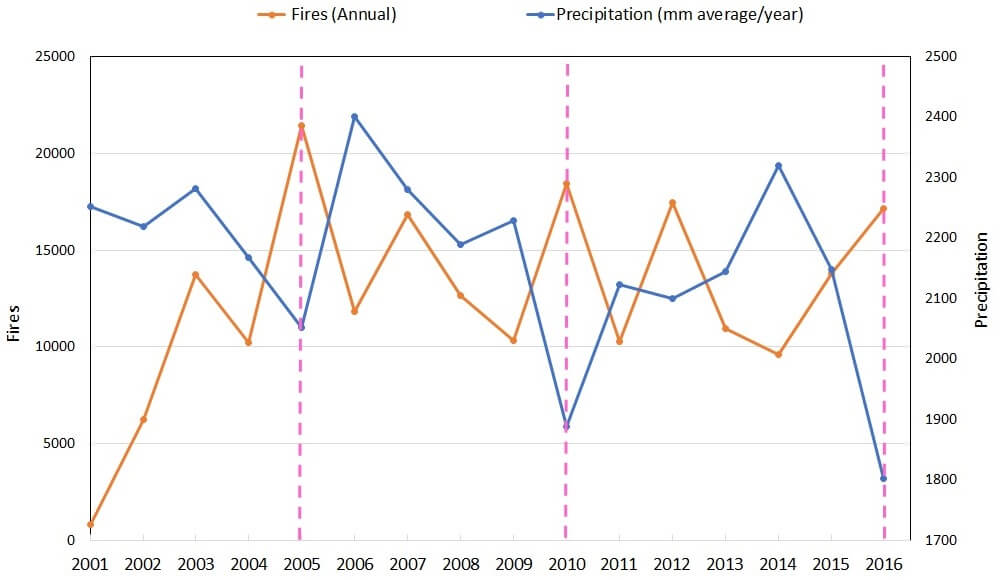
Image 62a. Data: TRMM, FIRMS/NASA, PNCB/MINAM, GLAD/UMD
MAAP #61: Illegal Gold Mining Decreases in Tambopata National Reserve
In the previous MAAP #60, we showed the rapidly increasing illegal gold mining deforestation in the buffer zone of Tambopata National Reserve. In contrast, here we show that the rate of illegal gold mining deforestation is decreasing within Tambopata National Reserve, due to the active interventions by the Peruvian Government. Tambopata is an important protected area in the southern Peruvian Amazon due to its high biodiversity.
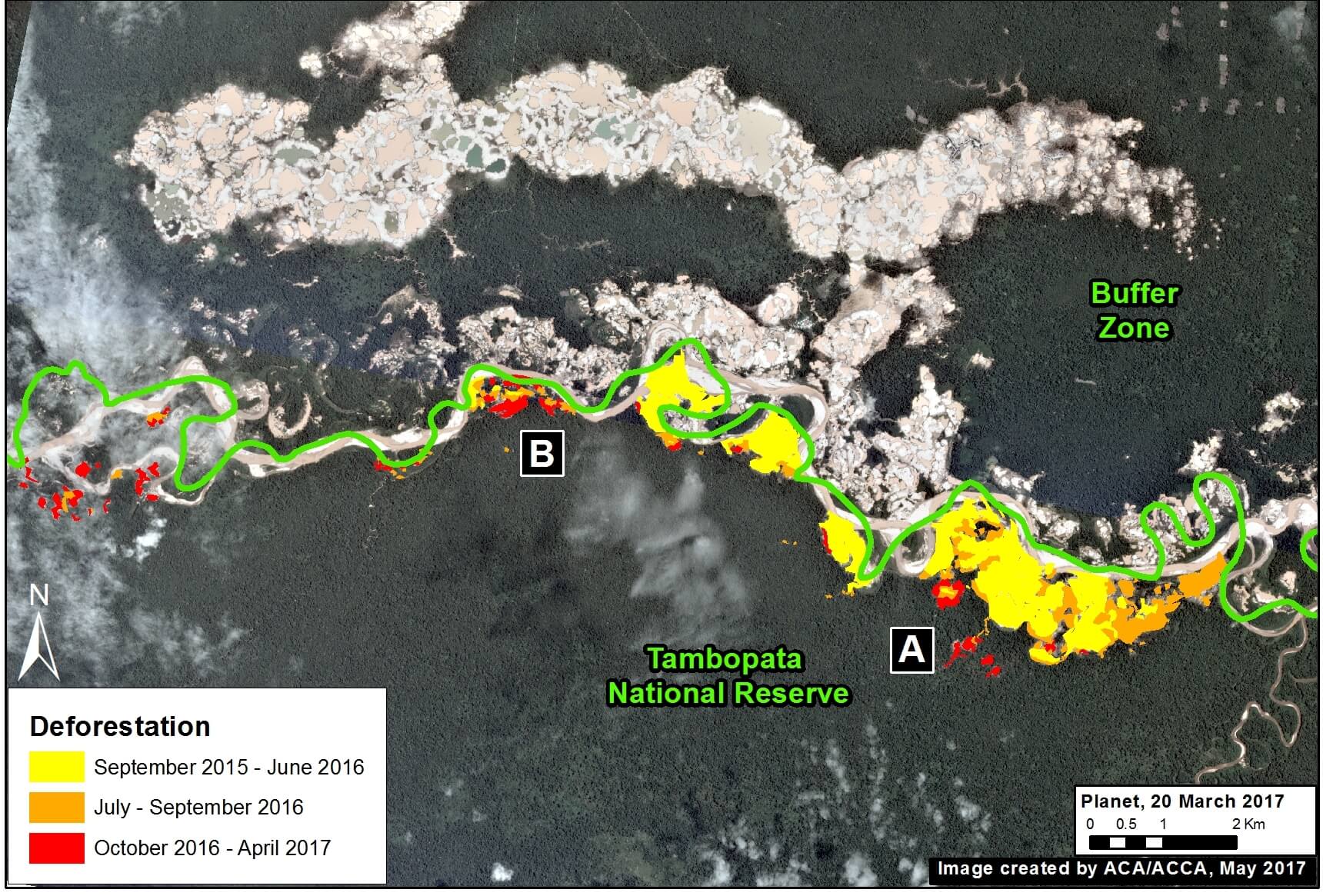
Image 61. Data: Planet, MAAP, SERNANP
MAAP #60: Gold Mining Increases in Buffer Zone Of Tambopata National Reserve
In the previous MAAP #50, we presented an analysis of the extent of gold mining deforestation in the southern Peruvian Amazon as of September 2016. Here, we partially update the data for the area within the buffer zone of Tambopata National Reserve.* We document the increase of 1,135 acres (460 hectares) of illegal mining deforestation during the last 8 months, from September 2016 to May 2017 (see red in Image 60). That brings the total deforested area in the buffer zone to 10,970 acres (4,440 hectares) since 2012.
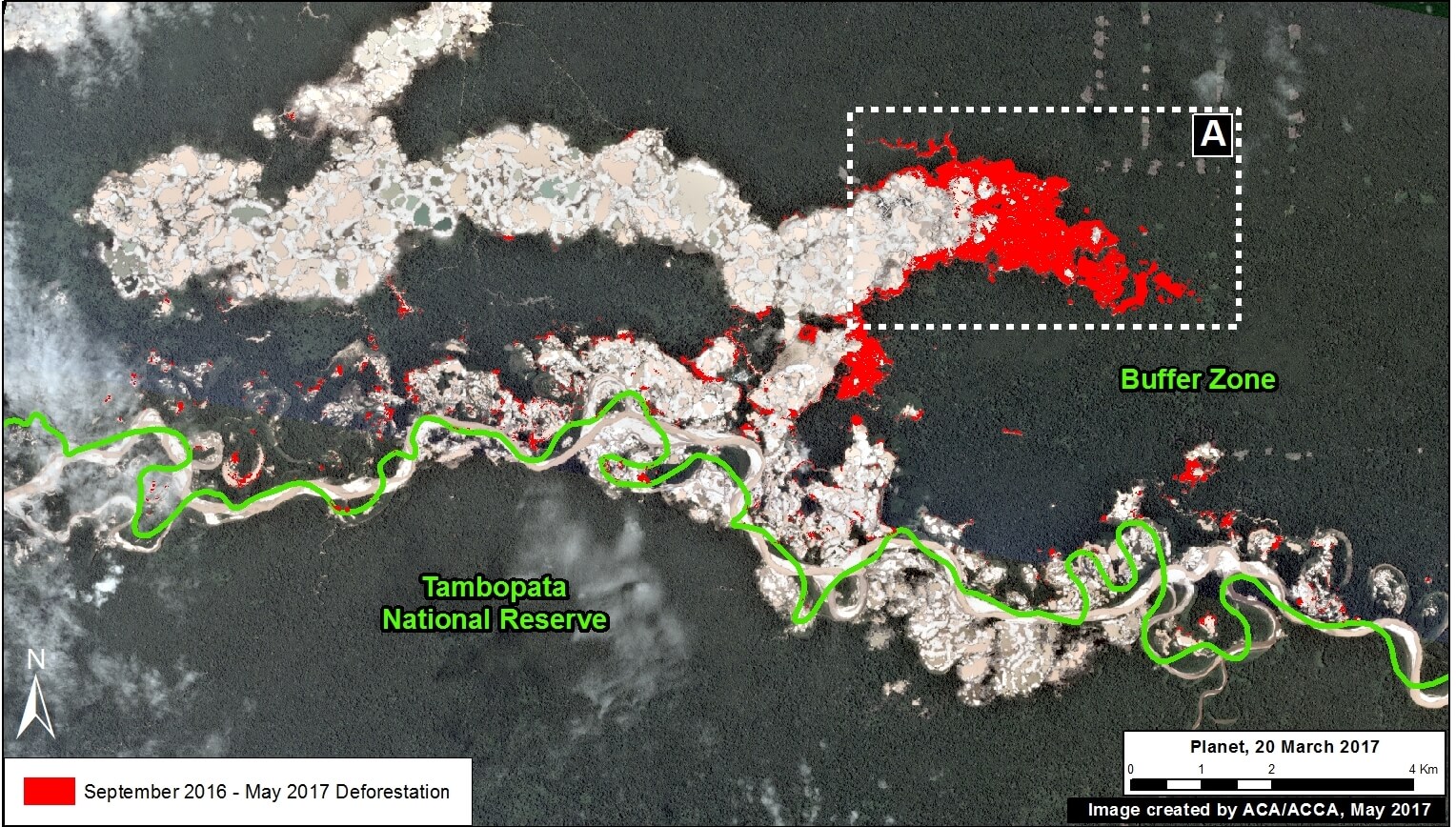
Image 60. Data: Planet, MAAP, SERNANP
*The buffer zone does not form part of the respective protected area, thus it is not under the jurisdiction of the Peruvian national protected areas agency, SERNANP. However, the illegal activities that are being carried out in the buffer zone are putting the conservation values of the protected area at risk, and are under the jurisdiction of other entities in the Peruvian government.
Exploring the Amazon with photographer Jessica Suarez
 The morning is cool and a rainstorm seems inevitable today as clouds hang low over Villa Carmen Biological Station. Today is one of my last days as an artist-in-residence with Amazon Conservation and I’m anxious to retrieve my camera trap that I left a month ago in a dip in the trail on one of my favorite hikes. Trail nine is steep, gaining several hundred meters of elevation in under a kilometer. As I hike, macaws and parrots keep me company from tree tops, dropping fruit as they eat and chatter. As soon as I reach 800 meters I suddenly realize that I am hiking through clouds. This section of forest with its tall trees cloaked in mist is just magical.
I make my way up to the small mirador and watch as waves of clouds move through the space obscuring and then revealing the bluish-green mountains and the confluence of rivers below. I spend time filming for my 360 video project, attaching the camera to trees hoping to relay the experience of this special scene. My primary project for my artist-in-residency is to pair 360 video with photos, camera trap images, audio and writing to re-create an immersive experience of what it’s like to be in the Amazon rainforest. As David Attenborough says, “No one will protect what they don’t care about; and no will care about what they have not experienced.” My hope is that this project will help others experience a bit of this amazing rainforest that has completely besotted me.

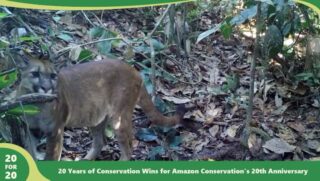
Margay captured on a camera trap April 4, 2017, trail 9, Villa Carmen Biological Station.
As I sit and spend a few more moments absorbing the beauty of this place, a mixed flock of birds flit between branches above me. I start photographing them and identify stunning Paradise tanagers, and even a Masked tanager, a new bird for me! Finally, I wind my way down from the mirador to the dip to discover what wildlife my camera trap has seen over the past month. I can hardly wait to hike back to the station to see what images will emerge.
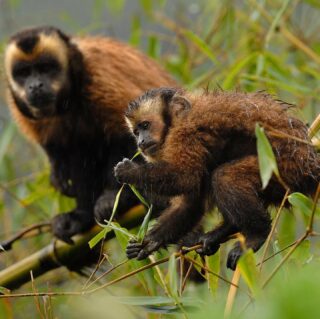
As I return to my cabin, the wind has picked up and thunder rumbles nearby. I quickly cover my backpack and pull out my rain jacket and as I descend the trail, the rain arrives refreshing and clean. Halfway down the trail I hear the familiar whimper of capuchin monkeys. One large fellow eyes me warily before disappearing all the while calling out to his troupe.
Later when I put the camera trap card into the computer, I am swept away with pictures of jaguars, margays, pumas, jagarundis, pacas, agoutis, opossums and giant armadillos. While I hope one day to see some of the animals in person, it is enough to know they are out there, walking these same trails I did, protected and safe.
Protecting the sacred rainbow mountains of Peru
 The “rainbow mountains” of Ausangate have become a popular tourist destination for their unique colorful appearance. The Andean mountain range is striped with colors ranging from turquoise and lavender to maroon and gold due to millions of years of weathering of its unique mineral composition.
In addition to being a geological marvel, the Ausangate mountains are also an important cultural element for local Peruvians, as the mountain range is believed to be the deity of Cusco and considered to be holy. In the month of April, one week before Corpus Christi, the festival of Quyllur Rit’i (which translates in the native Quechua language to “star snow”) brings together the local indigenous people of the Andes as a celebration of the stars. The mountains are inhabited by llama and alpaca herding communities, and constitute one of the few remaining pastoralist societies in the world.
However, this magical place and its inhabitants are currently not an area that is officially protected by the government and this unique ecosystem in the Andes-Amazon is threatened by human destruction. To safeguard Ausangate, we partnered with the local government to create a conservation area of 311,456 acres that will protect this national patrimony. The process is expected to be finalized in late 2017 and we have been able to promote this region through a variety of social media efforts, photography galleries, and more. To see more of this beautiful region, follow our Facebook page.
 Loading...